Onda Tiny House Flips the Layout, Bedrooms Below and Living Space Upstairs
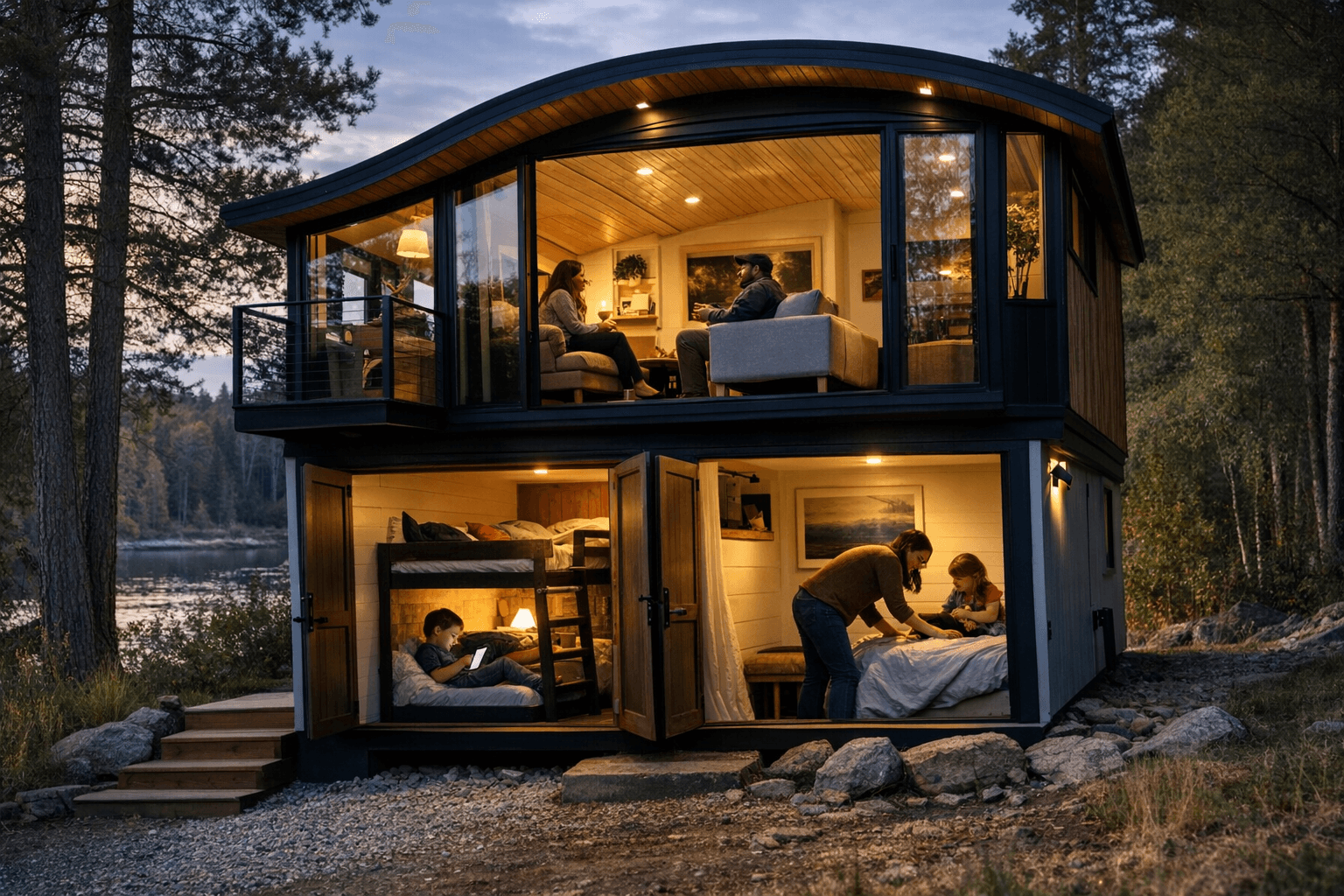
Onda turns the tiny-house script upside down, putting three bedrooms below so the upper level can feel more like a real family living room.
A reverse-loft that solves a real space problem
Onda is not just a tiny house with a quirky plan. It is a full reversal of the usual tiny-home hierarchy, with all three bedrooms on the lower level and the kitchen, bathroom, and main living space upstairs. Removed Tiny Homes calls it a “world-first layout,” and that claim makes sense once you see what it is trying to fix: the familiar compromise between family privacy and shared living in a very small footprint.
The house measures 32.8 feet long, 11 feet wide, and 14.7 feet high, which puts it in the family-size lane rather than the solo-loft category. That matters, because the layout is not a gimmick for its own sake. It is an answer to a practical question that many tiny-home designs sidestep: how do you give multiple sleepers real bedrooms without turning the common area into an afterthought?
Why flipping the floor plan changes the whole feel
In a standard tiny house, the living room often ends up on the ground floor while sleeping spaces get pushed into lofts. Onda flips that logic. By lifting the communal area above the bedrooms, Removed creates a more deliberate split between rest and gathering, which can make daily life feel less crowded and less exposed.
That separation is one of Onda’s biggest strengths. Families who want to put kids in separate rooms, or adults who want actual doors instead of curtained loft corners, get a setup that feels closer to a compact multi-level home than a conventional tiny house. Removed says the upstairs level is intended to separate rest and living in a way that “feels completely different to a traditional tiny home,” and that is exactly the point: the layout is trying to deliver privacy without giving up a usable social zone.
The downstairs level is where the privacy argument gets serious
The lower floor is not just a row of sleeping nooks. Removed says the hallway below has 200 cm of standing clearance, which is roughly 6.5 feet, so the circulation space is usable instead of cave-like. That detail matters more than it sounds like it might, because many tiny-house bedrooms feel squeezed by low ceilings, awkward rooflines, or ladder access.
Onda’s downstairs arrangement includes two Jack-and-Jill-style rooms and a master bedroom behind a door. That means the house is not relying on a single multipurpose room to do too much work. For buyers who care about nighttime separation, guest privacy, or simply not hearing every movement from the main living zone, this is the part of the design that feels genuinely ingenious.
It is also the part that makes the house more specialized. Someone who wants a lofted sleep space, minimal stairs, or one open room to flex between functions may not see the appeal. Onda is clearly built for people who want bedrooms to behave like bedrooms.
Upstairs is the social floor, not an afterthought
The upper level holds the kitchen, bathroom, and main living area, so the shared space gets the better outlook and a more open feel. In tiny-house terms, that is a major shift. Instead of asking the living room to coexist with sleeping areas on the same level, Onda gives the communal functions their own elevated zone, which can make cooking, lounging, and entertaining feel less cramped.
That move also changes daily flow. You do not have to climb into a loft to sleep, then come back down to make breakfast in the same compact zone. The separation gives the house a more residential rhythm, especially for households where more than one person is moving through the space at once. It is a plan that treats the tiny house less like a studio apartment on wheels and more like a compact two-story home.
Tiny Mansions points to the market Onda is chasing
Onda is part of Removed’s Tiny Mansions collection, a line the Brisbane, Queensland-based company positions as high-end tiny homes with luxe finishes, 1- to 3-bedroom layouts, and optional rooftop decks. That framing says a lot about the intended buyer. This is not about bare-bones downsizing alone; it is about turning tiny-house construction into something that can serve families, downsizers, and Airbnb investors without feeling stripped down.
Removed says it has helped “dozens of clients” build tiny homes, and that experience shows in the way the company talks about its audience. Families want separation and practicality. Downsizers want a smaller footprint without sacrificing comfort. Airbnb investors want a layout with obvious headline value, and Onda certainly has that. The flipped plan is unusual enough to be memorable, but it is also organized around a real use case: sleeping more people without sacrificing the feel of the shared space.
How this fits into the larger tiny-house conversation
Reverse-loft layouts are not entirely new, but they have usually appeared in smaller novelty builds, including a 24-foot model where the living room sat upstairs and the bedroom was below. Onda pushes that idea into a more ambitious family plan, which is why it stands out. It is less a novelty than a scaled-up argument that tiny homes can borrow the logic of a multi-level house without losing their mobility-minded roots.
Removed says its base designs are kept within road-legal parameters, with a maximum height of 4.3 metres, a maximum width of 2.5 metres, a maximum length of 10.0 metres, or 12 metres including the draw bar, and a maximum weight of 4.5 tonnes. That road-legal framework helps explain why the company emphasizes mobile trailers and flexibility in its FAQ. The bigger lesson is that inventive layouts still have to live inside the realities of towing, clearance, and classification.
Who will find Onda brilliant, and who will not
Onda will feel clever to buyers who want bedrooms that actually function as private rooms, not compromise spaces. It will make sense for families with multiple occupants, hosts looking for a standout rental plan, and downsizers who still want proper sleeping quarters for visitors. The hallway clearance, the separated sleeping level, and the upstairs social zone all answer a real problem with tiny-house living: how to preserve calm when more than one person is sharing a very small home.
It will feel impractical to anyone who wants one-level accessibility, minimal stair use, or a simpler open-plan setup. The design is more sophisticated, but it is also more demanding. That is the tradeoff Onda makes plain: if you want a tiny house that behaves more like a compact family home, flipping the layout may be exactly the right move.
This article was produced by Prism’s automated news system from verified source data, official records, and press releases, then run through automated quality and moderation checks before publishing. The system is built and supervised by the people who set the standards it runs under. Read our full AI policy.
Did this article answer your question?