Sequoia tiny house embraces rugged off-grid independence in Spain
Sequoia strips tiny living down to the essentials: no gas, barely any electricity, and full autonomy for life on the road. It is comfort, but only the hard-earned kind.
Sequoia as a rugged off-grid template
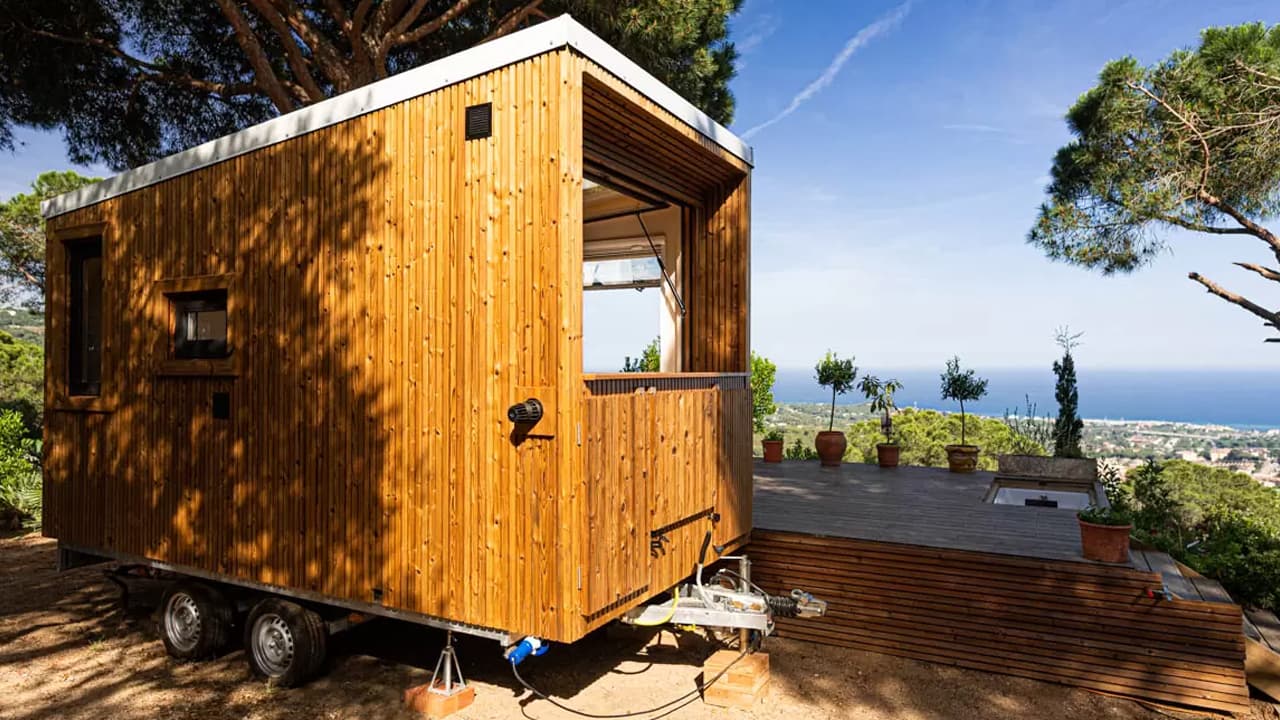
Sequoia is tiny-house design stripped down to the point where comfort has to earn its place. Built in Spain for a client named Luis, it was meant to travel with him across the country, not sit pretty as a display piece. Serena.House frames it as a home with all the comfort, but without gas and with minimum electricity use, which tells you exactly where this build sits on the spectrum: independence first, convenience second.
That makes Sequoia interesting for anyone who has spent time around tiny houses that promise freedom but still lean heavily on grid habits. This one goes the other direction. It is fully mobile, fully autonomous, and deliberately low-tech, the kind of build that treats self-reliance as the whole point rather than a marketing slogan.
What got sacrificed, and what stayed
The clearest tradeoff in Sequoia is the removal of the usual utility crutches. There is no gas system, and electricity use is kept to a minimum, so the house has to solve everyday tasks in a more deliberate way. A wood stove handles cooking and heating water, while a Berber fridge keeps food cold without electricity, which is exactly the sort of equipment choice that separates an off-grid home from a compact vacation cabin.
That approach gives the house a very specific personality. It is not trying to be a tiny version of a suburban apartment, and it is not chasing the polished, luxury-small-home look either. Instead, it leans into a rougher kind of livability, where the reward is autonomy and the cost is giving up the easy, push-button comforts most people take for granted.
The upside is durability and resilience. Serena.House says the Sequoia is suitable for year-round habitation and has complete autonomy, so this is not a fair-weather novelty. It is built to function through changing seasons, with the sort of systems that make sense when the goal is to keep moving and keep living without depending on hookups.
The build details that make it work
The structure itself stays compact and practical. Serena.House lists the trailer format as traditional and sized at 4 x 2.4 meters, which keeps the home within a highly mobile footprint while still leaving enough room for the essentials. That size also reinforces the design logic here: every element has to justify its presence, because there is no waste to hide in.
Materials matter just as much as equipment in a build like this. Sequoia uses natural-material insulation, double-glazed wood windows, ecological paints, and breathable walls, all of which fit the low-tech, self-sufficient philosophy Serena.House says guides its production center. Those choices point to a house designed not only for mobility, but for healthier, more stable living without relying on flashy systems.
The result is a home that reads as cozy and adorable at first glance, but underneath that softness is a very serious bit of kit. It is built to travel, to conserve, and to keep functioning with minimal outside input. For a buyer who sees off-grid living as a practical discipline rather than an aesthetic trend, that is the appeal.
Why Serena.House keeps coming back to autonomy
Sequoia did not come out of nowhere. Serena.House says it custom-builds tiny houses in its production center and has a design philosophy rooted in autonomy and travel. That matters because the company is clearly not experimenting with off-grid language for a single one-off build. It has been working through this idea for years, refining what a self-sufficient tiny house can actually be.
That lineage runs back to Les Abers, which Serena.House says was France’s first autonomous tiny house in 2016. The project then won the Loire Atlantique sustainable tourism trophy for environmental preservation in 2017, which gives the story a real milestone rather than just a style claim. After that came Stendhal, which Serena.House describes as Spain’s first off-grid tiny house in 2017.
Seen in that context, Sequoia feels less like a novelty and more like the next step in a longer European experiment. It belongs to a builder that has been testing the edge of autonomous living since the mid-2010s, moving from prototype to proof of concept to more mature custom work. That history gives the current build a kind of credibility that pure trend-chasing tiny homes usually lack.
What the broader tiny-house arc says about Sequoia
A 2026 retrospective from autoevolution describes Spain’s first off-grid tiny-house project as something that helped open the gates to sustainable tiny living. That same retrospective says that by 2020 more than 500 guests had spent at least one night in one of the self-sufficient tiny hotels tied to the project. Those numbers matter because they show this is not an abstract design exercise anymore. The concept has already been lived in, slept in, and tested by a real audience.
That is the deeper reason Sequoia stands out. It belongs to a lineage that moved from DIY experimentation in 2016 to a recognized niche in off-grid tourism and autonomous living. The house itself may be compact, but the idea behind it has scaled far beyond one trailer in Spain.
Who Sequoia is really for
Sequoia is for the buyer who wants tiny-house freedom without pretending that freedom is frictionless. If you are drawn to the idea of a home that can follow you through Spain, support year-round use, and function with no gas and minimal electricity, this is the kind of build that makes sense. If you want plug-in convenience, big-appliance ease, or the feeling of a conventional house shrunk down to size, this is probably too uncompromising.
That is exactly why Sequoia matters. It takes tiny living to an extreme-use case and refuses to soften the edges for mass appeal. The house is small, rugged, and deeply self-reliant on purpose, and the point of the exercise is obvious from the first look: this is what tiny living looks like when independence is the priority and comfort is allowed only if it can keep up.
This article was produced by Prism’s automated news system from verified source data, official records, and press releases, then run through automated quality and moderation checks before publishing. The system is built and supervised by the people who set the standards it runs under. Read our full AI policy.
Did this article answer your question?