Tiny homes in Georgia build stronger neighborhood connections
Will Johnston turned a half-acre in Clarkston into a working pocket neighborhood, showing how eight tiny homes can strengthen a block, not just shrink a roof.

Will Johnston did not just build a cluster of tiny houses in Clarkston. He helped turn a half-acre site into a working pocket neighborhood, and that is the real story in Georgia. At Cottages on Vaughan, the point is not the novelty of smaller floor plans, but the way shared space, ownership, and neighborhood design pull people into closer daily contact.
From tiny house advocacy to a real neighborhood
Johnston founded Tiny House Atlanta and later helped grow that effort into the MicroLife Institute, a Atlanta-based nonprofit that now focuses on pocket neighborhoods and small-scale community development. The organization says it started hosting tiny house festivals in 2016, which matters because the Clarkston project did not appear out of nowhere. It grew out of years of advocacy, public education, and a push to make tiny housing a policy conversation, not just a lifestyle trend.
MicroLife now describes itself as a national 501(c)(3) housing developer that specializes in creating pocket neighborhoods. Its stated goals are practical and specific: create complete neighborhoods, reduce carbon footprints, support aging in place, and add missing middle housing stock. That combination tells you exactly where the organization is aiming. This is not about building one cute little house and calling it innovation. It is about using compact homes to solve real housing gaps with a model that can fit into smaller parcels and still feel like a neighborhood.
Why Clarkston was the right place to test it
Cottages on Vaughan is MicroLife’s first project of its kind in Clarkston, and Clarkston is not a random backdrop. The city is widely described as “the most diverse square mile in America,” and DeKalb County materials characterize it as a refugee resettlement community with relatively affordable housing and economic opportunity. That context matters because it gives the project a local purpose beyond architecture. In a city shaped by migration, diversity, and affordability pressure, a small but connected housing model has a clearer job to do.
The site itself sits a block away from downtown Clarkston on Vaughan Street, which makes it close enough to everyday city life to matter. Clarkston approved Georgia’s first tiny home neighborhood in 2019, and the project later became Georgia’s first standalone village of tiny houses after breaking ground and finishing about two years later. That timeline matters to anyone trying to copy it elsewhere. The project did not succeed because it was theoretical. It succeeded because a city approved it, a developer carried it through, and the neighborhood was built.
What the site actually looks like on the ground
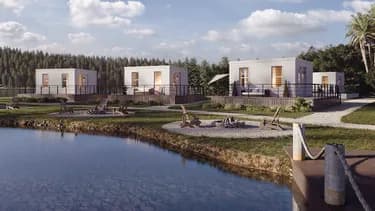
Cottages on Vaughan is small in acreage and intentional in layout. MicroLife says the community sits on just over half an acre, or about .57 acres, and includes eight micro-cottage homes. Seven of the homes are under 500 square feet, and one is 250 square feet in the latest official description, which is worth paying attention to because tiny-house reporting can drift if people keep repeating an older size estimate.
The arrangement is the part that makes the project feel like a neighborhood instead of an infill experiment. The homes share a parking lot, wrap around a central green space, and connect through walking paths and common gathering areas. MicroLife also lists solar panels and edible, regenerative landscaping as part of the site. That mix does more than look attractive in photos. It creates repeated points of contact, the kind that make neighbors see each other, talk, and actually use shared space instead of just passing through it.
What communities can borrow from the model
The strongest lesson from Cottages on Vaughan is that tiny homes become more useful when they are organized as a cluster with a shared purpose. The MicroLife approach shows how to get from idea to implementation: build a local advocacy base, work with city approval, choose a site near existing neighborhood fabric, and design around common space instead of isolating each unit. That formula is simple enough to copy in other towns, but it still requires one hard thing: a local organization willing to shepherd the project all the way through.
The project’s reach also suggests that pocket neighborhoods can function as public-facing demonstrations, not just private housing. MicroLife says more than 10,000 people have toured Cottages on Vaughan, which tells you how much curiosity this kind of community design generates. It has also received recognition from the Atlanta Regional Commission as an Innovative Development and has been tied to the national Jack Kemp Affordable Housing Award for Excellence, which moves it into the realm of policy and design credibility.
That recognition matters because it separates the project from the usual tiny-house conversation. Too many stories stop at square footage. Cottages on Vaughan shows the better question: what happens when eight small homes are arranged to support one another, with a central green, shared paths, and a neighborhood structure that invites people to stay connected? In Clarkston, the answer is already on the ground, and it looks a lot like a stronger block.
This article was produced by Prism’s automated news system from verified source data, official records, and press releases, then run through automated quality and moderation checks before publishing. The system is built and supervised by the people who set the standards it runs under. Read our full AI policy.
Did this article answer your question?