Benidorm tuna festival celebrates bluefin, almadraba heritage, and local identity
Benidorm’s tuna week turns bluefin into civic identity, with a record 15 restaurants, a 280-kilo ronqueo, and a deep link to almadraba.
Bluefin as the headline act
In Benidorm, bluefin tuna is not being treated like just another menu item. The city’s 6th Tuna Festival runs from April 17 to April 26, 2026, and it puts the fish at the center of a public celebration that blends food, local identity, and maritime memory. That matters because bluefin carries a different kind of cultural weight here: it is both a premium eating fish and a symbol of the fishing life that shaped this coast.
Benidorm City Council has framed the festival as a tribute to bluefin tuna and to the captains and sailors whose work in the almadraba tuna traps helped define the town’s image. For anglers, that combination is familiar in a different way. It shows how one species can live in two worlds at once, as a prized target and as a shared public emblem that draws in chefs, tourists, and the broader seafood trade.
What’s on the table this year
This edition is the biggest yet, with 15 participating restaurants, which Benidorm describes as a record for the event. Visit Benidorm says the festival has expanded across the city and runs through a menu range that goes from tapas and individual plates to complete menus. That spread makes the event less like a single dinner promotion and more like a citywide tuna circuit, with each restaurant putting its own spin on the same core ingredient.
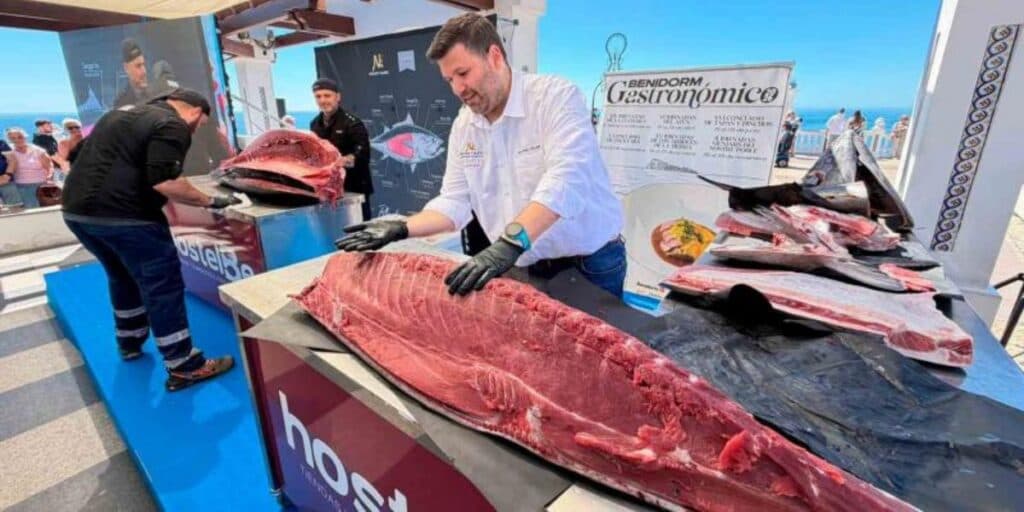
The festival also began with spectacle, not just service. A pre-festival ronqueo, the traditional tuna butchering demonstration, featured a 280-kilogram bluefin tuna supplied by the Murcian companies Nicolás y Valero and Atunes Fuentes. That kind of number lands with anyone who follows tuna closely: it is the kind of weight that reminds you this is not a casual fish, but a serious animal with serious cultural pull.
Benidorm’s mayor, Toni Pérez, took part in the presentation alongside Javier del Castillo, the president of ABRECA. That pairing says a lot about how the festival is built. It is not only a tourism play from city hall, but also a local business effort, with the restaurant and hospitality side pulling in hard behind the fish.
Why almadraba still carries so much weight
The festival’s deepest storyline is the almadraba itself. Benidorm’s heritage page places the technique at roughly 3,000 years old and traces its spread on the Iberian coast through Phoenician, Roman, Greek, Celtic, and Iberian activity along the western Mediterranean. In other words, the fishery is not presented as a quaint custom, but as a living piece of coastal history with roots older than most modern ports.
That history is not abstract in Benidorm. Background material says the Benidorm almadraba peaked in the 18th and 19th centuries and remained important until the mid-20th century. That arc helps explain why the festival feels like more than a food event: it is a way of turning seasonal fishing history into something visible again, especially in a city whose modern image is often dominated by hospitality and tourism rather than by boats and nets.
The city’s tourism department and ABRECA have been promoting Benidorm Gastronomic since 2010, and the tuna festival now sits inside that broader calendar. That matters because it shows the tuna event is not isolated. It is part of a year-round strategy to use food as a way to tell the city’s story, with bluefin serving as the most recognizable chapter.
What this says to tuna fishermen and seafood communities
For the tuna-fishing world, Benidorm’s festival is a useful reminder of how a fish becomes bigger than the fishery around it. Bluefin is valuable because it is tasty, famous, and dramatic on the plate, but in a place like Benidorm it is also a civic symbol, a tourism hook, and a link to older working methods that shaped the coast. That is exactly why the species still commands attention well beyond the dock.
The event also shows how a tuna fishery can be translated for the public without losing its identity. A ronqueo is part education, part theater, and part respect for the animal. The restaurant network then turns that same fish into a series of meals, which is how heritage becomes local commerce and how an old working tradition stays legible to a modern crowd.
Benidorm’s 2026 tuna week makes that transition especially clear. With a record 15 restaurants, a 280-kilogram bluefin at the center of the launch, and a program tied to the city’s broader gastronomic calendar, the festival gives bluefin the kind of visibility few species ever get. It is a reminder that in the right place, and with the right history behind it, a tuna can stand for far more than dinner.
This article was produced by Prism’s automated news system from verified source data, official records, and press releases, then run through automated quality and moderation checks before publishing. The system is built and supervised by the people who set the standards it runs under. Read our full AI policy.
Did this article answer your question?