Florida Yellowfin Tuna Fishing Thrives on Temperature Edges and Birds
The Cape Canaveral yellowfin bite stops looking random once you read the temperature break, current edge, and bird life together.
The bite turns real when the ocean starts repeating itself
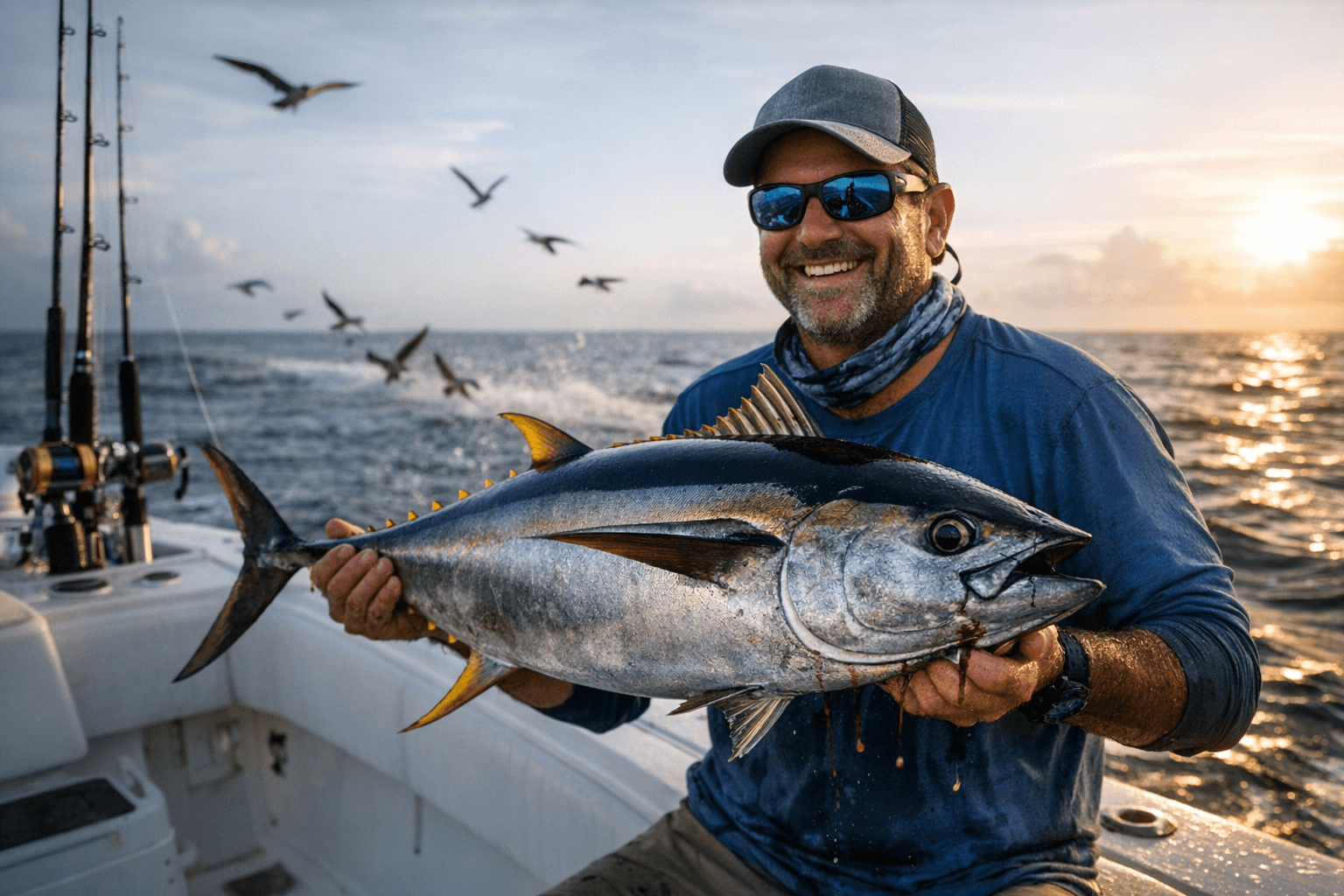
If you run 75 to 80 miles out of Port Canaveral and still think yellowfin tuna are a lottery ticket, you are missing the whole point of this fishery. The better Cape Canaveral crews are not freelancing offshore and hoping to get lucky. They are reading a pattern built on temperature, current edges, and birds, and when those pieces lock together, the bite can go from quiet to violent fast.
That is the core lesson from Capt. Adam Jeffrey aboard the 42-foot RazorHead catamaran Reel Dream, a boat set up exactly for this style of run with quad 300 Mercury outboards and the range to get there efficiently. The payoff is not just fish, it is repeatability. Jeffrey’s system works because it treats yellowfin like a water-reading exercise first and a casting contest second.
Why this bite is more predictable than people think
The reason Cape Canaveral has become so attractive is simple: the zone is close by offshore standards. That matters more than a lot of anglers admit. Instead of grinding through the kind of all-day haul that used to define yellowfin fishing, you can reach the productive water from east-central Florida without pushing all the way into the sharkier country farther toward the Bahamas.
That closer run changes the whole equation. You are able to fish harder, watch more water, and make better decisions without burning the whole day just getting there and back. When the setup is right, the fish are in a place that can be reached, checked, and repeated.
What specific signs turn this from a gamble into a pattern bite?
Start with temperature. In March and April, the fish tend to hold in the warmer water along the east edge of the Gulf Stream, where surface temperatures run roughly 76 to 81 degrees. Outside that band, the water is cooler, and that difference is one of the first filters Jeffrey uses before he ever calls a spot a tuna stop.
Then look for the current edge itself. The point is not simply to find warm water, it is to find the seam where that warm water is working against something else. That edge creates the kind of feed line yellowfin can use, and it gives you a place to hunt instead of a blank stretch of blue.
After that comes the bird picture. Jeffrey leans hard on terns and frigates, because the birds tell you whether the bait has stacked and whether predators are working beneath them. When those birds are showing in the right place, the fishery starts to feel less like a search and more like a map.
Birds are not decoration, they are the alarm system
A lot of anglers like to say they are “watching birds,” but in this fishery that phrase only matters if you actually know what you are looking for. Early in the season, the article notes, the bite starts opening in March with only small packs of frigates visible. That is the first hint that the system is waking up. By June, the bird activity becomes more obvious, which tracks with the fishery becoming easier to read.
Terns and frigates are not just pretty signs over a tuna hole. They are part of the structure of the bite. If the birds are sparse, the crew is mostly guessing. If the birds are active, the temperature is right, and the edge is there, the ocean starts giving up its pattern instead of hiding it.
Season matters, and May is the month that separates hope from habit
This is not a one-size-fits-all summer fishery. The season builds. March is the opening act, April is the adjustment period, and May is described as the pinnacle month. That should tell you a lot about how this fishery behaves. It is not about randomly stumbling into a school at any point in the year. It is about understanding when the pieces are most likely to align.
By May, the pattern is strong enough that you are not just chasing signs, you are fishing them with confidence. June still shows the fishery more clearly, but the peak belongs to that May window when the edge, temperature, and bird life are all most likely to stack up. If you are planning a trip around a yellowfin objective, that timing is not a footnote. It is the backbone of the plan.
How to turn the clues into a decision framework
The cleanest way to fish this is to treat every offshore run like a checklist, not a wish list.
1. Find the water temperature first.
Look for the warmer band on the east edge of the Gulf Stream, especially in the 76 to 81 degree range that has been holding fish in March and April.
2. Confirm the edge is working.
Do not settle for warm water alone. The current line is where the bite gets organized, and that seam is what makes the spot worth slowing down on.
3. Watch the birds before you commit.
Small packs of frigates early in the season are a useful sign. Terns and frigates together are even better, because they point to bait and pressure underneath.
4. Respect the season.
March starts the window, May is the sweet spot, and June shows the fishery more clearly. A good spot in the wrong month is still a bad bet.
5. Stop forcing blind miles.
If the water, edge, and bird life are not lining up, move on. The point of this fishery is not to cover ocean. It is to find the right layer where tuna are already set up.
That last part is the difference between a smart offshore day and an expensive exercise in optimism. Jeffrey’s approach is a reminder that yellowfin off Cape Canaveral are not some magical surprise. They are there when the conditions say they should be there.
The real advantage is not luck, it is reading layers
Hall’s report frames the fishery the right way: as a system of layers. Temperature, structure, edges, and bird life all matter, and none of them works in isolation. Once you start thinking that way, Cape Canaveral stops feeling like a blind offshore gamble and starts looking like a pattern bite you can actually repeat.
That is why this fishery keeps pulling more attention. The boats do not need to disappear into the horizon for a fantasy run. They need to read the water, trust the signs, and fish the setup when the Gulf Stream gives it to them. When those clues line up, the yellowfin do not hide for long.
This article was produced by Prism’s automated news system from verified source data, official records, and press releases, then run through automated quality and moderation checks before publishing. The system is built and supervised by the people who set the standards it runs under. Read our full AI policy.
Did this article answer your question?