Mass Southern Bluefin Tuna Die-Off Near Port Lincoln Triggers Investigation
A tow cage carrying southern bluefin tuna passed through discoloured water south of Port Lincoln and emerged with a significant number of dead fish, triggering a major probe into one of Australia's most valuable fisheries.
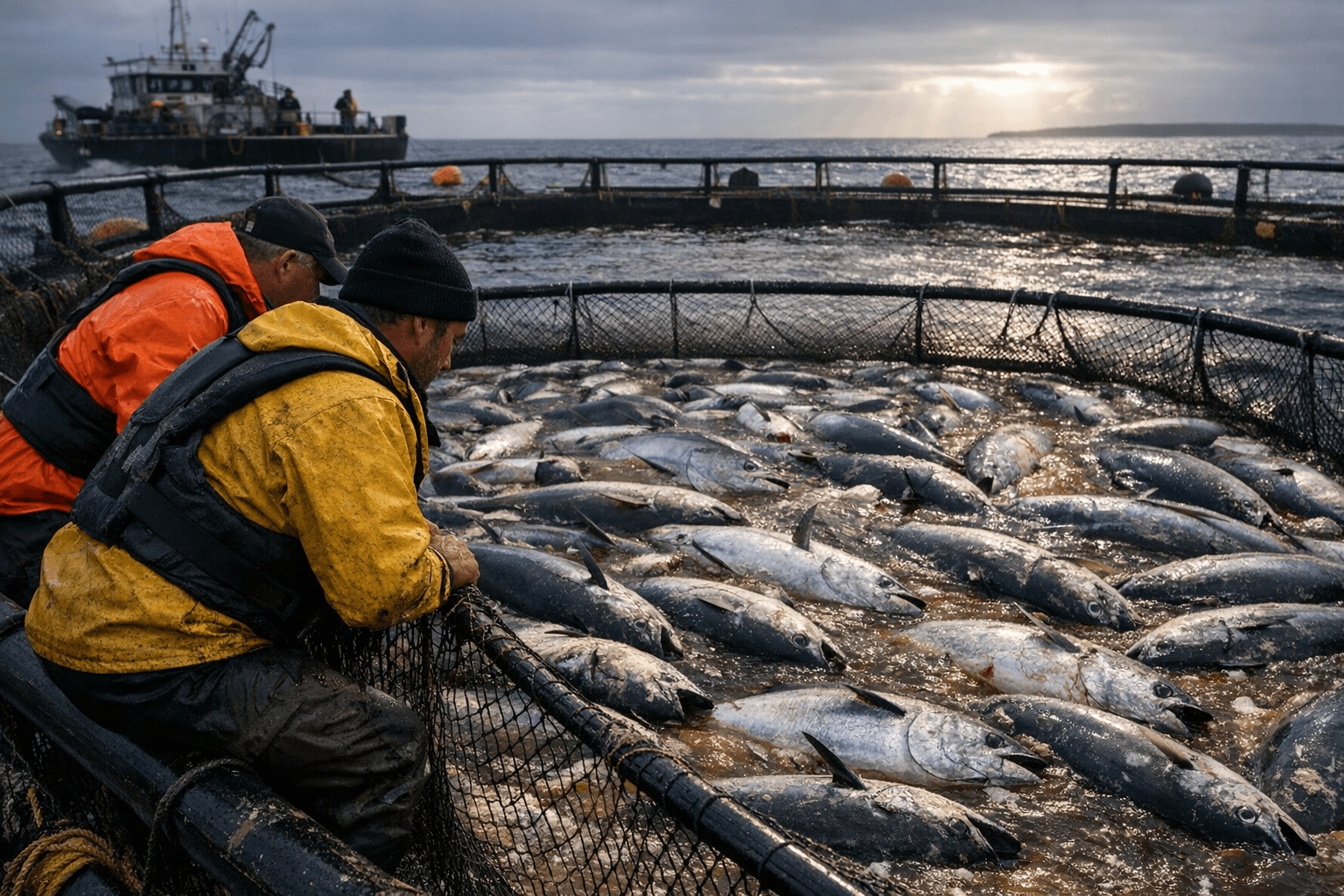
A tow cage carrying southern bluefin tuna passed through discoloured water south of Port Lincoln and emerged with a significant number of dead fish. The incident has triggered a major investigation into what went wrong in one of Australia's most financially consequential aquaculture industries, and the ripple effects could reach anglers and markets far beyond South Australia's Eyre Peninsula.
The Australian Southern Bluefin Tuna Industry Association and the South Australian Research and Development Institute (SARDI) are now analyzing whether a strong upwelling event drove the kill. Investigators have ruled out algae as a direct cause, but the precise mechanism behind the deaths has not yet been determined.
Upwelling is the process by which cold, nutrient-dense water rises from depth to the surface, and the lower western Eyre Peninsula is known to be one of Australia's most active upwelling zones. A PIRSA situation update from late March 2026 confirmed that cooler surface waters were already evident off the lower western Eyre Peninsula, with the current upwelling "slightly stronger than the long-term average conditions expected for this time of year." Strong upwellings can rapidly deplete dissolved oxygen near the surface, creating localized hypoxic pockets that are nearly invisible to crews navigating tow boats through open water. When a tow cage, which can carry 10,000 to 15,000 fish in transit from the fishing grounds back to Boston Bay's static sea cages, passes through one of those pockets, the consequences can be catastrophic and sudden.
The financial stakes are substantial. The southern bluefin tuna ranching industry employs approximately 4,000 people per season in the Eyre Peninsula region, with about 90 percent of its premium sashimi-grade product exported to Japanese buyers who fly to Port Lincoln each season to grade the catch in person. A significant die-off mid-tow doesn't just represent lost animals. It removes quota-counted fish from the supply chain entirely, since operators' harvest limits are set against the weight of fish caught wild, meaning deaths in transit shrink the final product without reducing compliance obligations. That kind of supply shock, applied to a species already managed under strict Commission for the Conservation of Southern Bluefin Tuna quotas, can push prices higher and prompt calls for additional scrutiny of tow-route planning and water-quality protocols at the international management level.
South Australia has been contending with elevated marine mortality pressure since March 2025, when a major harmful algal bloom, caused by the dinoflagellate Karenia mikimotoi, began affecting the state's coastal waters and aquaculture operations. While investigators ruled out algae in this specific incident, the broader context of compromised water quality across the region matters: when background stress on the marine environment is already elevated, localized events like strong upwelling become harder to detect and manage in time.
SARDI and the industry association are continuing their analysis. What they conclude will shape not only how tow routes are scouted in future seasons but also what information operators are expected to monitor before putting 10,000 fish in a cage and pointing a towboat toward port.
ANGLER ALERT: READING DANGEROUS WATER BEFORE YOU LAUNCH
Offshore anglers working the southern Eyre Peninsula grounds should know what this incident looked like before it happened. Discoloured water ranging from murky brown to milky green is a visible warning that something in the water column has changed. A sudden temperature break, even a drop of two or three degrees over a short distance, can mark the edge of an upwelling plume where oxygen levels may be suppressed. A sulphur or rotten-egg smell near the surface is a more acute sign of anoxic conditions and a signal to move well clear. Before any offshore trip from Port Lincoln, check PIRSA's regularly updated algal bloom and water quality situation page (pir.sa.gov.au/algal-bloom) for the latest oceanographic forecast modelling, satellite chlorophyll data, and regional alerts. SARDI posts monitoring updates through the same channel. The Bureau of Meteorology's sea surface temperature charts can also flag anomalous upwelling activity before you ever leave the ramp.
Know something we missed? Have a correction or additional information?
Submit a Tip