ARP Soloist made preset synths practical for working musicians
The Soloist turned synth presets into a working-player tool, and the Pro Soloist carried that idea onto stages where instant brass, reeds, strings, and leads mattered.
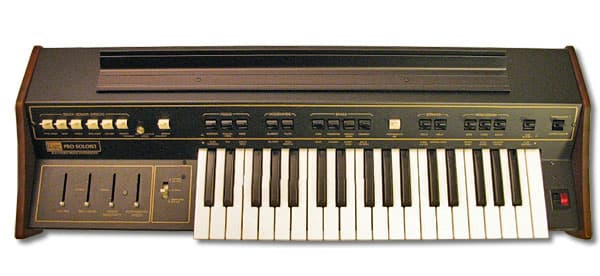
The ARP Soloist did something that now feels ordinary but was genuinely disruptive in 1970: it put instant, playable synth sounds under a keyboardist’s fingers before patch programming was realistic for most musicians. With 18 presets and basic controls, it made the synthesizer behave less like a laboratory and more like a stage instrument, and that shift changed what players expected from keyboards.
The Soloist’s real breakthrough
Cherry Audio’s Pro Soloist user guide frames the Soloist as ARP’s first move into the organ-top preset lead synth market, and that detail matters because it shows how deliberately ARP targeted working players. Instead of asking musicians to build sounds from scratch, the Soloist gave them fixed voice recipes they could reach for immediately. That meant brass, reed, string, organ, and lead tones were available at stage speed, not after a long evening of knob twisting.
The early-1970s context explains why this was such a leap. Analog synthesizers were still mysterious to most people outside college music labs, and the idea of a reliable gigging synth was still new. ARP was not alone in trying to soften the learning curve, but the Soloist stood out because it made a complex new technology feel usable without a technician’s mindset.
Why presets mattered before patch memory
Before patch memory became standard on later instruments, changing sounds on many synths meant recreating settings by hand. That was fine in a studio experiment or a university electronics room, but it was a poor fit for a live set where the next song might demand a completely different voice in a few seconds. The Soloist’s preset architecture solved that problem by packaging a small but useful set of sounds into one instrument.
That design choice is easy to underestimate now because modern players take instant sound recall for granted. But the Soloist made a clear argument that still holds up today: if a keyboard cannot deliver a usable sound quickly, it is harder to trust on a gig. The Soloist was built around trust, speed, and repeatability, which is why it belongs in the story of how synths became performance tools instead of just electronic curiosities.
The Pro Soloist tightened the formula
ARP refined the idea with the Pro Soloist, which was officially introduced in 1972 by ARP Instruments, Inc. at a manufacturer’s recommended price of $1,350. The revised model succeeded the earlier Soloist and expanded the preset concept into something even more stage-ready, with about 30 preset sounds. It is described in the research as one of the first commercially successful preset synths, and that success helped validate the whole category.
Tony Banks is one of the best-known early users associated with the Pro Soloist, which says a lot about the instrument’s audience. This was not a machine meant to sit in the corner as a curiosity. It was aimed at players who needed dependable electronic colors in front of an audience, and it arrived at exactly the moment progressive rock, fusion, and soundtrack writing were all hungry for new timbres without wanting to rebuild a modular patch every time the arrangement changed.
From preset novelty to standard workflow
The Soloist and Pro Soloist also point directly toward the way later synths were designed. Once musicians proved they valued instant recall, preset banks stopped being a convenience and started becoming a basic expectation. Sequential Circuits’ original Prophet-5 is a key example: it shipped with 40 factory programs, including 38 unique sounds and 2 duplicates for patch management.
Roland’s Jupiter-8 shows the same evolution in a different form. A factory patch sheet for the instrument lists classic categories such as brass, strings, organs, leads, and percussion-oriented sounds, which underlines how normal preset organization had become by the time big polysynths arrived. The line from the Soloist to these later instruments is straightforward: the industry learned that players wanted fast access to usable sounds, not just synthesis power.
Why vintage buyers should care now
If you buy vintage synths, the Soloist matters for more than nostalgia. It sits at the turning point where preset design became a practical answer to a real musician problem, and that makes it historically important in a way that goes beyond rarity or collector cachet. You are looking at one of the earliest attempts to make analog synthesis immediately playable on a working stage.
ARP’s own arc gives the model even more context. ARP Instruments, Inc. was founded in 1969 in Massachusetts, and the Alan R. Pearlman Foundation’s Google Arts & Culture material says the company lasted 11 years and created roughly two dozen musical instruments. That is a short life by industry standards, but it produced a deep catalog, including machines like the 2600 and Odyssey, alongside the preset lead synths that helped shift the expectations of keyboard players.
The Soloist is worth understanding because it marks the moment when synth design stopped assuming every user wanted to learn the machine from the inside out. It answered a simpler question: can this instrument give me a good sound right now? That question still shapes every stage-friendly keyboard on the market, and the ARP Soloist helped define the answer.
This article was produced by Prism’s automated news system from verified source data, official records, and press releases, then run through automated quality and moderation checks before publishing. The system is built and supervised by the people who set the standards it runs under. Read our full AI policy.
Did this article answer your question?