EMS and the VCS3, how Britain’s synth revolution began
EMS turned a £50 brief into the VCS3, and its pin-matrix workflow still explains why restorers, players, and emulation fans chase British synth history.
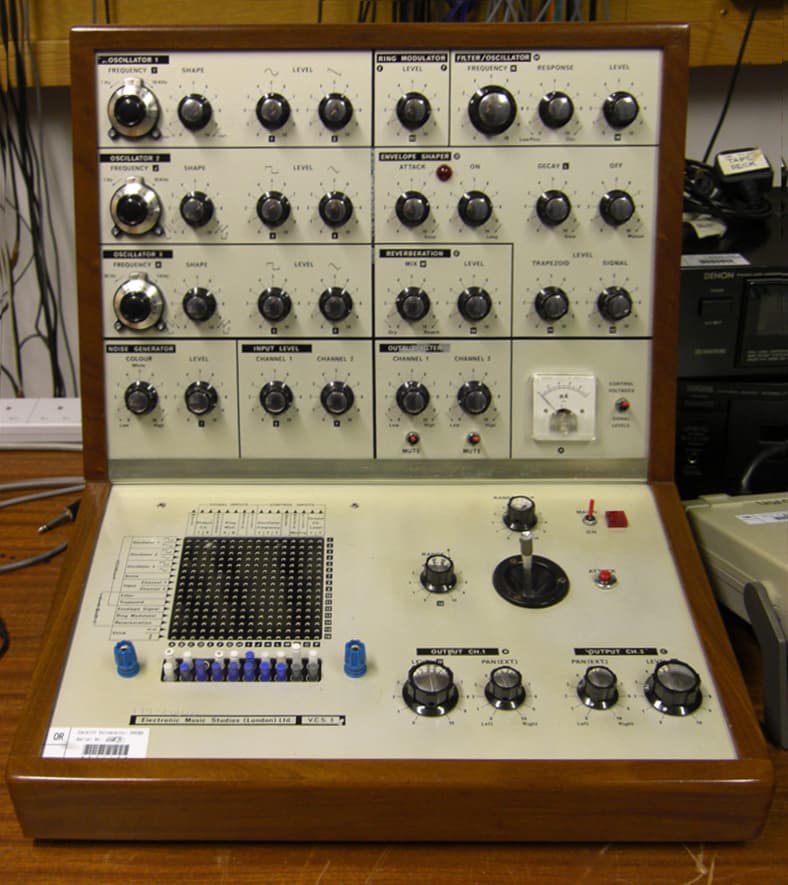
The VCS3 still lands like a challenge: how did a compact British box with no patch cables end up changing the way people think about synthesis? The answer sits in the machine’s awkward brilliance, a design that treated portability, experimentation, and unpredictability as core features rather than compromises. That is why EMS matters now, not just as a name from the past, but as the source of a workflow vintage-synth fans still measure everything else against.
From a £50 brief to a Putney workshop
EMS began in Putney, London in 1969, when Peter Zinovieff, Tristram Cary, and David Cockerell turned a small London operation into Electronic Music Studios. The company’s archive now sits with the Science Museum Group, which is fitting for a firm that was never really built to chase the mainstream keyboard market. EMS behaved more like a laboratory, producing inventive and sometimes eccentric prototypes that musicians later turned into standards.
The VCS3 grew out of a 1968 request from Australian composer Don Banks, who wanted an electronic music device that would cost no more than £50. That brief did not produce a cheap toy, but it did force the team to think differently about form, access, and function. The result was EMS London Ltd. and, soon after, a synth that would become one of the most important British instruments ever made.
Why the VCS3 looked and worked so differently
Introduced in 1969, the VCS3 is widely described as the first commercial European synthesiser and also the first commercially available portable synthesizer. That portable label matters because the instrument compressed a fully modular, highly experimental architecture into a tabletop package at a time when that idea was still unusual. Before the ARP 2600, before the SEM, and even before the Minimoog, EMS had already made portability part of the synth’s identity.
Its most famous design choice was the pin-matrix patching system, which replaced conventional patch cables with a grid of pins. For players, that meant patching felt more immediate and more visual, but also less forgiving, with signal paths built through a matrix rather than traced along hanging leads. Tristram Cary’s L-shaped desktop concept reinforced that hands-on approach, positioning the instrument as a tool for teaching, demonstration, and composition rather than a black-box performance keyboard.
EMS also extended the VCS3 with the DK1 in 1969, a velocity-sensitive monophonic keyboard controller. That addition gave players a more familiar way in, while the core machine stayed defiantly unconventional. The VCS3 cost just under £330 in 1969, a price that placed it beyond the casual experimenter but still within the reach of serious studios, broadcasters, and adventurous musicians.
How artists made the weirdness useful
The BBC Radiophonic Workshop is one of the clearest reasons the VCS3’s reputation stuck. The synth fit perfectly into the Workshop’s world of effects, cues, and sonic invention, and its influence spilled into television and beyond, including Doctor Who. Outside broadcast work, the VCS3 became a fixture for artists who wanted synthesis to do more than imitate a keyboard.
Pink Floyd and The Who are part of that story, as are Jean-Michel Jarre, Roxy Music, Hawkwind, Brian Eno, Todd Rundgren, King Crimson, and Gong. Those names matter because they show how quickly the instrument moved from experimental tool to a language for progressive rock and electronic composition. The VCS3 was especially valued for sound design and external-processing work, where its character mattered as much as its pitch stability.
That stability was not always celebrated. The instrument developed tuning-instability complaints, and restorers still recognize that reputation as part of the machine’s identity. Yet that same looseness helped define the VCS3’s personality, which is one reason so many players still prefer it for textures, effects, and voices that feel alive rather than polished.
Why EMS still shapes vintage-synth culture
EMS never became a mass-market keyboard brand, and that is exactly why its influence is so strong. The company kept building instruments that pushed ideas forward, not products that blended in, and that posture still echoes through modern semi-modular builders, instrument designers, and software developers. The VCS3 established a design language where architecture and workflow mattered as much as tone.
The Synthi-A carried the same electronics into a briefcase format, extending the idea of portable experimentation even further. The Synthi-100 pushed the concept up in scale with improved VCS3 technology, but only about 20 were sold, which underlines how far EMS stayed from mass production. These instruments were not built to dominate showrooms; they were built to open doors for composers, studios, and sound explorers.
That is why the VCS3 still matters at the bench and on the listening test. It is not just that the machine sounds unique, or that it sits inside a lineage with the BBC Radiophonic Workshop, Pink Floyd, and Jean-Michel Jarre. It is that EMS proved a synth could be portable, modular, awkward, and deeply musical at the same time, and that idea still drives the chase to restore, emulate, and debate these machines today.
This article was produced by Prism’s automated news system from verified source data, official records, and press releases, then run through automated quality and moderation checks before publishing. The system is built and supervised by the people who set the standards it runs under. Read our full AI policy.
Did this article answer your question?