Moog Releases 100 Recreated Memorymoog Presets for Muse With Free Download
Moog released the Memorymoog Preset Collection for Muse, 100 recreated factory patches, each with a B‑timbre for roughly 200 free presets, available now as a free download.
1. What the release is
Moog Music has released the “Memorymoog Preset Collection” for the Moog Muse: a factory preset pack that recreates the Memorymoog’s original library and is available as a free download. “The free collection was created by synthesist and sound designer Eric Frampton, and recreates all 100 original Memorymoog factory presets,” as Synthtopia put it, so Muse owners get immediate access to the classic factory sounds reimagined for Muse’s engine.
2. Who made the collection
The collection was produced by Eric Frampton, a synthesist, longtime Memorymoog owner, and a member of the Moog Muse factory‑preset/sound‑design team. Moog and the reporting outlets credit Frampton directly: his involvement is also reflected on social channels where he noted the project as a “fun and challenging exercise” tied to his role on the Muse sound‑design team.
3. Scope: 100 originals, plus B‑timbres (≈200 presets)
Frampton recreated all 100 original Memorymoog factory presets, and each patch includes a “B‑timbre” version that uses Muse’s modern features, effectively giving Muse users about 200 usable presets. Synth Anatomy captures the math plainly: “Alongside the 100 patches, each patch also offers a B‑timbre version… So you get basically 200 free patches for your Moog Muse.”
4. What’s different versus the originals
The recreated sounds preserve the Memorymoog character while taking advantage of Muse’s modern controls: velocity, aftertouch, macro knob assignments, onboard effects and expanded modulation are applied where useful. As Synthtopia summarized, “Using Muse’s modern architecture, each sound goes beyond the original, adding velocity, aftertouch, macro controls, effects, and expanded modulation, while preserving the three‑oscillator design of the original Memorymoog patches.”
5. How Frampton handled the three‑oscillator challenge
Memorymoog factory patches are built around three‑oscillator textures; Muse’s voice architecture uses two main VCOs plus a modulation VCO per voice. Frampton’s patch programing retains the three‑oscillator design in sound and behavior by using Muse’s modulation oscillator and routing to achieve comparable timbral density, but with the caveat that the results are reimaginings rather than exact clones. As Synth Anatomy frames it, “these presets sound strikingly close to the originals, though there are subtle variations due to differences in the voice architecture of each synth... the Muse is not a Memorymoog clone but an original modern instrument.”
6. Muse architecture that makes the reimagining possible
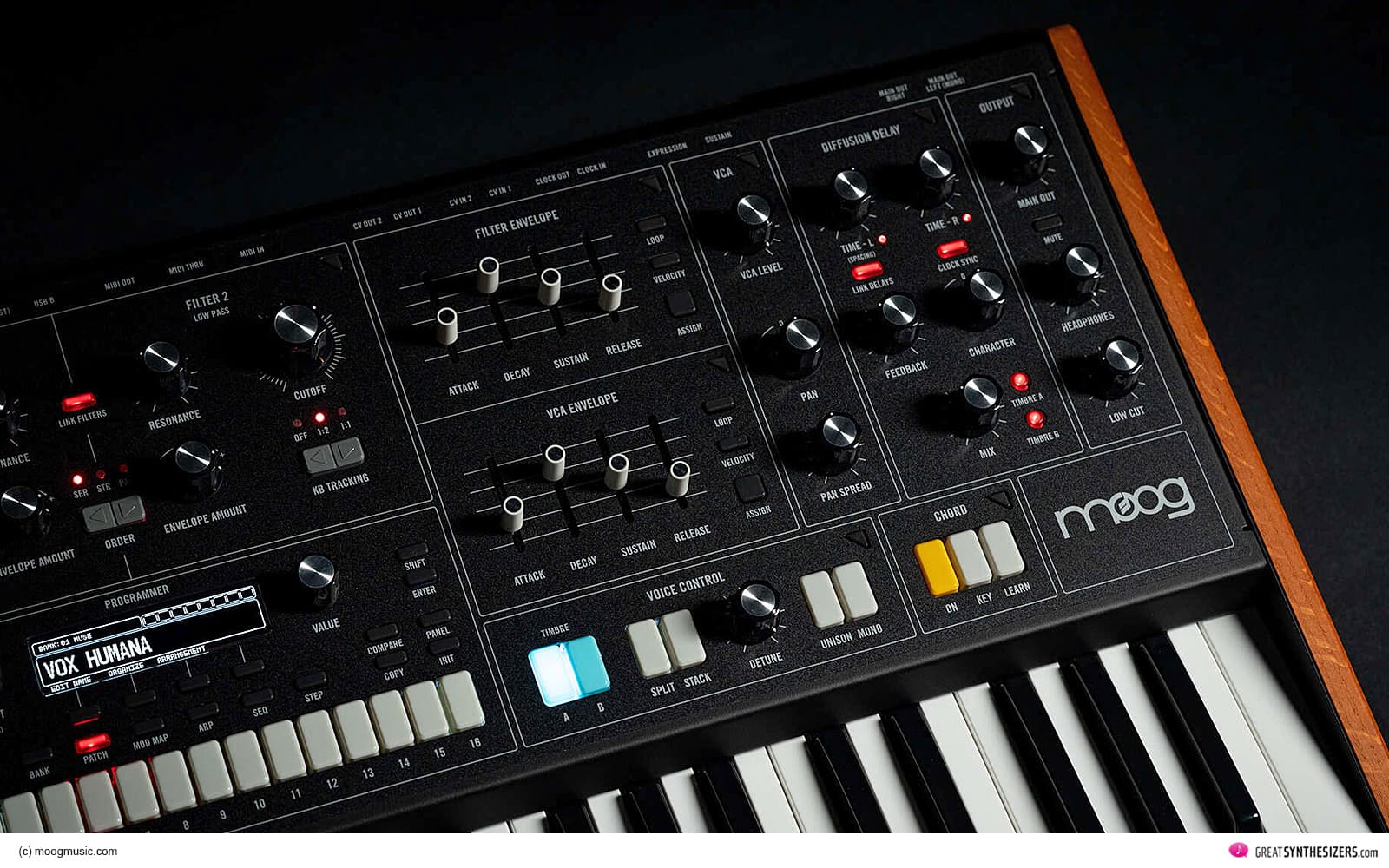
Muse is specified by Moog as “eight analog voices, each with two VCOs, modulation VCO, dual VCFs, and a stereo VCA,” and Moog describes Muse as combining “discrete oscillators derived from the Minimoog Voyager… brought together by a saturating mixer, dual transistor ladder filters, and stereo discrete VCAs.” That design, two VCOs plus a modulation oscillator per voice, is what allowed Frampton to approximate Memorymoog’s three‑oscillator textures while adding modern expressive layers and effects.
7. The demo and reference videos to hear the results
Moog and the press published demo material so you can compare sounds: Synthtopia embedded a head‑to‑head comparison between the original Memorymoog and the Muse versions, and Moog released an hour‑long “Moog Muse | Factory Preset Tour | All Sounds, No Talking” with Lisa Bella Donna and Max Ravitz. Moog’s video description is explicit: “All sounds recorded direct from Muse with no external effects added,” which makes it a handy reference for evaluating how faithful and how different the reimagined patches sound in isolation.

8. Historical context that matters for listeners
The Memorymoog was produced from 1982–1985 and offered three oscillators, ladder filter and preset memory, it was used by artists such as Jean‑Michel Jarre, Jan Hammer and Nick Rhodes. Moog’s modern poly lineage progressed through Moog One (released 2018) and then Muse; Synth Anatomy underscores the 40‑year technological gap between the Memorymoog and Muse, which explains why a faithful re‑creation is an interpretation rather than a literal clone.
9. Early reactions and quick takes
Synth Anatomy calls the pack “a lovely gift from Moog to Muse users,” and online comments reflect the expected split between nostalgia and appreciation for modern features. One Synthtopia commenter said it bluntly: “The envelopes sound much snappier on the the Memorymoog. Goes back to the saying, ‘they don’t make them like they used to.’ I love my Moog Muse though –it is my first polysynth purchase and i’m very happy with it’s limitless modulation possibilities.”
10. Availability and what’s not stated
The Memorymoog Preset Collection is “available now as a free download,” according to reporting, but the outlets don’t reproduce a direct download link or list installation file formats or system requirements in the reports. Moog’s official site hosts Muse media and tutorials, but if you’re planning to grab the pack you should expect to go to Moog’s Muse resources or your Muse preset manager to locate and install the files, the pack is free, but the specific download URL and installer details weren’t quoted in the coverage.
11. Practical implications for Muse owners and patch hunters
If you chase classic three‑oscillator textures, this is the fastest route to a Memorymoog‑flavored library on a modern instrument, 100 factory sounds plus B‑timbres means immediate variety without rebuilding patches from scratch. Remember the caveat from Frampton’s reporting: “these presets sound strikingly close to the originals… they don’t sound 100% the same is normal,” so expect authenticity with modern flexibility: velocity, aftertouch and macro tweaks let you push patches into territory the original hardware couldn’t.
12. Unanswered technical points worth confirming
The public materials don’t say whether the head‑to‑head demo used original Memorymoog hardware or samples, nor do they specify how the B‑timbres are implemented in Muse (separate preset slots vs. per‑preset timbre mapping). If you want that technical granularity, those are sensible follow‑ups for Moog or for Eric Frampton: confirm the demo source, the exact preset/slot implementation, and any firmware requirements for the B‑timbre functionality.
Conclusion This is a tidy, no‑cost shortcut for Muse owners who want Memorymoog vibes without hunting vintage hardware: Eric Frampton recreated all 100 factory presets, each with a B‑timbre that exploits Muse’s expressive controls, and Moog published demos including an hour‑long Factory Preset Tour recorded direct from Muse. It’s not a clone; it’s a modern reimagining that delivers classic textures plus modern playability, a practical, immediate library for anyone owning a Muse.
Know something we missed? Have a correction or additional information?
Submit a Tip