New BJOOKS Book Traces Drum Machines From Organs to 1980s Icons
Beat Gems turns drum machines into a collector’s map, from organ accompaniments to the 808 and LM-1, and it helps buyers spot significance before prices catch up.
Why drum machines belong in the synth collector’s canon
A drum machine is more than a box of patterns. Britannica defines it as an electronic musical instrument that creates percussion sounds, beats, and patterns, and that definition only gets richer once you follow the hardware trail BJOOKS is tracing in Beat Gems. Gearnews describes the book as a look at the impact, influence, and culture of drum machines, from early organ-accompaniment units to their rise as credible replacements for human drummers in the 1980s and beyond.
That framing matters because it treats rhythm boxes the way synth collectors already treat keyboards: as objects with design lineage, commercial context, and cultural afterlife. A machine that flopped on the sales floor can still be historically central, and a machine that was once just studio furniture can later become an estate-sale grail. Beat Gems is being positioned as the drum-machine counterpart to Synth Gems 1, which is exactly the kind of shelf-mate that helps a collector see the whole story instead of only the famous front-panel names.
The BJOOKS model: gear books as reference objects
BJOOKS describes its titles as beautiful hardcover coffee-table books for music studio and gear enthusiasts, and that is not just branding fluff. The catalog already includes Push Turn Move, Patch & Tweak, Pedal Crush, Patch & Tweak with Moog, Synth Gems 1, Inspire the Music, Patch & Tweak with Korg, and The Minimoog Book. In other words, Beat Gems arrives inside a very specific culture of reference books that are meant to live beside the equipment they document.
That collector-friendly format is part of the utility. Synth Gems 1 is described by BJOOKS as a guide to an eclectic collection of synthesizers as art, covering history, technology, and sonic innovation, along with the designs and stories behind instruments from many manufacturers. Gearnews added in 2021 that the book included over 60 vintage synthesizers and more than 330 color photographs, with a foreword by Vince Clarke. For anyone who cares about vintage hardware, that combination of visual documentation and historical framing is exactly what helps separate a toy from a milestone.
The machines that changed the script
If you are building a mental map of drum-machine history, three names do a lot of work. The Roland CR-78, released in 1978, let users program and store their own drum patterns. That is a major shift from fixed accompaniment, because it gives the player actual authorship instead of a preset loop.
Then comes the Linn LM-1 Drum Computer, released in 1980 and the first drum machine to use samples of acoustic drums. That detail matters because it tells you why the machine became such a reference point even beyond its sales numbers: it brought a new kind of realism into electronic rhythm programming.
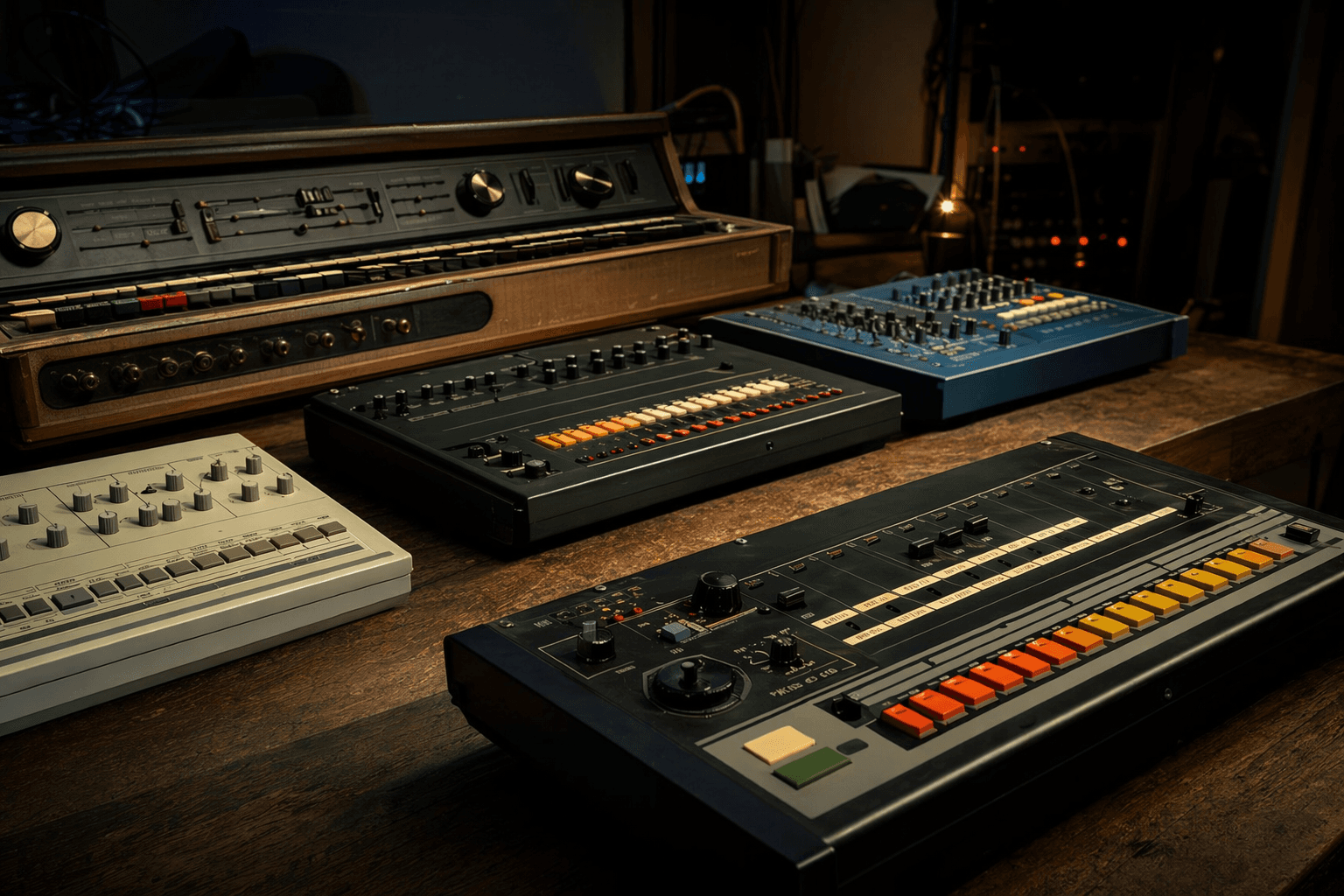
The Roland TR-808, manufactured from 1980 to 1983, pushed the idea further by becoming one of the first drum machines to let users program rhythms instead of relying on preset patterns. It was initially a commercial failure because many musicians wanted more realistic drum sounds and electronic music had not yet gone mainstream. That market rejection is part of its collector appeal now. The machine that did not immediately win the room later became one of the defining objects in rhythm-machine culture.
The LinnDrum tells a similar story in smaller numbers. It sold about 5,000 units, which is enough to matter in studios and enough scarcity to matter on shelves. Those figures help explain why books like Beat Gems are not just pretty objects themselves; they are tools for identifying the models that shaped the canon before the broader market fully prices them in.
What the early organ-accompaniment era teaches you
Gearnews makes a point of starting the drum-machine story with early examples made as organ accompaniments, and that is a useful reminder for collectors. The earliest machines are important not because they are the loudest names in synth culture, but because they show where the category came from: practical support hardware that gradually became a creative instrument in its own right.
That evolution is where design quirks start to matter. A machine with pattern memory, programmable rhythms, sampled sounds, or a limited factory palette tells you something about the moment it was built. Once you know the timeline, you stop asking only whether a machine sounds good and start asking what problem it solved, who wanted it, and why later players turned it into an icon.
A field guide for spotting significance before the market does
The real value of a book like Beat Gems is that it gives collectors a vocabulary for judging what they are looking at before hype finishes the job. If you are scanning a listing, a shelf, or an estate-sale table, these are the details that deserve your attention:
- Pattern memory changes everything. The Roland CR-78’s ability to program and store patterns marks a meaningful leap from fixed accompaniment into user-defined rhythm.
- Sampling history matters. The Linn LM-1’s use of acoustic drum samples makes it a landmark, not just an old drum machine.
- Preset-vs-programmable is a big clue. The TR-808’s programmability is part of why it became a cultural reference point rather than just a box of factory beats.
- Commercial failure does not mean cultural irrelevance. The 808’s weak initial sales, and the LinnDrum’s roughly 5,000-unit run, are exactly the kind of numbers that often precede collector interest.
- Look for the transition moment. Machines tied to the shift from organ backing to standalone electronic drumming are often the ones that later define the category.
Those are the distinctions that keep a buyer from mistaking a footnote for a landmark. They also help explain why archive-minded books keep finding an audience: they slow the market down just enough for a collector to see significance before a price tag does.
Why Beat Gems belongs next to the gear, not apart from it
Beat Gems reads like part of a broader preservation movement around classic electronic instruments. The book is not merely announcing that drum machines existed; it is helping establish which models carried the cultural load, which ones pioneered the technology, and which ones became iconic only after the market and the music caught up. That is the same value proposition that made Synth Gems 1 compelling for keyboard people: the equipment is treated as art, history, and working technology all at once.
For the vintage-synth crowd, that matters because drum machines are not a side quest. They are the pulse section of the same story, with the same mix of engineering choices, commercial misfires, cult followings, and late-breaking acclaim. Books like this do something practical and rare: they make it easier to recognize the machine that will still matter after the room has moved on.
This article was produced by Prism’s automated news system from verified source data, official records, and press releases, then run through automated quality and moderation checks before publishing. The system is built and supervised by the people who set the standards it runs under. Read our full AI policy.
Did this article answer your question?