OB-Xf v1.0.1 Brings Envelope Fixes and New Patches to Free Oberheim Emulator
OB-Xf v1.0.1 fixes envelope legato bugs that silently broke community patch banks, making the best free OB-X emulator sharper and more reliable across every platform.
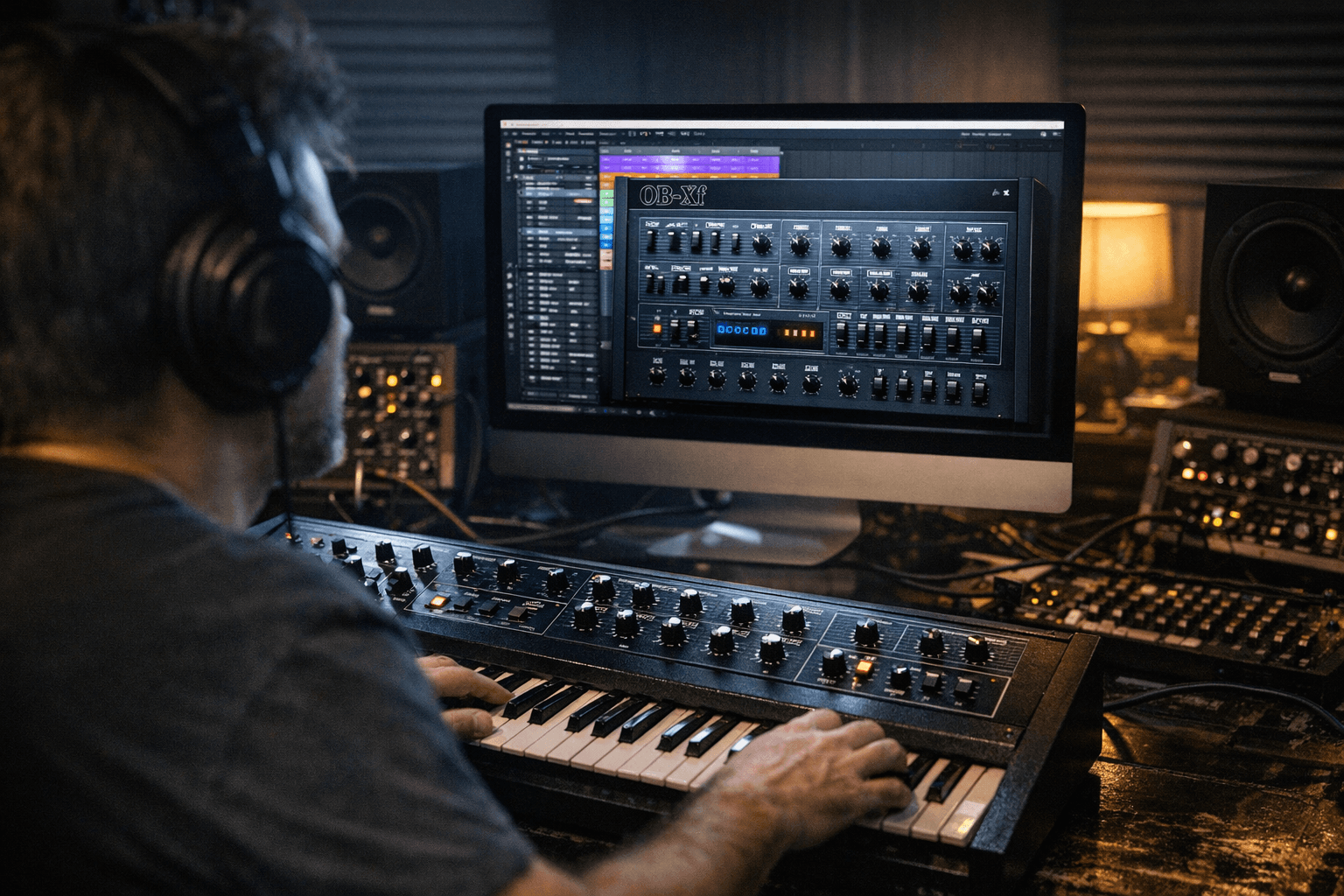
The Oberheim OB-X's fat, detuned polyphonic pads helped define an era, from the wide brass of late-seventies prog to virtually every synthwave record released in the past decade. The Surge Synth Team's OB-Xf is the most serious free attempt to preserve that circuit behavior, and version 1.0.1, published on March 25, arrived with a tight, purposeful changelog targeting exactly the kind of subtle bugs that erode trust in a preset collection over time.
The headline fix addresses envelope legato and retrigger behavior in several patch banks. Community patches from Aleksey's Keys, which had been circulating with incorrect envelope legato settings, were corrected in this release. It is the kind of bug that does not announce itself dramatically: you load a lush pad, play a slow chord progression in legato style, and the envelope attacks feel slightly off, never quite as smooth as the patch name implies. v1.0.1 eliminates that inconsistency. A separate fix resolved menu scaling inside Bitwig Studio, rounding out the two core issues that motivated getting the update out quickly.
The release also bundles new and updated factory patches, expanding the preset library that shipped with 1.0.
To get a feel for what the fix actually changes, try this A/B: load one of the corrected Aleksey's Keys banks, hold two notes in legato fingering with the amp envelope set to a long attack around 0.8 seconds and maximum sustain, then toggle envelope legato off and back on. The pre-fix behavior would restart the attack from zero on each new legato note; the corrected version smoothly continues the envelope contour the way an original OB-X voice would, holding the swell while the pitch shifts underneath it. That behavior is the texture behind countless classic pads, and getting it right in software matters.
OB-Xf itself is a direct fork of the last open-source OB-Xd codebase, originally written by Vadim Filatov under the name 2DaT. When discoDSP later took over OB-Xd development and introduced a 99-euro commercial tier alongside the free version, the Surge Synth Team forked the open-source branch and restarted work under the OB-Xf name, keeping the project fully free. That lineage is why the community invested in it: it is not a ground-up reimplementation but a direct continuation of the same open code, now maintained inside the infrastructure that supports the Surge synthesizer. OB-Xf is designed to recreate the behavior of the OB-X, OB-Xa, and OB-8, and it ships as VST3, Audio Unit, CLAP, and LV2 formats with signed macOS DMG installers, a Windows EXE, and Linux DEB packages.
That cross-platform reach is its own preservation argument. When hardware OB-X units regularly sell above $4,000 and paid emulations from commercial vendors require per-seat licenses, a freely redistributable plugin with an active public commit history on GitHub is the format most likely to still be installable in 2036. Every patch fix the Surge Synth Team ships to OB-Xf is also a commit against forgetting what that filter sounded like.
Know something we missed? Have a correction or additional information?
Submit a Tip