Synthpro Restorations Fits Custom Wood Panels on Client's Memorymoog
Carpenter Frank Peluso's custom wood panels are now fitted to William Beith's Memorymoog, one of roughly 3,000 ever built, in a new Synthpro Restorations update.
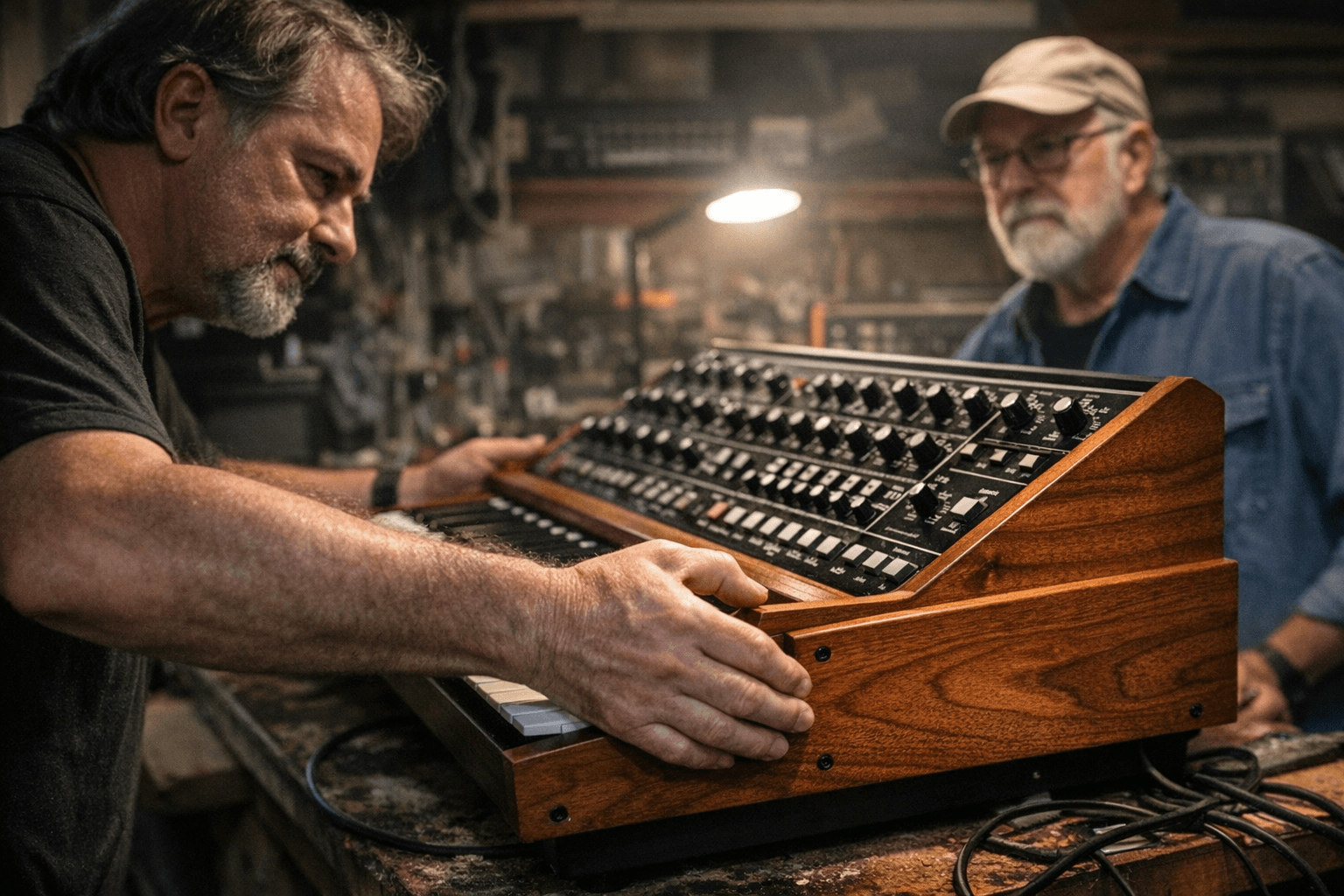
Custom wood panels fabricated by carpenter Frank Peluso are now fitted to William Beith's Memorymoog, completing a cosmetic and functional restoration milestone at Synthpro Restorations. Jareth Lackey, the shop's technician and owner, posted a roughly four-minute video to the Synthpro YouTube channel on March 29 showing the before-and-after fitment alongside a short audio demo of the instrument running after the woodwork was reinstalled.
The Memorymoog being restored is one of approximately 3,000 units assembled at Moog Music's facility in Trumansburg, New York, between 1982 and 1985. Announced at the Winter NAMM show in 1982 and originally priced at $4,195 USD, the instrument is the last polyphonic synthesizer Moog Music ever released before the company declared bankruptcy in 1987. That launch price, adjusted for inflation, is equivalent to roughly $13,500 to $14,000 today, and working examples currently trade between $5,000 and $8,000 on platforms like Reverb and eBay.
Architecturally, the Memorymoog was unlike anything Moog had built before. Where the earlier Polymoog (1975) used divide-down technology, the Memorymoog gave each of its six voices its own dedicated oscillators and filter, for a total of 18 voltage-controlled oscillators across the instrument. That three-VCO-per-voice design is where the often-repeated description "six Minimoogs in one unit" comes from, and it produced a thickness and harmonic density that competitors like the Sequential Circuits Prophet-5 and Oberheim OB-Xa couldn't match. The 61-key, 100-patch-memory instrument arrived at exactly the wrong commercial moment: simultaneously with the Yamaha DX7, just as the market was pivoting to digital synthesis.
None of which makes owning one easy. Lintronics, the German company that developed the LAMM (Lintronics Advanced Memorymoog) upgrade in 1992 in association with Bob Moog's then-company Big Briar, described the instrument as "plagued with hardware instabilities and operating system shortcomings." The specific culprits are well-documented among Memorymoog owners: heat-sensitive oscillators, failure-prone multi-pin connectors, degraded ribbon cables, and original capacitors not rated for the temperatures they were asked to handle. A unit can play in tune in a shop and drift after being shipped across town.
That reliability backdrop makes Peluso's woodwork significant beyond its aesthetics. Cosmetic restoration of this kind typically accompanies completed internal work, including keybed reconditioning, recapping, and voice-board calibration. Beith's Memorymoog is a high-value instrument in a category where documented, professional restoration is a direct factor in market valuation. LAMM-upgraded and professionally restored Memorymoogs command premiums above the standard used-market range, and the LAMM upgrade itself, while widely regarded as the definitive solution to the instrument's reliability problems, costs thousands of Euros and has historically carried a wait time of around eight months at Lintronics.
Lackey's Synthpro channel has built a catalogue of multi-part restoration documentaries covering Minimoogs, Multimoogs, and Memorymoogs, giving both clients and prospective buyers a peer-reference archive of what complete restoration work on these instruments actually looks like. For an instrument produced in a three-year window at a single upstate New York facility, that documentation is itself a form of preservation.
Know something we missed? Have a correction or additional information?
Submit a Tip