Technics SY-1010 reveals the hi-fi brand’s rare analog synth gamble
Technics turned the SY-1010 into a showroom-only mono synth, not a mass-market keyboard. Its Japanese-market rarity now weighs as heavily as its simple VCO voice.
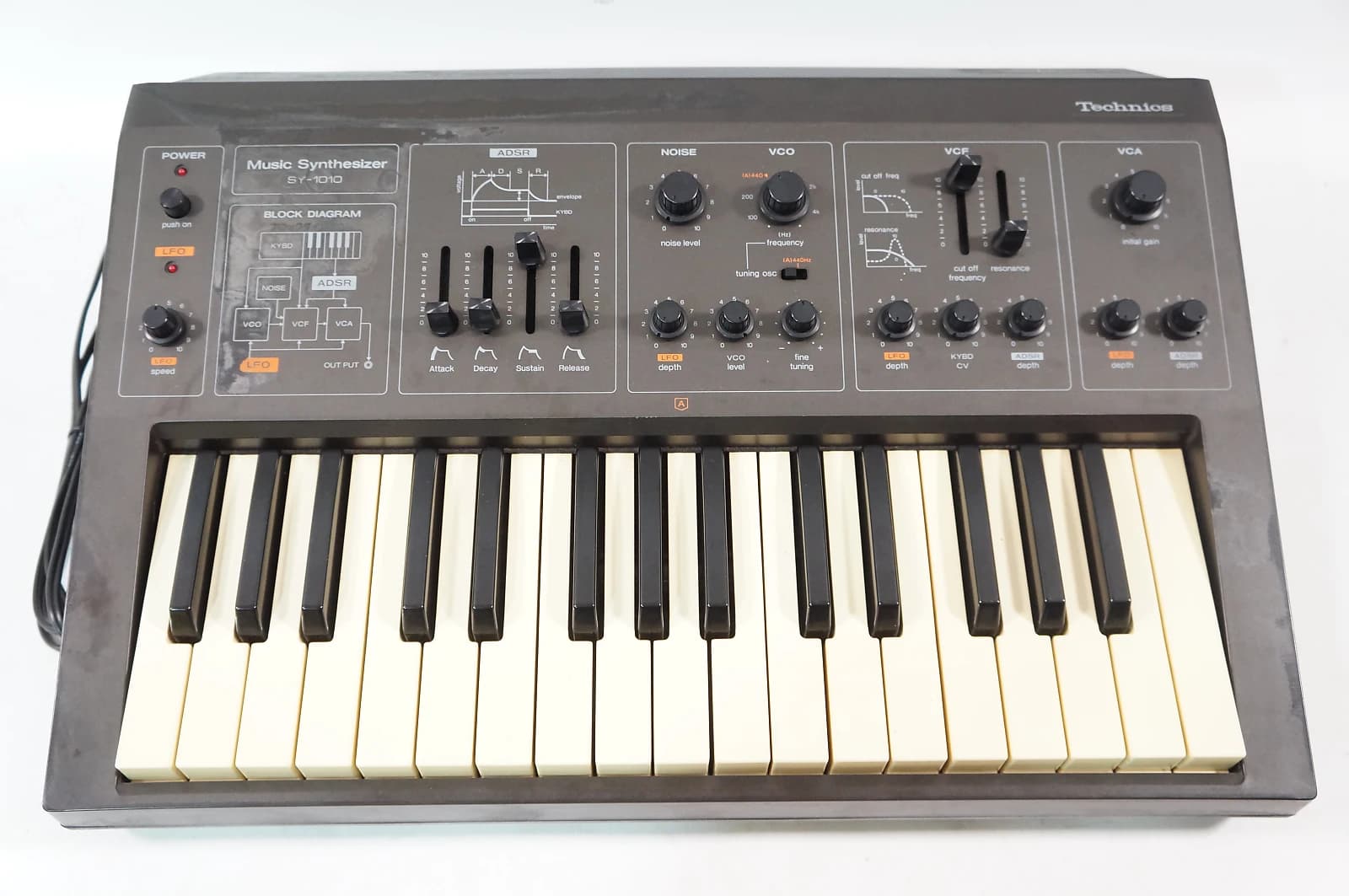
Technics did not launch the SY-1010 as a stage staple. The analog monophonic synthesizer debuted in 1979 and was sold only through Technics showrooms, which makes its whole existence read less like a keyboard release and more like a prestige audio experiment.
A hi-fi brand trying to earn a place in synth culture
That gamble makes more sense once you look at where Technics came from. The brand name was introduced in 1965 for premium loudspeakers, and Technics’ own history traces the origin to the Technics 1 speaker system. Panasonic Group still describes Technics as its hi-fi audio brand, which is a reminder that the company’s identity was built in living rooms and stereo racks before it was ever tied to synth benches.
In the late 1970s, Japanese electronics firms were pushing into the spaces between home audio, keyboard instruments, and studio gear. Technics was not operating in the same lane as Moog, ARP, Roland, Yamaha, or Korg, where instrument design defined the brand from the start. It was testing whether a synthesizer could be presented with the same upscale engineering and retail polish as a premium stereo component.
That is what makes the SY-1010 interesting to collectors now. It was not just a rare Technics oddity, it was a statement that a hi-fi company believed it could sell a synth as a prestige object, with showroom presence doing some of the work that musician word-of-mouth normally handles.
What the SY-1010 actually offers
On paper, the SY-1010 is straightforward. Reverb describes it as a single-VCO mono synth with VCO, LFO, VCF, ADSR, and VCA, and other synth databases identify it as an analog monophonic synthesizer. Matrixsynth also labels it a 1979 analog monophonic synthesizer, which lines up with the 1979 debut date attached to the model.
That simplicity matters. A 2023 demo description says the SY-1010 was produced only for the Japanese market and calls it a "very simple design but very nice sounding," while also comparing its character to a Roland SH-101. That comparison tells you where the instrument sits in the market: not as a deep, complicated flagship, but as a plain-spoken mono synth whose appeal comes from tone, layout, and the Technics badge.
For modern buyers, that creates a very specific value proposition. The SY-1010 is not trying to win on synthesis depth or on the kind of spec-sheet intimidation that comes with larger polysynths. It is a single-voice analog machine with a clean signal path, and its appeal depends on whether you value a compact Technics-built sound source as much as you value the story behind it.
Why the SY-1010 stayed so obscure
The showroom-only release strategy is the biggest reason the SY-1010 remains hard to spot outside specialist circles. Most vintage synths built their reputation through music shops, catalogues, touring acts, and visible studio use. A Technics synth that lived mainly in branded showrooms had a much narrower path into the hands of players, which changes both its visibility and its collector profile.
The Japanese domestic model label adds another layer. Reverb’s listing identifies the SY-1010 as a Japanese domestic model, and the 2023 demo description says it was only produced for the Japanese market. Put those details together and the rarity stops being mysterious: this is not just an uncommon synth, it is a model whose circulation was intentionally limited from the start.
That matters in collector terms because rarity and fame are not the same thing. A machine can be scarce without becoming iconic, especially when it comes from a company better known for hi-fi than for keyboard design. The SY-1010 is exactly that kind of object, a footnote to some buyers and a meaningful crossover piece to others.
What collectors should take from the SY-1010
The SY-1010 is worth studying because it shows how wide the analog era really was. Vintage synth culture often circles the same names, but the Technics story proves that the market also included one-off brand experiments, showroom-only launches, and domestic Japanese models that never had a chance to become global standards.
That has practical value for anyone shopping in this corner of the market. The first question is not whether the SY-1010 belongs in the same conversation as a Minimoog or Juno, because it does not. The better question is whether you want a rare, single-VCO Technics mono synth with a clear historical identity, or whether you are after a more common machine with a larger support network and a deeper pool of examples to compare.
For collectors and restorers, the model is also a good reminder to pay attention to distribution history. A synth sold only in Technics showrooms and identified as a Japanese domestic model carries a different kind of scarcity than a model that was widely exported and simply survived in small numbers. That difference shapes how often it appears, how easily it is recognized, and how much of its identity is tied to the market it came from.
Technics did come back to synths, but only much later
The SY-1010 was not the start of a long, uninterrupted Technics synth line. Vintage Synth Explorer notes that Technics had mostly focused on stereo equipment, organs, and electric pianos before the SX-WSA1 arrived in 1995. That gap makes the SY-1010 feel even more like a special case, a brief intersection between hi-fi ambition and keyboard design rather than a continuing product family.
Seen against that backdrop, the SY-1010 is exactly the kind of machine that keeps vintage synth collecting interesting. Technics tried to bring premium audio credibility into the analog synth market, and the result was a mono instrument that now survives as both a sound source and a branding artifact. The showroom-only gamble did not make it a mainstream legend, but it did leave behind a rare piece of late-analog history that still carries the weight of where it came from.
This article was produced by Prism’s automated news system from verified source data, official records, and press releases, then run through automated quality and moderation checks before publishing. The system is built and supervised by the people who set the standards it runs under. Read our full AI policy.
Did this article answer your question?