UDO Audio DMNO Ships as 8-Voice Binaural Analog-Hybrid Synthesizer
UDO Audio's DMNO pairs two independent 4-voice FPGA-hybrid engines with a per-voice Dynamic Multi-Core Stereo VCF, with retailer listings appearing mid-March 2026.
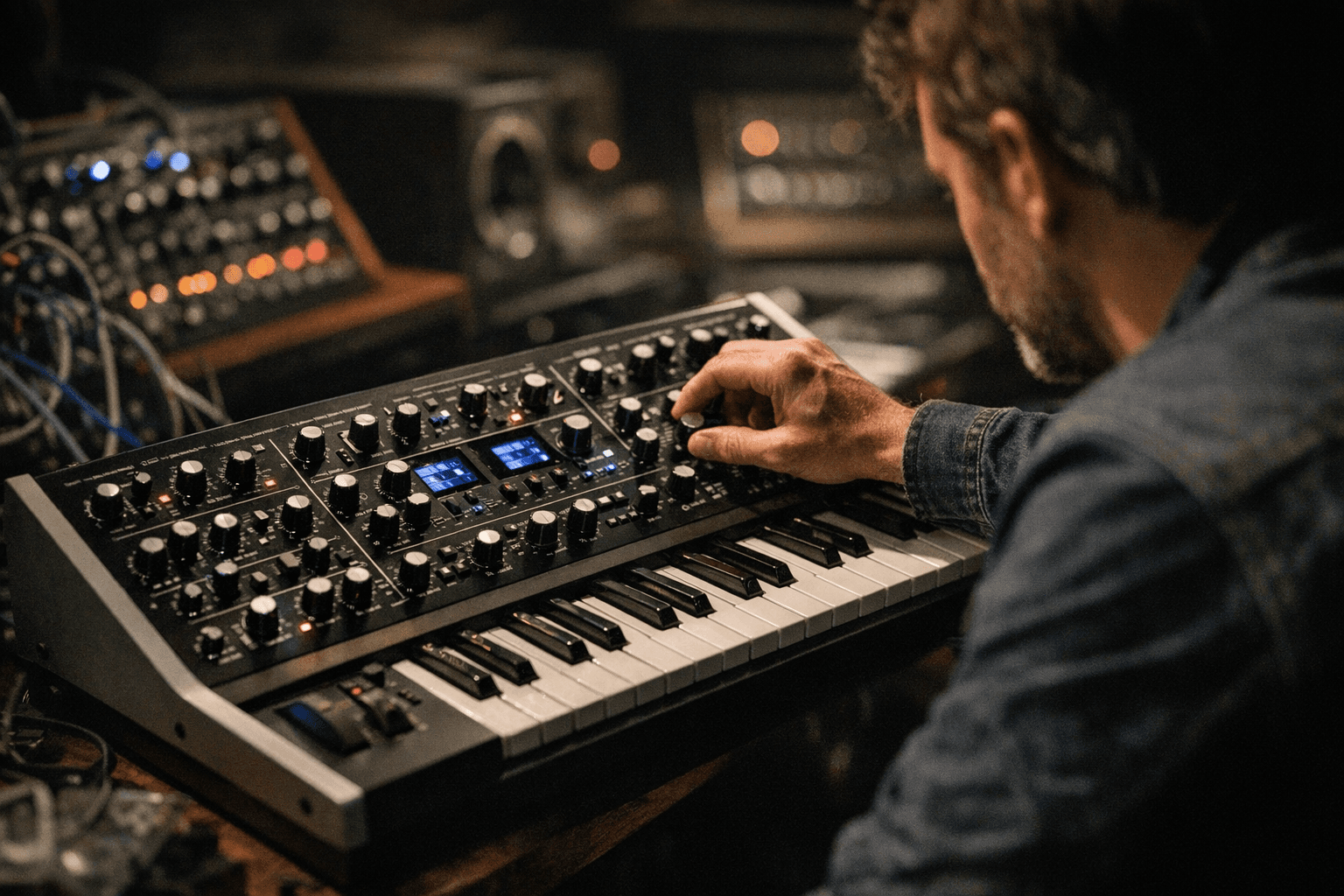
UDO Audio began shipping the DMNO last week, putting into players' hands an 8-voice, 2-part multitimbral hybrid that pairs FPGA-based digital oscillators with analog filter stages and a per-voice Dynamic Multi-Core Stereo VCF. Retailer listings at Altomusic and Kraftmusic went live mid-March 2026, confirming the instrument as in-stock and new.
The architecture at the heart of the DMNO is genuinely unusual: two completely independent 4-voice analog-hybrid synthesizers share a single chassis, each with its own dedicated front-panel controls. Each voice carries two oscillators, and the oscillator routing goes deeper than most hybrids in this class. Drone mode is available on OSC 2, pulse waveforms run on both OSC 1 and OSC 2, and hard sync runs in either direction, 1 into 2 or 2 into 1. Eight selectable Play Modes then reconfigure the signal flow between those two engines on the fly, redefining how the two timbres interact at the touch of a single control.
The filter is where UDO has done the most novel work. The Dynamic Multi-Core Stereo VCF runs per voice and offers parallel, series, and stereo connection modes, with multiple filter modes available for each connection type. Forum discussion noted that despite a visual resemblance to the SEM topology, the DMNO does not include a continuously morphable SEM-style filter, which is worth knowing before you assume it covers that particular ground.
Effects are handled by a 32-bit DSP chain UDO markets under the "eSects" branding. The chain includes a syncable delay with time, feedback, and mode parameters; a reverb with size, pre-delay, lo-cut, damping, and width; a multi-mode distortion insert; a chorus insert with rate, depth, mix, and delay parameters; and a three-band EQ with adjustable low shelf, high shelf, and mid parametric bands. The display driving all of this is a vacuum fluorescent display, described in retailer copy as "a beautifully sharp, yet somehow warm and organic, high-contrast electroluminescent glass VFD," paired with dedicated rotary controls.
Memory runs to 128 rewriteable performance memories covering both layers and all global settings, plus 128 separate patch memories for saving individual layers independently. Connectivity includes a 2-in 2-out 24-bit USB digital audio interface. Physical I/O beyond the USB spec has not yet been confirmed in available retailer documentation; UDO's full technical specifications page is the place to verify jack counts, MIDI implementation, and any CV presence.
One figure circulating in forum posts puts the retail price at £2,499, with channel aftertouch rather than polyphonic aftertouch. Neither figure has been confirmed by retailer spec sheets or official UDO copy at the time of writing, so treat both as unverified until UDO or an authorized dealer makes it official. The forum reaction, at least, was unambiguous: "OMG, and no money in my pockets.
Know something we missed? Have a correction or additional information?
Submit a Tip