Armageddon’s surface revealed, hive cities and Ork strongholds exposed
Armageddon’s real battlefield is the map itself: three hive cities, a killer jungle, and ash wastes that make Yarrick’s return look like a full-scale invasion.
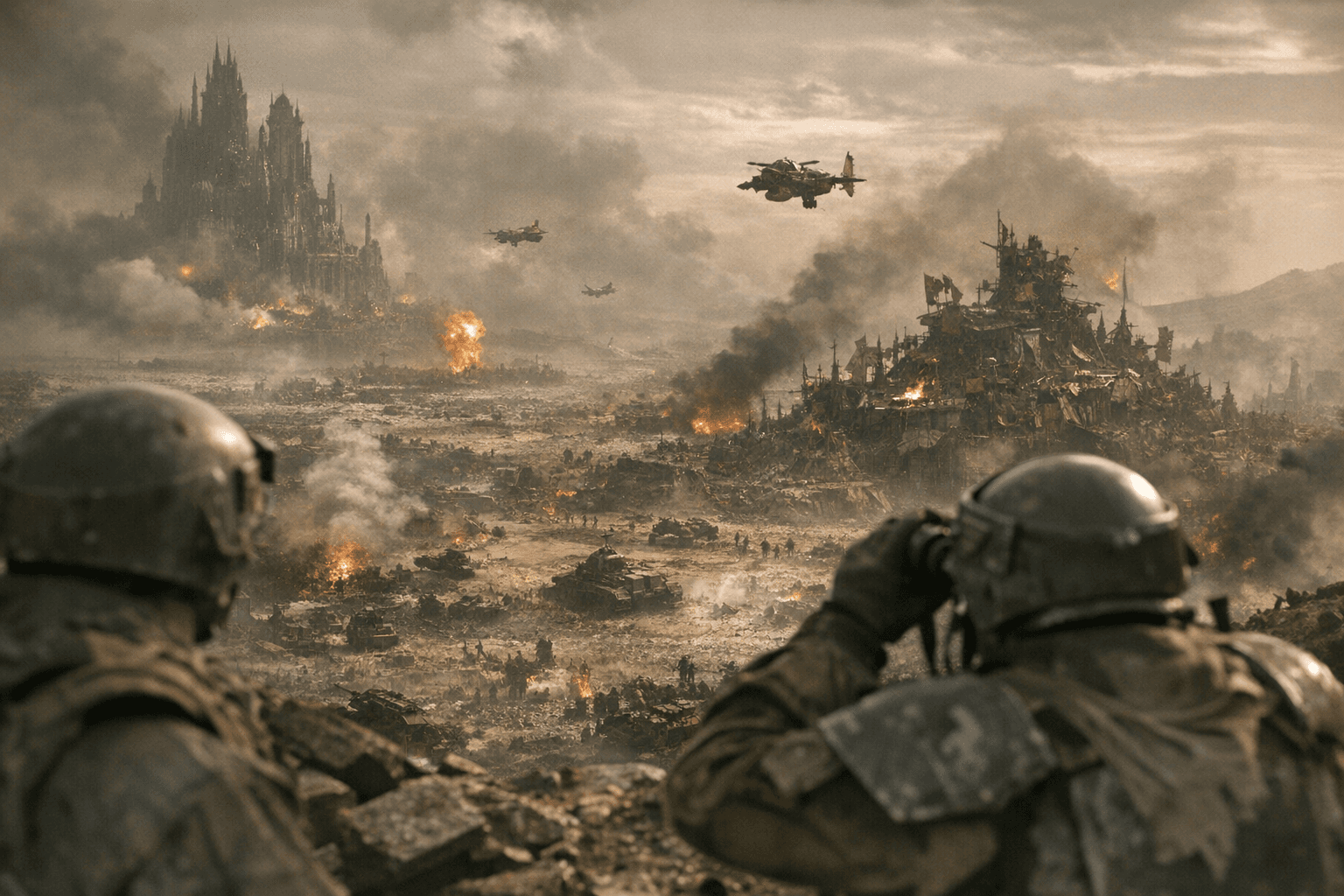
Armageddon is a planet that decides where the war will happen, then punishes everyone for showing up. The new surface-level view makes that obvious fast: this is not just a hive world with some ruins scattered on top. It is a machine for creating chokepoints, burn zones, ambush lanes, and last-stand fortresses, all held together by tectonic violence, poisoned ground, and a history of wars that never really ended.
A world split between hives and ruin
Armageddon’s central landmass is divided into Armageddon Prime and Armageddon Secundus, with a vast equatorial jungle cutting between them and hostile seas sealing off the polar regions. That alone would make the world awkward to campaign on, but the planet’s elliptical orbit around Tisra turns the whole surface into a hazard. Every close pass brings violent tectonic instability, which is why the setting feels permanently half-broken and half-erupting.
That detail matters because Armageddon’s geography does not just look dramatic. It explains the mood of the war zones. Volcanic activity, seismic cracking, and unstable passes give commanders limited routes, limited breathing room, and very little patience for slow advance. If you want Armageddon to feel right on the table, it should look like a world where the terrain is as hostile as the enemy.
The three hives that define Armageddon Prime
Armageddon Prime carries the real weight of the planet’s strategic value, and it is dominated by three major hive cities: Hive Volcanus, Hive Tempestora, and Hive Death Mire. Each one tells you something different about how the war works here. Volcanus is the hard shell, a heavily fortified mountain bastion that has become a prime target for Ork assaults. It feels less like a city and more like a fortress under siege that refuses to die.
Then there is the Mannheim Gap, one of the clearest examples of Armageddon’s geography doing battlefield work. It is one of the rare navigable passes, and it reads like a graveyard of Titans, Gargants, and broken war machines. That kind of terrain is not background dressing. It is the sort of place that becomes a scenario centerpiece, a brutal corridor where every advance is made under the shadow of what died there before.
Hive Tempestora is the one that should immediately catch your eye if you care about current campaign logic. It is now the largest Ork-held stronghold left from earlier fighting, and it is ringed by the Morpheon Line, a massive trench and fortification network built to contain it. That is exactly the sort of front line that turns a campaign into a siege narrative, with breaches, counterattacks, and vehicle thrusts smashing against prepared defenses.
Hive Death Mire sits closer to the infrastructure that keeps the planet moving. Its proximity to logistical hubs and the Eyes of the Emperor observatory gives it strategic value before the first shot is fired. On Armageddon, logistics are never boring. They are the difference between a functioning war machine and a collapsing front.
The dead ground is where Orks thrive
Between the hive zones, Armageddon turns ugly in a very literal sense. The ash wastes are saturated with pollutants, radioactive waste, and poisonous compounds, so humans have to wear respirators constantly just to operate there. That is exactly the kind of environment where Orks get better value out of their enthusiasm and brutal practicality, because the same terrain that grinds down Imperial forces becomes a playground for scrap-built war machines and reckless movement.
The equatorial jungle is not any kinder. During Armageddon’s Season of Fire, temperatures soar and seismic stress can split the terrain open. That gives the Imperial plan to burn through the jungle from one edge to the other a very specific feel: it is not just a punitive scorched-earth campaign, it is a deliberate attempt to turn a dense, hostile natural barrier into open ground before the enemy can exploit it.
If you are building terrain around this map, the key is contrast. Put dense jungle against scorched clearings. Put trenchworks next to toxic ash flats. Put a fortified hive edge next to a broken pass full of wrecked super-heavy hulls. Armageddon works because the planet refuses to stay in one shape long enough for anyone to feel safe.
Why Yarrick’s return changes the whole campaign
The new expansion, Armageddon: The Return of Yarrick, frames all of this as more than lore. It is the battlefield logic behind Commissar Sebastian Yarrick’s return and the fight against Wazdakka Gutsmek’s Speedwaaagh!. The official preview makes the point plainly enough: the blasted wastes around Armageddon’s hives are ideal ground for Speed Freeks and their vehicles.
That is the practical appeal of the setting right now. Ork mobility, Imperial fortification, and broken industrial terrain all point in the same direction. This is a war about lanes, choke points, and movement under fire. Yarrick is not returning to a neutral world. He is returning to a planet that already knows how to turn military legend into attrition.
The wider lore only sharpens that. Warhammer Community recently revisited the moment when Ghazghkull Thraka left Armageddon to begin Da Great Waaagh!, with Yarrick pursuing him off-world alongside the Black Templars. That gives the return a proper sense of unfinished business. Armageddon is where his legend was forged, and now the same world is calling him back into a fight shaped by the next generation of Ork war doctrine.
A war world with a memory
Armageddon has already endured three major wars: the First War for Armageddon, the Second War for Armageddon, and the Third War for Armageddon, which began in 998.M41. The First was a Chaos invasion led by Angron and the World Eaters, and the Third came fifty-seven years after the Second. That is the kind of number that tells you the planet is not merely contested, it is trapped in a cycle of repeated catastrophe.
The current conflict raises the stakes even further with the Red Angel’s Gate and corruption spreading through the Fire Wastes. Add in heretic uprisings and rebellions across the hives, and you get the full picture: this is not a clean front line with neat deployment zones. It is a sprawling collapse of order in a place already scarred by old wars.
St Jowen’s Dock, the home base of Battlefleet Armageddon, is another reminder that the planet’s importance reaches beyond the ground war. Armageddon’s hives and industrial base matter because they feed the Imperium’s war machine, and every invasion tries to choke that machine at its source. When a world like this goes hot, everyone feels it.
How to use Armageddon on your own table
If you want your collection, narrative, or terrain to feel like Armageddon, build around pressure points, not just scenery. The map gives you the blueprint.
- Use trench lines and barricades to represent the Morpheon Line around Tempestora.
- Build a fortress mesa or mountain bastion for Hive Volcanus, then make every approach look expensive.
- Turn the Mannheim Gap into a kill corridor with Titan wrecks, Gargant fragments, and broken road sections.
- Use toxic ash flats, respirator-heavy infantry, and ruined industrial shells to sell the dead ground between the hives.
- Make the jungle a real problem, not a decorative edge, with fire scars, split earth, and mission objectives that force movement through the Season of Fire.
That is the lasting value of this Armageddon update. It gives you a planet where the geography is already doing half the storytelling, and where every new campaign can feel like it is dragging old grudges, buried engines, and half-collapsed fortresses back into the light.
This article was produced by Prism’s automated news system from verified source data, official records, and press releases, then run through automated quality and moderation checks before publishing. The system is built and supervised by the people who set the standards it runs under. Read our full AI policy.
Did this article answer your question?