Chaos Space Marines, the betrayed super-soldiers of the Horus Heresy
Chaos Space Marines are the best kind of bad decision: a faction of betrayed super-soldiers with brutal rules, wild hobby freedom, and a clear path from first box to Long War.
The appeal of Chaos Space Marines starts with the betrayal
Chaos Space Marines are not just evil Space Marines with spikes bolted on. They are the setting’s central tragedy in armour: genetically augmented super-soldiers who once served the Imperium, then turned on it through heresy, disillusionment, or temptation and gave themselves to the Dark Gods for infernal power. That matters because it gives you a faction with a real identity, not a gimmick. If you want an army that feels like fallen heroes rather than generic monsters, this is one of the cleanest entry points in Warhammer 40,000.
Their roots go all the way back to the Horus Heresy, which is set 10,000 years before Warhammer 40,000. In that war, the 18 Space Marine Legions split between the Emperor and the forces of Chaos, and the Chaos Space Marines you collect now are the surviving remnants of that fracture, plus later renegades who followed the same path. That history is why the faction still feels so charged in The Era Indomitus: these are not relics, they are the living consequence of the Imperium’s oldest wound.
What the army looks like on the table
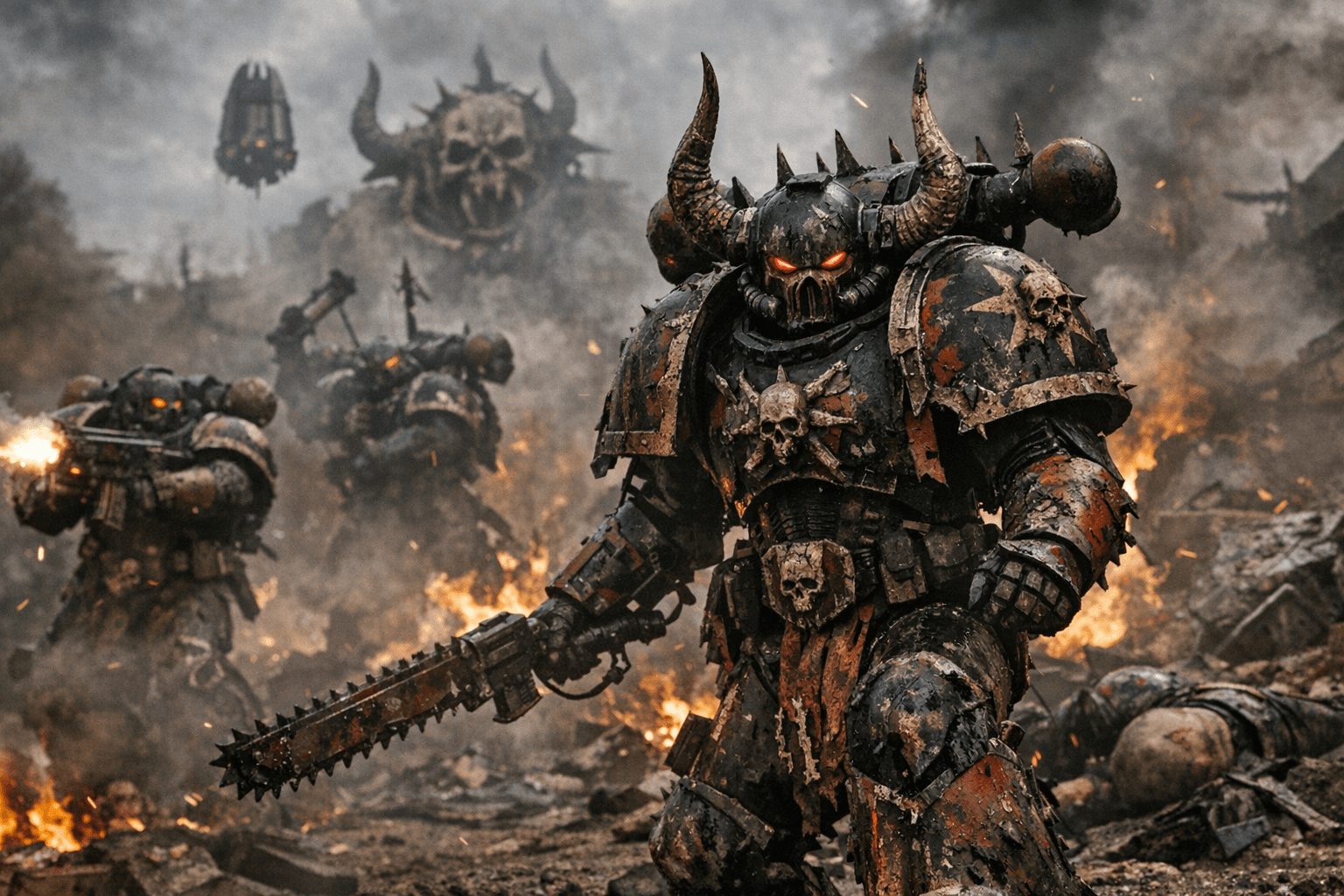
Games Workshop describes Chaos Space Marines as marching to war with “baroque power armour bedecked in macabre trophies and infernal iconography,” and that is exactly the point. This army sits in a visual space that loyalists can never reach: corrupted plate, warped trim, trophy racks, daemonic mutations, and relics that look half-sacred and half-cursed. On the tabletop, they fight alongside battle tanks, Daemon Engines, cultist thralls, possessed warriors, Chaos-tainted artefacts, and warp sorcery, which gives you a huge amount of visual variety inside one faction.
That variety is one of the biggest practical advantages of starting here. You can lean into heavily armoured infantry, grotesque monsters, grimy machine cult, or a more disciplined raiding force under a warlord like Abaddon the Despoiler and the Black Legion. If you like armies that reward weathering, conversion work, trophy bits, and messy layering of colours and textures, Chaos Space Marines are far more forgiving than a pristine loyalist force.
Why this faction is a smart first Chaos choice
If your real goal is to pick your first traitor legion without wasting money, the key question is not “Which Chaos army is coolest?” It is “Which version of Chaos will still excite me after I have built 30 models and painted all the trim?” Chaos Space Marines are a strong answer because the faction supports several hobby moods at once: elite infantry, massed power-armoured bodies, cultist support, daemon engines, and warped centrepieces. That means your collection can grow in different directions without feeling like you boxed yourself in.
The Black Legion is the easiest public face of that choice. It gives you a recognizable identity, ties neatly into Abaddon the Despoiler, and makes sense if you want a broad, flexible warband rather than a hyper-specific subtheme. If you are undecided, starting with the Black Legion look is a practical move because it keeps your options open while still looking instantly like Chaos Space Marines.
What the current codex gives you
The current 10th-edition Codex: Chaos Space Marines is a 160-page book, and it comes with the kind of depth that makes the faction feel worth building around. It includes Combat Patrol and Crusade rules, 48 datasheets, and eight Detachments, which is a strong spread for list-building. That matters if you want to experiment instead of locking into one narrow build from day one.
Those eight Detachments are especially useful because they let the army flex around different playstyles without forcing you to start over. If you like the idea of a collection that can evolve from a compact starter force into a more specialised warband, Chaos Space Marines are well supported. The codex also makes the army feel current inside the 10th-edition ecosystem, rather than like a faction that only survives on nostalgia.
The 2024 launch wave and what to buy first
Games Workshop’s 2024 Chaos Space Marines release did a lot of the work for you, because it refreshed the range with a new Chaos Lord model and a useful starter-style battleforce. The Veterans of the Long War battleforce contains one Chaos Lord, five Chosen, 10 Legionaries, 10 Chaos Terminators, and five Possessed. That is not random filler. It is a concentrated bundle of the unit types that define the faction’s look and battlefield role.
It also includes five Chaos Space Marine transfer sheets with 364 decals each, which is a quiet but important detail if you care about marking armour properly. Chaos armies look better when they look claimed, not just painted. If you are building from scratch, this kind of set gives you a strong core without forcing you to buy a dozen separate boxes just to reach a usable army shape.
The Chaos Space Marines datasheet cards set is another practical purchase if you like having rules at hand during games. It includes 48 datasheet cards plus cards for Combat Patrol and the army rule. If you are the kind of player who wants to move between casual games, learning games, and early list tweaking without constantly flipping through a codex, that convenience is real.
Painting Chaos without hating your life
Chaos Space Marines reward painters who enjoy controlled ugliness. The army lets you combine corrupted armour, daemonic details, rough finishes, and weathering in a way that can look dramatic even when the model is not technically perfect. That is a gift if you want your first faction to feel characterful, not sterile.
Games Workshop’s own painting guidance points beginners toward a dark Black Legion look for a Combat Patrol, and that is a sensible starting point. Black armour gives you an immediate, legible force on the table, and it also lets brass trim, bone trophies, red lenses, and daemon effects pop without fighting the base coat. It is a much safer first step than trying to invent a custom scheme before you have even learned how Chaos trim behaves under a brush.
- Start with Black Legion colours if you want maximum flexibility.
- Add obvious unit marking through transfers, trophies, or shoulder-pad accents.
- Save the most elaborate conversion work for characters, Possessed, and Daemon Engines.
- Use weathering to hide rough transitions, not to excuse sloppy planning.
A practical approach looks like this:
The faction’s real selling point
Chaos Space Marines work because they sit at the intersection of lore, hobby, and playability. You get the emotional weight of the Horus Heresy, the visual freedom of corrupted super-soldiers, and a rules package that supports multiple ways to build. The army is large enough to stay interesting, but focused enough that your first purchases still feel coherent.
If you want a faction that looks like it has lived through ten millennia of betrayal, siege warfare, and warp corruption, this is the one. Start with the Black Legion look, lean on the current codex, and build toward the style of warband that matches how you actually like to hobby. That is the smartest way to begin the Long War.
This article was produced by Prism’s automated news system from verified source data, official records, and press releases, then run through automated quality and moderation checks before publishing. The system is built and supervised by the people who set the standards it runs under. Read our full AI policy.
Did this article answer your question?