Ruleshammer explains Warhammer 40k 11th edition charge phase rules
The charge phase now decides more than distance. In 11th edition, the roll, target choice, and 12-inch declaration window are where games swing before combat starts.
An assault army that misses its charge in 11th edition Warhammer 40,000 can be stranded in the open. A unit either gets where it needs to be, or it doesn’t, and that single moment can flip objective control, blunt a shooting castle, or leave an assault army stranded in the open.
Why the charge phase matters now
In 11th edition, Games Workshop has tightened the language around movement and combat, and the charge phase is now one of the clearest examples of how those changes play on the table. The new core rules were released for free on 1 June 2026 with a focus on clear rules language and referencing.
A successful charge is no longer just a distance check, it is the bridge between maneuver and damage, between a unit that threatens a point and a unit that actually clears it. For melee armies, that bridge is everything. For shooting armies, the charge phase is often the last safe window to keep a key threat outside the danger zone.
The big 11th edition changes that alter how you charge
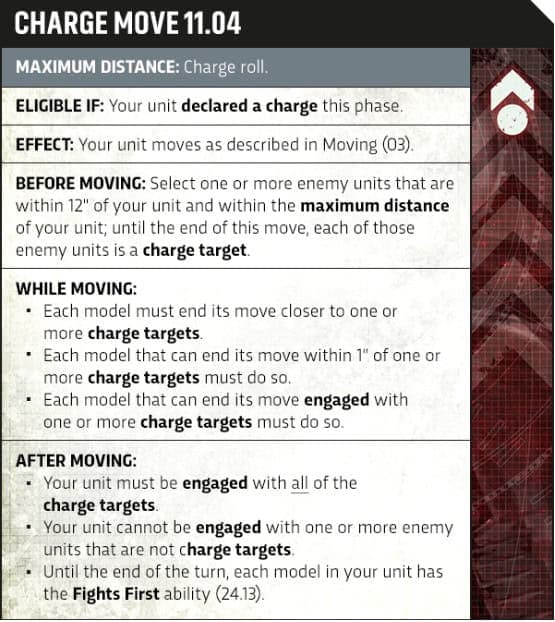
The combat preview from 15 April 2026 set out the biggest changes. Engagement range is now 2 inches instead of 1 inch, which changes how close models need to be before they can start interacting in combat. You now pick the targets of your charge after you roll, which makes the charge roll itself part of the tactical decision, not just the delivery mechanism.
A charge can be declared if at least one enemy unit is within 12 inches. In practice, that gives a wider decision space than the old “hope I made the angle” mindset some players still carry over from earlier editions. The rules are designed to make the declaration step cleaner, but they also punish sloppy assumptions about what can be reached once the dice are down.
Deep Strike-style ingress follows the same logic. Those units now set up more than 8 inches away from enemy models instead of 9 inches away, which preserves the familiar 9-inch charge math while giving more flexibility in landing zones. That is a subtle change with a real table impact, because it changes how aggressively you can stage reserves and still expect a reasonable follow-up charge.
The mistakes players make before the dice matter
The biggest charge-phase error is treating the roll as the whole problem. It isn’t. The real mistake happens earlier, when players fail to think through whether the target is actually worth declaring, whether another unit is the better pressure point, or whether the charge is being used to pin a unit, tag an objective holder, or force a bad activation order.
The second mistake is forgetting that target selection now happens after the roll. That means players need to think in terms of charge lanes, fallback options, and casualty placement before they ever pick up the dice. If you have two possible targets within reach, the old habit of declaring the “best” target first can lead you into a dead end, because the actual choice comes after the roll tells you what is possible.

The third mistake is underestimating the 2-inch engagement range. A larger engagement band makes contact easier in some situations, but it also changes pile-in geometry, model spacing, and the way you trap or screen a unit off an objective. A unit that barely thought it was safe at 1 inch can now be within the fight sooner, and that can swing activation order or expose a character you thought was screened out.
- If you are staging a charge to take an objective, count the actual models that can reach the point after contact, not just the ones that can make the roll.
- If you are trying to avoid melee, build your spacing around the full 2-inch engagement range, not the old 1-inch assumption.
- If you are making a reserve or Deep Strike play, remember that the landing zone changed to more than 8 inches away, which changes how often a follow-up charge is realistic.
Why Ruleshammer is the right tool for this edition
This is the kind of rules interaction that is clear on paper but still easy to misplay under time pressure. That is especially true in 11th edition, where the rollout has been dense with new terminology, revised mission structure, and a lot of movement and combat interactions that reward careful sequencing.
Games Workshop’s downloads page shows the pace of the current rules cycle: a Core Rules update dated 1 June 2026, faction-pack updates dated 8 to 11 June 2026, and a Munitorum Field Manual update dated 17 June 2026. The FAQs and errata incorporate feedback from the Warhammer community, the playtesters, and the studio design team. That is a live rules environment, not a set-and-forget document.
In 2023, Games Workshop called 10th edition a complete revision of the game from the ground up, and the late-2024 core-rules commentary document included clarifications that referenced charge rolls and other key game rolls.
What swings games at the table
The charge phase is where all of this becomes concrete. A successful roll can turn a midfield objective from contested to owned, force a shooting unit to spend its next turn fighting instead of firing, or open a lane for a melee unit to activate exactly when it needs to. A failed charge can leave the same unit exposed, out of position, and forced to absorb the counterpunch.
This article was produced by Prism’s automated news system from verified source data, official records, and press releases, then run through automated quality and moderation checks before publishing. The system is built and supervised by the people who set the standards it runs under. Read our full AI policy.
Know something we missed? Have a correction or additional information?
Submit a Tip