Warhammer 40k Battle Ready explained, the easiest path to painted armies
Battle Ready is the quickest honest finish for a 40k army: painted main areas, a simple base, and a standard that gets models onto the table fast.

Battle Ready is the shortest honest path from gray plastic to a force that looks finished on the table. Games Workshop defines it as a model that is ready to game with, with the main areas coloured and a simple finish on the base, and it uses that standard as the minimum for Warhammer World events so tables are full of painted armies.
What Battle Ready actually means
The useful thing about Battle Ready is that it is not a display cabinet standard pretending to be a gateway requirement. It is an achievable, widely recognised finish that says yes to getting your army on the table, yes to accessibility, and yes to more games with painted models. That matters if you are trying to finish a 40k force without falling into the trap of chasing one more highlight pass on every shoulder pad.
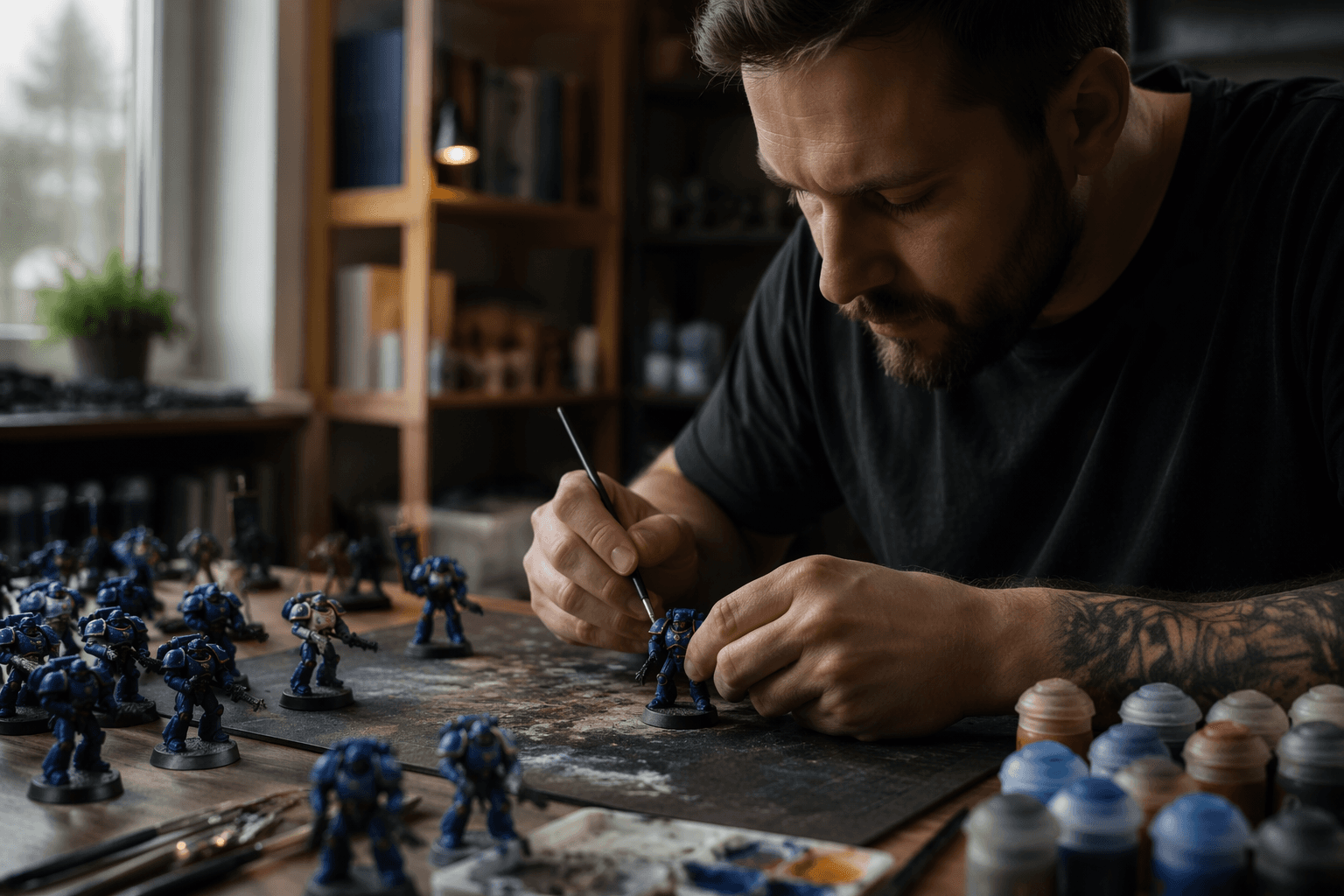
In practical terms, Battle Ready is the point where your models stop reading as work in progress. The standard applies to a squad, an army, a Legion, a Warband, a Kill Team, or even a Blood Bowl squad, so it is built for real hobby use, not just for one flagship army project that may never get over the line. If you want a target that is strict enough to matter and forgiving enough to finish, this is it.
The classic route: Base, Shade, Technical
The classic Battle Ready method uses Base paints to block in the main colours, Shade paints to add definition, and Technical paints to finish the base. Base paints are the fast, high-pigment step that gets the broad colour on the model, while Shade paints do the dirty work in the recesses and panel lines. That combination is the workhorse approach if you want a solid tabletop result without learning a more complicated workflow first.
The Shade range has been reformulated to flow better into the recesses of miniatures, which makes the classic route faster and cleaner than older wash-heavy methods. In other words, the standard is not asking you to paint more slowly in order to look respectable. It is designed so a basic, disciplined sequence still produces a result that reads as fully painted from gaming distance.
If you are the sort of painter who likes a little more control than Contrast gives you, this is the route that leaves room for it. You can treat it as the minimum effective result and stop there, or you can build on top of it later with edge highlights and detail work once the whole army is already playable. The big win is that the model is doing its job long before you decide whether it deserves extra polish.

The Contrast route is the real shortcut
The streamlined Battle Ready route uses Contrast paints plus Technical paints. Games Workshop says to start with an undercoat of Wraithbone, Grey Seer, or White Scar, then apply one coat of Contrast per colour on the miniature. That is the fast lane for anyone who wants to turn a pile of new kits into a coherent force without spending days doing separate basecoat, layer, and shade passes.
The selling point is consistency. Contrast paints are designed to go on straight from the pot and give reliable results in a fraction of the time, and the range includes 25 new colours, which means there is enough variety to cover a huge spread of army themes. That matters whether you are painting a dark Iron Warriors force, a bright Aeldari scheme, or something stranger for a Warband or Kill Team.
The pitfall is easy to spot: if you choose the Contrast route, respect the undercoat and keep the application clean. The whole method is built around one coat per colour over a light primer, not endless reworking and fussing over every area. Used properly, it gets you a force that looks intentional fast; used badly, it just becomes another half-finished pile of shame with a nicer base coat.
Where to spend time for maximum payoff
If you only have energy for one place to improve the finish, put it into the base. Games Workshop explicitly calls out Technical paints like Stirland Mud or Astrogranite for making the miniature look like it is standing on a battlefield, and that is the difference between “painted model” and “finished miniature.” A clean, consistent base does more for the overall read of an army than obsessing over tiny details no one will notice across the table.
That is why Battle Ready is such a useful standard for 40k. It tells you where the line actually is: main colours on the model, a simple battlefield base, and enough definition that the army looks deliberate when you set it out for a game. Once you have that, you are not cutting corners. You are getting the force to the point where it earns table time, which is exactly the job Battle Ready was meant to do.
This article was produced by Prism’s automated news system from verified source data, official records, and press releases, then run through automated quality and moderation checks before publishing. The system is built and supervised by the people who set the standards it runs under. Read our full AI policy.
Did this article answer your question?