Lost Delta Air Filter Remote Leaves Woodturner Seeking Replacement
A dead remote can park a perfectly good Delta air cleaner, but the 50-868 still has realistic rescue paths if you know what still exists and what does not.
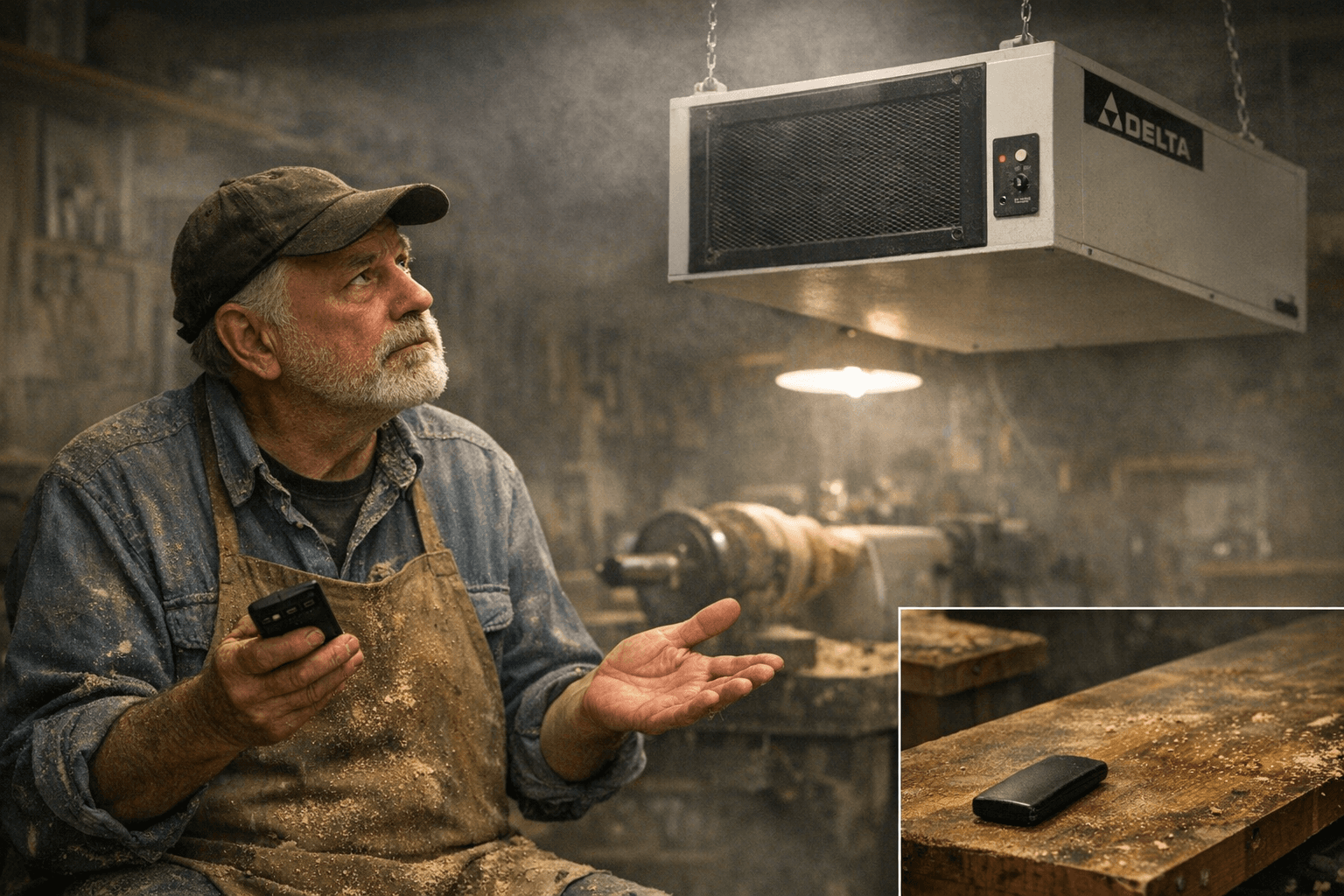
When one dead remote sidelines a good air cleaner
A lot of shop gear dies the dumbest possible death: not by burning up a motor or cracking a housing, but by losing a tiny accessory that keeps the whole machine usable. Jeff Walters’ Delta 50-868 air filter is exactly that kind of problem. The unit still has life in it, but with the remote gone and Delta no longer supporting that part, it has become awkward enough that he is asking the right question: do you hunt for a used original, try a universal remote, or build a workaround that gets the air cleaner back in daily rotation?
That matters in a woodturning shop more than people outside the craft usually understand. Fine dust from sanding bowls, spindle work, and end-grain cuts hangs in the air long after the chips are swept up. If an air cleaner is meant to be a set-and-forget safety net, a dead remote can turn it into a machine you stop bothering to use, and that is exactly how good dust-management gear gets sidelined.
What the Delta 50-868 was built to do
The Delta 50-868 was never an afterthought unit with remote control bolted on later. Its instruction manual includes a dedicated “Using the Remote Control” section, which tells you remote operation was part of the design from the start. The same manual warns that dust from certain woods and wood products can be hazardous to your health, and it says the machine is intended only for dry airborne dust in non-explosive, non-metallic atmospheres.
That last part matters. This is not a general-purpose shop gadget. It is a dust-control machine built for a specific environment, and it is sized with a specific room in mind. The manual says the air cleaner will filter a 20 x 20 x 8 foot room 13, 16, or 18 times an hour depending on the setting. In other words, the 50-868 is supposed to be doing real work, not sitting on the wall looking important while the remote gathers dust in a drawer.
The part that disappeared, and the parts that did not
The obsolescence problem is very specific here. A current parts listing shows the Delta 50-868 remote, part number 410091600001, as no longer available. The same listing still shows the control panel as a separate part, number 410093310006, and that panel is still listed as in stock. That tells you the machine is not a total orphan, but the accessory chain is broken in exactly the place that makes the unit convenient to live with.
At the same time, not everything around the unit has vanished. Delta still sells replacement filters for the 50-868, including the 50-858 pleated outer pre-filter and the 50-859 inner filter. The 50-858 is listed as a 5-micron pre-filter, while the inner filter is listed as 1 micron. Aftermarket suppliers also still list compatibility with the Delta AP200, 50-860, 50-868, and 50-875 air cleaners. That is the useful clue: the core machine still has a service life, even if one small control piece has fallen off the map.
The most realistic replacement paths
If you are trying to get a 50-868 back into use, start with the least glamorous answer: a used original remote. That is often the cleanest fix when a manufacturer has stopped making the accessory, because it preserves the original control scheme and avoids compatibility guesswork. The downside is obvious, old remotes surface unpredictably, and there is no guarantee the one you find will be any healthier than the one that died in your hand.
A universal remote is the next idea people reach for, but it only makes sense if the underlying control system will accept it. The first question is whether your unit is infrared or radio-based, because that decides whether a generic remote has any real chance of working. If the system depends on a specific code set or receiver pairing, the odds get worse fast. If the remote communicates through a proprietary receiver, then a universal remote may be more trouble than it is worth.
A bypass or retrofit can be smarter than chasing the exact remote forever. Some owners look at a wall switch, a direct control solution, or a replacement control panel if the existing panel and wiring allow it. The eReplacementParts listing is useful here because it confirms the control panel is sold as a separate part even though the remote is gone. That does not guarantee a simple swap, but it does tell you the machine’s control side is not necessarily one sealed, irreparable assembly.
If you are evaluating a retrofit, treat it like any other shop-machine modification: ask what powers the unit, what its control path expects, and whether a replacement switch would preserve safe, convenient operation. A fix that technically works but makes you avoid the machine is not a real fix in a dust-heavy shop.
Why this problem feels familiar to woodturners
This is not just a Delta story. It is what happens when a machine outlives the small electronics around it. Grizzly’s current dust-collector support documentation shows the modern version of the same world: its remotes use a 12V A27 battery, operate by radio frequency, and have up to 60 feet of range. It also notes that some older two-button remotes have been discontinued and that newer remotes may require a receiver upgrade.
That is the pattern in plain sight. The machine body survives, the filters still exist, and the accessory ecosystem shifts underneath it. For a turner, that means the smartest maintenance habit is not only keeping belts, filters, and motors healthy, but also understanding how the control side ages. A dead remote on an air cleaner is not a minor annoyance when the machine is there specifically to keep sanding dust out of your lungs.
When replacement makes more sense
There is a point where you stop rescuing the accessory and start judging the whole setup. If you cannot source a usable remote, if the control panel path is awkward or expensive, and if a retrofit would be messy enough that you would leave the air cleaner off most days anyway, replacement starts to look practical. That is especially true if the unit’s airflow no longer suits the shop layout or you are already leaning on aftermarket filters and workarounds to keep it alive.
But if the 50-868 still moves air properly, the filters are still available, and the only thing standing between you and daily use is the remote, the smarter move is usually to solve the control path first. A discontinued accessory should not be the thing that ends the useful life of a solid dust-management machine. In a woodturning shop, the gear that wins is the gear you actually keep running.
This article was produced by Prism’s automated news system from verified source data, official records, and press releases, then run through automated quality and moderation checks before publishing. The system is built and supervised by the people who set the standards it runs under. Read our full AI policy.
Did this article answer your question?