San Diego Woodturners preview resin casting demo and club service work
San Diego Woodturners is juggling a resin-casting demo, a natural-edge challenge, and fair production, all while feeding bowls, pens, and Torrey Pines work into TAV.

A packed month, with three different jobs for the lathe
San Diego Woodturners is doing what strong clubs do best: turning one month into three separate opportunities to make better work. The May newsletter puts Don Owen’s resin-casting demo at the center, throws down a natural-edge challenge for the Instant Gallery, and keeps the club’s fair and service obligations in plain view.
President Larry Szafraniec frames the month as a reset point, a time to rejuvenate, reassess, and move forward. That is more than clubhouse filler. It matches the practical shape of the newsletter, which is part demo calendar, part production reminder, and part inventory check on the pieces that keep the club’s outreach and fundraising machine running.
Don Owen’s resin demo is the technical anchor
The featured event is Don Owen’s resin-casting and turning session, listed for May 16, 2026, from 8:30 a.m. to 12:00 p.m. at the Nottingham Center for the Arts in San Marcos. The business meeting starts at 9 a.m., and the demo follows at 9:30 a.m., which makes this a standard club morning with enough structure to catch both the discussion and the hands-on material.
That matters because resin casting is one of those topics that separates casual curiosity from real shop utility. If you already turn bowls, hollow forms, or accent pieces, resin opens a second material vocabulary. It lets you stabilize visual problems, add color, and combine cast material with traditional turning in a way that can be either stylish or disastrous, depending on how careful you are with the blank, the tooling, and the finish.
The club describes the session as a must-see for members who want to combine cast material with lathe work, and that is exactly the right framing. Resin turning rewards patience and punishes assumptions, so a demo that gets into the practical side of the process is worth the morning.
The April bowl demo still shapes the conversation
The April meeting gives the newsletter some continuity, and it is not just a placeholder recap. Szafraniec notes that Ernesto delivered a bowl-making demo, and the April newsletter identified the piece as Ernesto Aquino’s ogee bowl. That earlier issue also explained the profile itself, describing an ogee as an S-shaped curve formed by concave and convex lines.
That detail matters because it shows the club is not chasing spectacle for its own sake. An ogee bowl is a design lesson as much as a form lesson, and it sits in the same lane as resin casting in a useful way: both push turners to think about shape, line, and finish, not just spindle speed and sharp edges. If the resin demo is about material experimentation, the ogee bowl was about clean architecture at the rim and wall.
Put another way, April handled the form, and May is handling the material. That is a pretty smart programming sequence.
Natural-edge work gives members a low-risk challenge
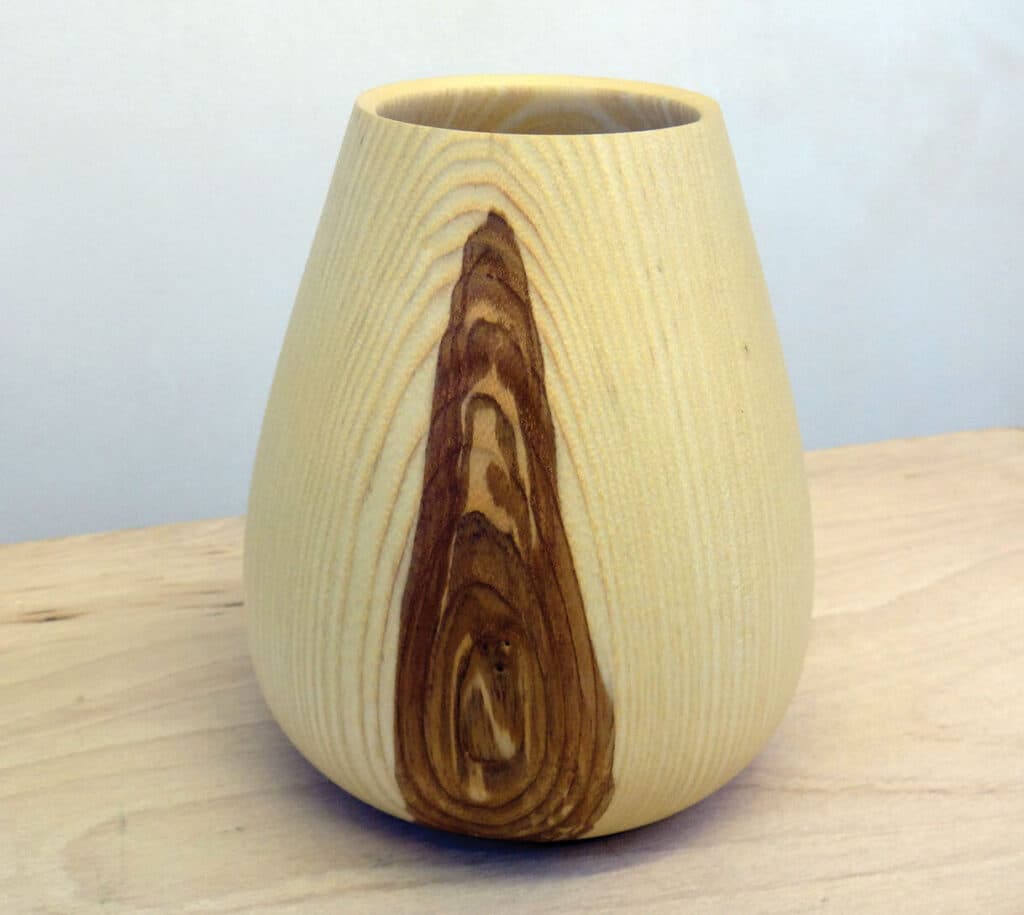
Alongside the demo, the newsletter sets a natural-edge challenge and invites members to bring those pieces to the Instant Gallery. That is the kind of prompt that tends to pull people back into the shop fast, because natural-edge turning sits right on the line between control and surprise. The wood tells you what it wants to keep, and the turner has to leave enough of it intact to make the edge work.
The club’s decision to make natural-edge the challenge of the month is clever because it is both approachable and unforgiving. Anyone can rough a blank and try for an edge, but getting a natural edge to look intentional rather than accidental takes better timing, better sanding, and a cleaner eye for where the bark, sapwood, and wall thickness meet. The Instant Gallery turn-in gives that work a public setting instead of letting it stay buried in the shop.
For members, that means one practical thing: this is a good month to finish something that already has a live edge, a rim with bark, or a form that can carry an edge without looking clumsy. The challenge is less about winning and more about showing a piece that proves you can make a natural feature look designed.
Fair prep is the club’s most urgent production deadline
If the resin demo is the shiny part of the month, the fair is the hard stop. San Diego Woodturners says its Del Mar Fair booth is the club’s biggest event, held each June through July 4 in the Design in Wood Exhibit Building, and it takes 160 volunteer shifts to cover. The club also says members produce more than 3,000 tops and about 400 pens for the booth.
That is a production line, not a casual display. Tops and pens are exactly the kind of items that disappear fast at a fair booth, and they are also the kind of pieces that turners can make efficiently when the club needs volume more than one-off artistic flourishes. The newsletter’s reminder that the club still needs turned tops is the sort of sentence that should send people straight back to the bench.
- Fair pieces need repetition and consistency.
- Tops should be quick, durable, and cleanly finished.
- Pens need to hold up under constant handling and sales-table wear.
- Volunteer shifts matter as much as inventory, because the booth does not run itself.
The practical takeaway is simple:
That mix of labor and output is what makes the fair such a central part of the club’s calendar. It is not just a place to show off woodturning. It is where the club proves it can meet a deadline.
TAV keeps the club’s shop work tied to service
The newsletter also circles back to Turn Around for Veterans, and that thread is a big part of why San Diego Woodturners feels more like an operating organization than a social club with a lathe problem. TAV began in 2012 after member Tom Lightner read about beetle-damaged Torrey Pines being removed and contacted forest manager Darren Smith to ask permission to gather the wood.
That wood now becomes bowls, pens, and small Torrey Pine Christmas trees for the gift shop, and sales support TAV. The club says the items sold out at the Earth Day event at Torrey Pines, which is a good sign for demand and a bad sign for anyone hoping the gift-shop stock will last on its own. The newsletter says the club still needs help producing those items, because the proceeds support both TAV and the club itself.
The service side is not incidental. TAV operates at Naval Medical Center San Diego, the Wounded Warrior Battalion at Camp Pendleton, and the VA Aspire Residential Rehabilitation Treatment Program in San Diego. That reach explains why the club’s work products have to stay steady. A bowl or pen is not just a sale item here; it is part of a sustained relationship with service members and veterans.
A club built to do the work, not just talk about it
San Diego Woodturners says it was founded in 1987 by eight woodturners and now has about 250 members, all working through unpaid volunteer labor. That background makes the May newsletter read less like a routine bulletin and more like a snapshot of how the club actually survives: by pairing teaching, production, and outreach in one monthly rhythm.
The club’s 2025 American Association of Woodturners Community Impact Award fits that picture. So does the way the newsletter bundles resin casting, ogee bowl memory, natural-edge challenge work, Torrey Pines gift-shop stock, and fair prep into the same issue. It is a club that knows exactly what needs making next, and exactly why it matters.
That is the real story behind the packed month. The resin demo feeds curiosity, the natural-edge challenge pushes design, and the fair and TAV work keep everyone honest about what has to leave the shop next.
This article was produced by Prism’s automated news system from verified source data, official records, and press releases, then run through automated quality and moderation checks before publishing. The system is built and supervised by the people who set the standards it runs under. Read our full AI policy.
Did this article answer your question?