Woodturners Share Simple Joinery Tips for Stacked Wood Finials
A tiny forum question surfaced a sturdy way to build stacked finials: let the center piece become the anchor, then fit the top and bottom into it with real mechanical support.
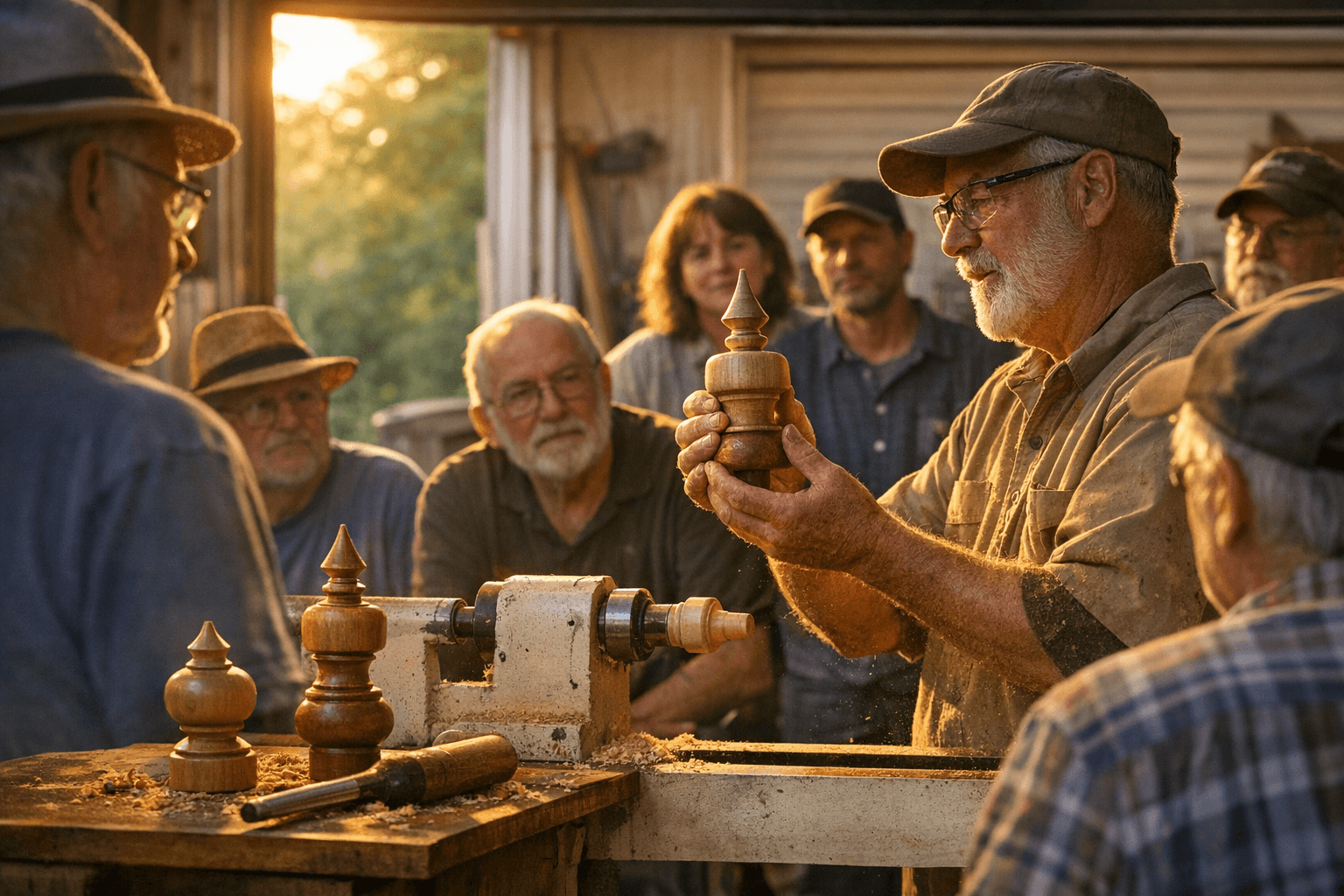
The small joint that keeps a finial from failing
The question was narrow, but the shop value was huge: when you stack wood finials, do you simply glue end grain to end grain, or do you reinforce the assembly with a dowel or a metal rod? That is the kind of problem every turner runs into sooner or later, because a finial has to look feather-light while still surviving handling, shipping, and display.
The practical answer from the thread is almost elegant in its simplicity. Drill a hole through the bulbous center element, then turn tenons on the upper and lower pieces so they fit into that opening and glue together cleanly. In other words, the center section becomes the anchor, and the two outside sections are shaped to lock into it. The result looks like one continuous form, but the hidden joint carries much more confidence than a plain butt joint.
Build the finial around an anchor, not a guess
That center-first method matters because it keeps the parts aligned as much as it strengthens them. A stacked finial is usually read by the eye as one flowing silhouette, whether it tops a lidded box, a vessel, an ornament, or a sculptural spindle. By letting the middle section control the fit, you preserve that symmetry while giving the glue something better to work with than a flat end-grain face.
The method also fits the way many finials are actually made. You may turn three separate components that are later assembled into one delicate-looking top. The center piece does the quiet structural work, while the upper and lower sections are turned to match it cleanly. That is the kind of hidden engineering that makes ornamental turning hold together over time.
A simple way to think about it at the lathe:
- Make the middle element the structural core.
- Bore or drill the center piece so the adjoining parts have a positive location.
- Turn matching tenons on the top and bottom pieces.
- Dry fit before glue-up so the stack reads as one continuous shape.
- Use the glue-up to lock in alignment, not to solve a bad fit.
That approach is especially useful when the finial is thin, tall, or likely to be handled repeatedly. The less bulk you have up top, the more important it becomes to let the joinery do some of the work.
Why the grain matters as much as the shape
The larger lesson is that finials are not just decorative, they are structural puzzles in miniature. AAW’s educational material makes the grain issue plain: grain orientation greatly affects glue-joint strength, sidegrain-to-sidegrain joints are generally the strongest, and endgrain is more absorbent than sidegrain. That is exactly why a pure end-grain butt joint is the least satisfying option when the part is slender and exposed.
That does not mean end grain can never be joined. It means you want more than hope holding the stack together. A drilled center section and fitted tenons give the assembly a mechanical relationship, which is far more reassuring when the piece is going to be touched, packed, transported, or displayed in a busy room.
The design logic is useful beyond finials too. The same thinking applies when you are building ornaments, small boxes, or spindle details where the visible line must stay clean but the hidden structure has to work hard. If the joint is doing its job, the eye can stay on the profile instead of the repair.
Why this thread landed so quickly with turners
The exchange drew multiple replies within days, and that speed tells you something important about how turners use forums. This is not just idle discussion. It is the fast circulation of a shop-tested method that can save someone from rebuilding a fragile top section after a split, a loosened glue line, or a bad fit.
That kind of public problem-solving has a strong home in the American Association of Woodturners. The organization says it has more than 360 chapters worldwide, which helps explain why a small question can get practical attention so quickly. It also points to a broader learning culture, one that includes the annual International Symposium, scheduled for June 4-7 in Raleigh, North Carolina, and a long-running journal, American Woodturner, which has been published bimonthly since 1986 and still carries an archive reaching back to its first year.
Finials show up repeatedly in that ecosystem for a reason. AAW project material includes finial-driven work in ornament and clock projects, which reinforces that this is not a niche trick reserved for one style of turning. It is a repeatable construction problem with many uses. And if you know the names that travel through the AAW conversation, from Mike Peace to Chris Lawrence, Joe Larese, and Don McIvor, you know the culture values exactly this kind of clear, useful, shop-floor advice.
The takeaway is straightforward: when a stacked finial needs to survive real use, build it like a tiny structural assembly, not a fragile stack of ends. Let the center piece act as the anchor, fit the upper and lower parts into it, and use the grain to your advantage. That is how a finial keeps its grace without giving up its strength.
This article was produced by Prism’s automated news system from verified source data, official records, and press releases, then run through automated quality and moderation checks before publishing. The system is built and supervised by the people who set the standards it runs under. Read our full AI policy.
Did this article answer your question?