Students with special needs learn workplace skills at Fearvana Yoga
A towel routine at Fearvana Yoga is doubling as job training, giving David Brearley students hands-on practice in customer service, workflow, and workplace confidence.

A towel job with real workplace value
At Fearvana Yoga in Kenilworth, a weekly towel run is doing far more than keeping class on schedule. For freshmen in David Brearley High School’s LLD program, the task opens a direct path into customer service, workflow, and the rhythm of a real business.
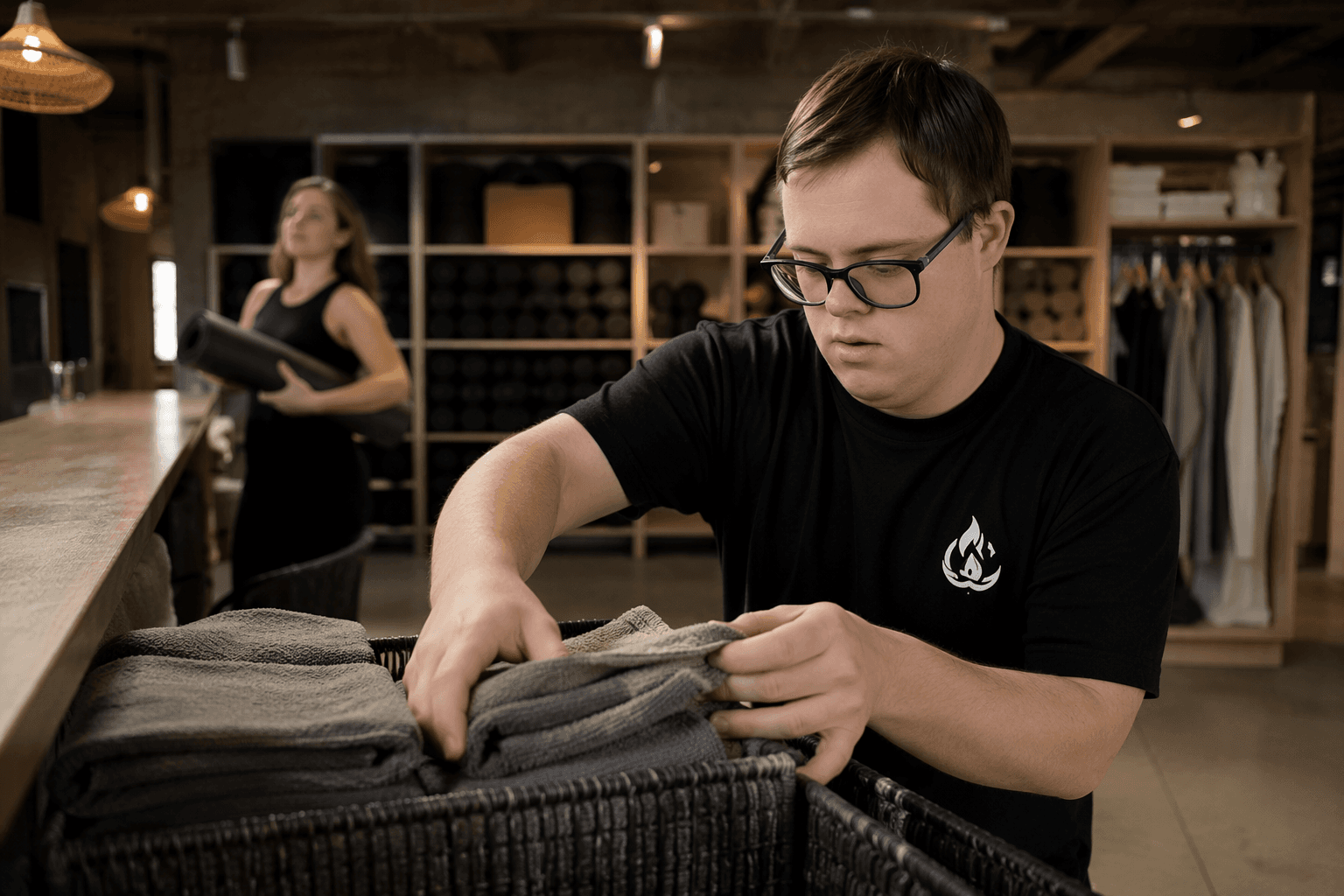
The partnership links a special-education program built around life skills with a yoga studio that depends on reliable daily support. Students are handling towel pickup, folding, and delivery, and they recently visited the studio for hands-on training so they could learn how to fold towels correctly and understand how studio operations actually move.
How the school frames transition training
This fits squarely within the way Kenilworth Public Schools describes David Brearley. The district calls the school a small, nurturing environment focused on academic, social, and emotional growth, and its special-education materials place transition classes in the center of that mission. Those classes are described as career exploration and independent-living preparation, with practical work that includes cleaning, cooking, and budgeting.
The LLD program itself serves students with special needs from elementary school through high school, and it is built around support, life skills, and preparation for adult independence. That makes the Fearvana arrangement feel less like an add-on and more like a natural extension of the school’s stated goals: learning how to show up, follow through, and take responsibility for a task that matters to someone outside the classroom.
The wider New Jersey transition framework reinforces the same idea. State guidance says students with disabilities should be prepared for further education, employment, and independent living, and the NJ Transition Toolkit is designed to help students and families prepare for successful adult life after high school. New Jersey’s Division of Vocational Rehabilitation Services also offers pre-employment transition services starting at age 14 and continuing to age 21, which gives partnerships like this one a broader context. The state’s Pathways to Postsecondary Success initiative pushes in the same direction, aiming to expand access to transition services and competitive integrated employment for youth with disabilities.
Why a yoga studio makes sense as a training site
Fearvana Yoga is a strong fit for that kind of work-based learning because the studio already runs on routines that are easy to see, measure, and repeat. The studio has been part of Kenilworth for more than a decade, celebrating 11 years in town in 2025 after previously marking nine years at a ribbon-cutting when it opened a new location.
It also offers a mix of non-heated and infrared-heated classes, which gives it a wide cross-section of students and a steady operational pace. That matters for training. A student helping with towels is not practicing an abstract office exercise. They are helping a business that needs supplies moved, sorted, and reset on a schedule so classes can keep flowing.
The towel work also connects directly to the client experience. Fearvana uses several loads of towels each week, and the studio offers warm lavender and tea tree towels during savasana, along with cold damp towels in hot yoga classes. That means the students are contributing to something clients notice immediately, the kind of small service detail that shapes whether a studio feels cared for and professional.
What students learn from a simple task
The power of the partnership is that the task looks simple but teaches layered skills. Folding towels is one lesson. Understanding how many towels a studio uses in a week is another. Learning when towels are delivered, where they go, and how they support different class formats gives students a view into workflow, sequencing, and accountability.
There is also a workplace culture lesson built into the routine. A studio is a service environment, and the towel station is one of the places where reliability shows up in public. When students help with pickup, folding, and delivery, they are practicing the kind of dependability that employers look for, while also seeing how a yoga business depends on small acts of coordination to create a calm experience for clients.
That kind of exposure matters because it turns transition instruction into something visible. Instead of talking in the abstract about job readiness, the school can point to a real responsibility at a real local business. Instead of rehearsing only in a classroom, students are seeing how a studio opens, resets, and serves people day after day.
A model for yoga businesses that want to do more
Fearvana’s role in this story is bigger than charity or community goodwill. It functions as a case study in how yoga businesses can become training environments for underserved students, especially when the work is tied to authentic operational needs. The studio gains dependable support, and the students gain repeated practice in responsibility, communication, and workplace confidence.
There is also an environmental layer that makes the arrangement even more grounded in the studio’s day-to-day reality. The towel system helps reduce paper waste, so the students’ work supports both reuse and sustainability while meeting a genuine business need. In other words, the partnership is practical in every direction: it supports the studio, it supports the school, and it gives students a place to learn adult habits in a setting that expects them to contribute.
That is what makes the Fearvana collaboration stand out. It is not a symbolic gesture hung on a yoga wall. It is a working system where a towel folded correctly, delivered on time, and used in class becomes part of how students with special needs learn to move toward employment, independence, and confidence in the real world.
Know something we missed? Have a correction or additional information?
Submit a Tip