Yoga may beat exercise for function and mood in chronic back pain
Yoga did not beat exercise on pain scores, but it did show a larger lift in function and mood for people with chronic low back pain.

For people living with chronic low back pain, the striking part of this new review is not that yoga erased pain. It is that, when put head-to-head with active exercise, it looked better for moving more easily and feeling better emotionally.
Tian Li, Quan Wen and Liping Zhang at Gannan Medical University pooled seven randomized controlled trials from India, the United States and Turkey in a systematic review and meta-analysis published in Frontiers in Medicine on April 14, 2026. The team did not choose a soft comparison like a waitlist or usual care. They matched yoga against physiotherapy, stabilization work and home exercise, then searched PubMed, Embase, the Cochrane Library, Web of Science and PEDro through November 23, 2025, following PRISMA 2020 and the Cochrane Handbook and registering the review in PROSPERO.
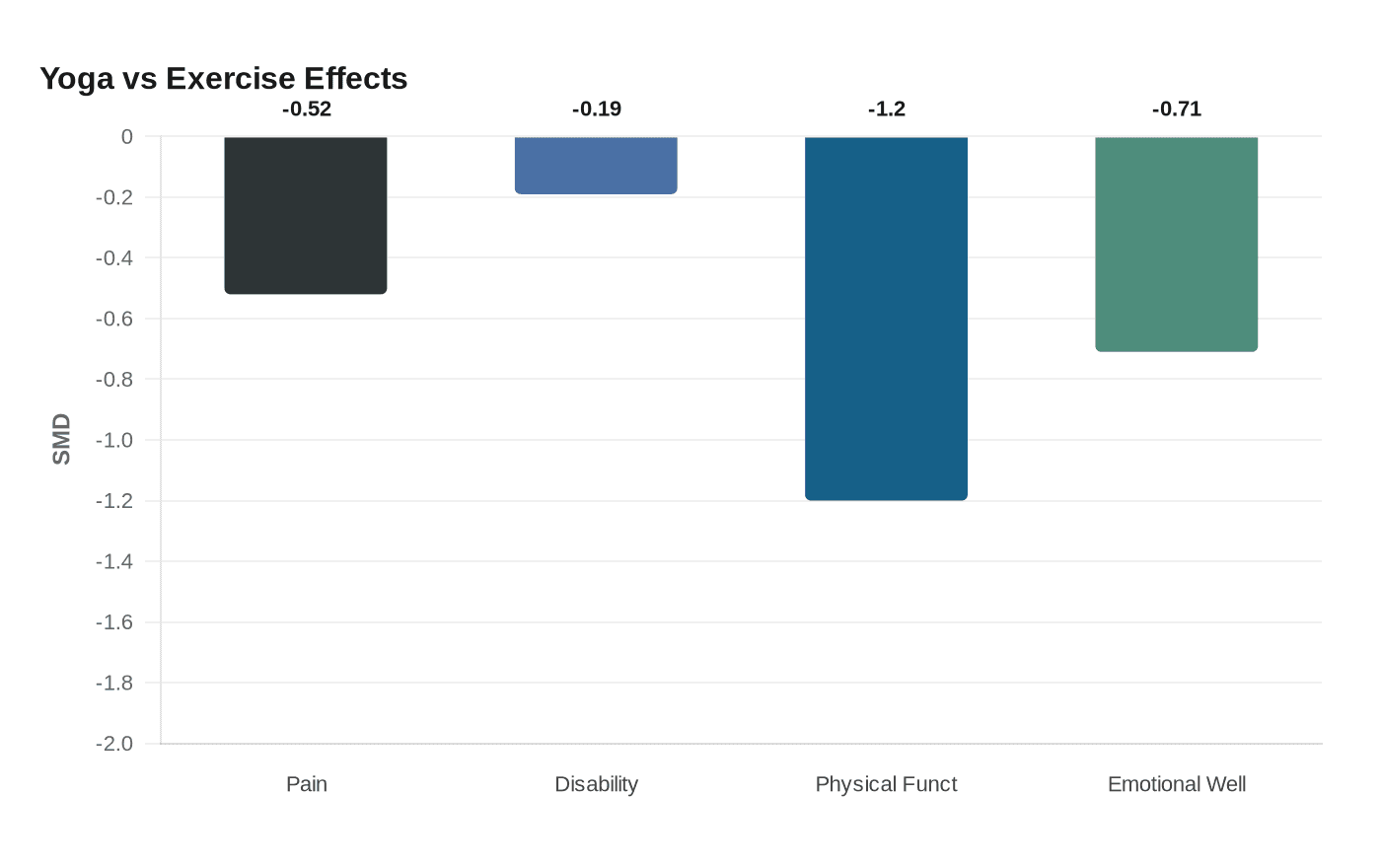
The result was mixed but meaningful. Yoga was not statistically better than exercise for pain intensity, with an effect size of SMD = -0.52 and a wide confidence interval that crossed zero. It also did not clearly outperform exercise on disability, where the pooled estimate was SMD = -0.19. But on physical function, yoga showed a significant benefit, SMD = -1.20, with low heterogeneity at I² = 31 percent, though that finding came from only two studies. Emotional wellbeing also improved, SMD = -0.71, and that signal became more consistent after one influential study was removed, even as heterogeneity remained high.
The styles represented were traditional yoga, Iyengar yoga, integrated yoga and Hatha yoga, with Hatha appearing most often. That matters because this was not a single-school result. It suggests that the broader yoga toolbox, breath, movement, attention and pacing, may be helping people reclaim daily function even when raw pain scores do not move much farther than they do with exercise.
That nuance fits a larger back-pain picture. The World Health Organization says about 619 million people live with low back pain, that it is the leading cause of disability worldwide, and that non-specific low back pain accounts for about 90 percent of cases. The Global Burden of Disease study projects about 843 million cases by 2050. U.S. guidance already places yoga among recommended non-drug options for chronic low back pain, and the National Center for Complementary and Integrative Health says yoga’s effects on pain are similar to exercise.
If you are asking whether to try yoga for a stubborn back, the practical question is not whether it is a pain cure. It is whether the class, clinician or studio can help you work safely toward better function, with modifications for your back, clear pacing, and enough guidance to keep your mood and mobility in the same frame. That is where this review points, and it is why yoga keeps earning a place in the chronic pain conversation.
This article was produced by Prism’s automated news system from verified source data, official records, and press releases, then run through automated quality and moderation checks before publishing. The system is built and supervised by the people who set the standards it runs under. Read our full AI policy.
Know something we missed? Have a correction or additional information?
Submit a Tip