7.50-Carat Emerald Valued at Over $44,000 in Latest Gemval Report
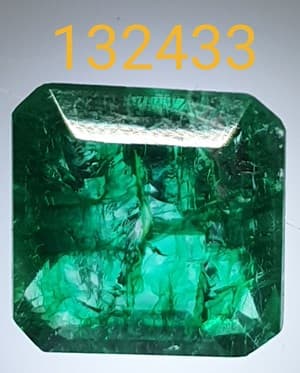
A 7.50-carat emerald with strong medium-dark green color was valued at $44,128 in Gemval report #132433, revealing how sharply origin, treatment, and clarity nuance shift emerald prices.
Cleopatra commandeered the emerald mines near the Red Sea and presented departing monarchs with stones carved with her own likeness as a parting gift. Pliny the Elder asserted that nothing in existence could be greener. When the American National Retail Jewelers Association standardized the modern birthstone list in 1912, emerald's place as May's stone required no deliberation. Cleopatra viewed emeralds as symbols of youth and fertility, and that association had already spent roughly three millennia accumulating the kind of cultural premium that no gemological report can fully quantify.
Gemval report #132433, dated April 4, 2026, attempts to quantify it anyway. The report assigns a retail market estimate of $44,128.35 to a 7.50-carat natural emerald graded with medium-dark green color at strong saturation (color code 088), I1 clarity, excellent cut, and an octagon shape. The implied per-carat figure is approximately $5,884, and that number is where the real conversation begins for anyone buying, selling, or insuring a stone of this size.
To sanity-check $5,884 per carat, origin is the first variable to establish, and it is conspicuously absent from Report #132433. Geographic source is the single largest driver of emerald pricing. Fine Colombian emeralds can command up to $18,000 per carat, while fine Zambian emeralds of similar quality and enhancement trade closer to $6,000 per carat. That spread is enormous at 7.50 carats. An independent laboratory origin determination, from GIA or a comparably accredited body, should be the first document requested before any transaction or insurance appraisal proceeds.
The I1 clarity grade warrants a separate explanation, because it carries different weight in an emerald than it does on a diamond grading report. Unlike diamonds, where 10x magnification sets the standard for clarity grading, emeralds are graded by eye; an emerald with no visible inclusions to the naked eye is effectively considered flawless, a threshold that makes eye-clean stones extraordinarily rare. The trade generally accepts eye-visible inclusions in higher-quality emeralds, and these internal features, called "jardin" (the French word for garden), are the geological signature of an emerald's formation rather than evidence of damage or poor quality. What a grading report must specify is whether those inclusions compromise structural integrity or transparency, because when they do affect transparency, value drops dramatically. The grade alone is never sufficient; the character and placement of the jardin matter as much as the letter assigned to them.
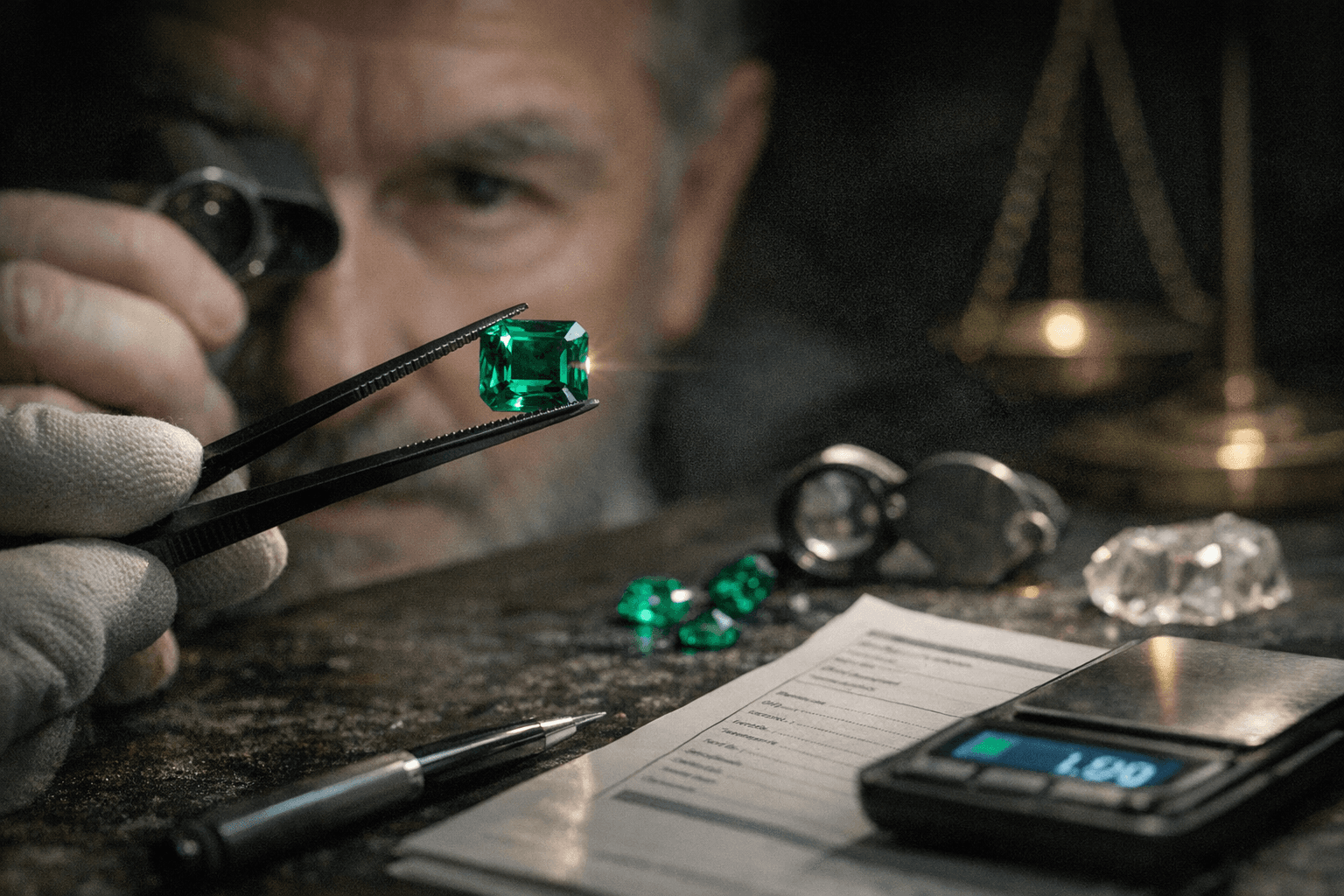
Treatment disclosure is equally non-negotiable. The vast majority of natural emeralds are fracture-filled with oil or resin, a practice so standard the U.S. Federal Trade Commission mandates its disclosure at point of sale. The degree of filling is graded on a scale from none to significant, and an untreated stone commands a meaningful premium over a treated one of equivalent appearance. Any valuation at this price point should include a treatment grade, not merely a disclosure note.
Cut completes the picture. In an octagon step-cut emerald, the large parallel facets either illuminate the body color or expose its weaknesses. An excellent cut at 7.50 carats signals that the proportioning works with the stone's depth and tone rather than against it, distinguishing stones that look alive in hand from those that photograph well and disappear on the wrist.
Gemval's $44,128.35 is a statistical retail estimate calibrated to market data, not a signed appraisal by a credentialed gemologist who has physically examined the stone. Insurers and estate attorneys require the latter. The Gemval figure serves best as a reference point: if a dealer's price deviates significantly without a compelling explanation rooted in confirmed Colombian origin, minimal treatment, or verified provenance, the premium demands justification. Cleopatra's lost mines were not rediscovered until 1817, and the stone's scarcity has only deepened since. What Pliny could not stop admiring still does not yield its full value on paper; it requires documentation to match.
This article was produced by Prism’s automated news system from verified source data, official records, and press releases, then run through automated quality and moderation checks before publishing. The system is built and supervised by the people who set the standards it runs under. Read our full AI policy.
Did this article answer your question?