Bloodstone Revealed: Geology, Identification, Sources, Lapidary Uses and Care
Rock & Gem’s March 2026 feature spotlights bloodstone, a dark-green cryptocrystalline quartz studded with hematite “blood” spots, most marketplace material coming from India.
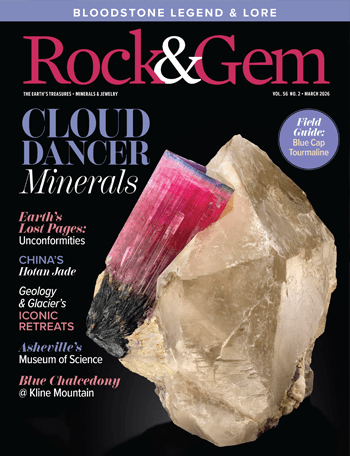
Rock & Gem’s March 2026 issue, with digital availability listed February 27, 2026, devotes a feature to bloodstone that traces its geology, identification and lapidary uses. All major lab descriptions converge on one image: a dark-green, polycrystalline quartz body shot through with red iron-oxide inclusions, commonly hematite, the pattern that gives the gem its name.
Gemological classification is where the labels split, and the texts make that clear. GIA calls the material “Bloodstone, also known as heliotrope, is a variety of chalcedony (cryptocrystalline quartz) that is traditionally semi-translucent to opaque dark green jasper with red inclusions of iron oxides, especially hematite.” AGS notes the alternate name blood jasper but stresses “it’s actually chalcedony, which is a cryptocrystalline quartz,” while Gem-A uses both “dark green jasper” and “dark green chalcedony” in its entries. The consistent technical anchor across the organizations is cryptocrystalline quartz; the choice of “jasper” or “chalcedony” depends on parlance and market context.
Appearance and quality criteria are concrete. Gem-A explains the red inclusions “resemble spots of blood,” though they can appear yellow or white, and notes red is “the most well-known and popular.” AGS advises that for “good-quality bloodstone gems, a solid green color with visible veins of red is usually considered the best.” GIA illustrates the variety with a “giant slab” example that shows green with red, yellow and white spots; Gem-A’s close-up photography by Pat Daly captures dark-green jasper with iron-oxide inclusions.
Geology and sources are specific and practical: GIA reports that “most bloodstone in the marketplace today is from India,” while Gem-A and AGS list additional occurrences in Brazil, Australia and the United States, with Gem-A adding Germany, Italy and South Africa and GIA noting parts of China as supplementary sources. All three describe occurrence modes that lapidaries know well: filling fractures or cavities in host rock and appearing as riverbed pebbles.
The material’s history and lapidary life are long and varied. Gem-A documents bloodstone’s use for intaglios, signet rings and decorative panels in snuff boxes and pietra dura; GIA records an engraved bullae bloodstone cameo from the Roman Empire. AGS ties the look to folklore: “Bloodstone’s appearance is why it was associated with catching Christ’s blood at the foot of the cross, giving it religious significance. The stone was believed to stop and heal bleeding issues…”
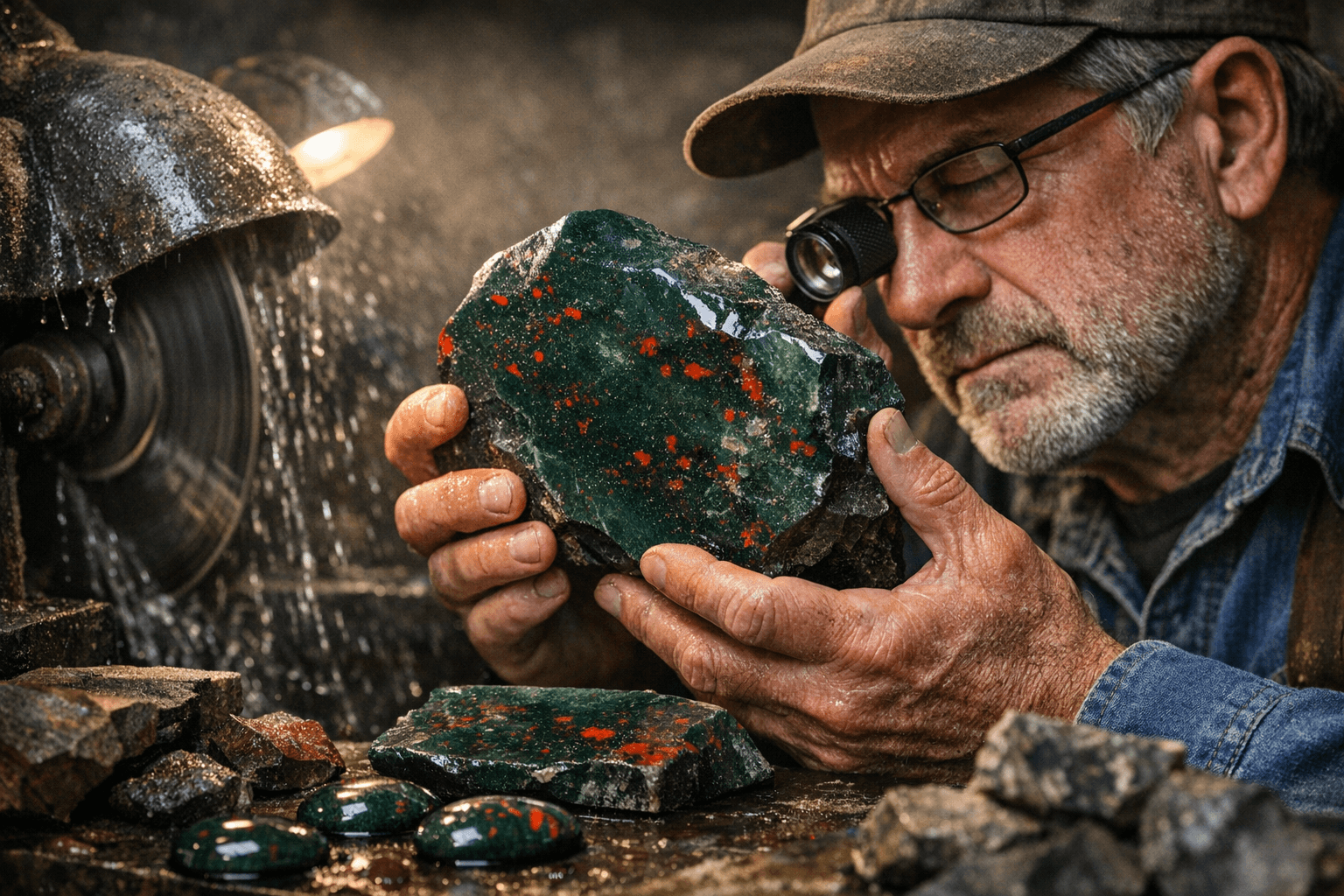
Durability and care are straightforward and consistent across sources. Gem-A states, “Bloodstone is a polycrystalline material and as is fairly tough and resistant to fractures and chipping,” and gives a hardness range of “6-7 on the Mohs scale.” GIA cites a slightly narrower range, “(it’s) 6.5–7 on the Mohs scale,” and offers home-care instructions: “Your bloodstone birthstone can be easily cleaned at home with warm soapy water and a soft brush. It is important to keep your bloodstone away from harsh chemicals and extremely hot temperatures. Dry off this March birthstone with a clean, soft cloth. To keep the stone from getting scratched (it’s 6.5–7 on the Mohs scale), it is important to store your bloodstone birthstone in a soft fabric.” Gem-A concurs: “When cleaning, use a soft cloth or brush and warm, soapy water.”
Market guidance is clear: AGS emphasizes affordability and common cuts—emerald, oval and cushion—while GIA and Gem-A underline that India supplies most commercial material. One internal caution appears in the AGS excerpt about an uncommon term: “I would recommend leaving out the other sentence or mentioning plasma. GIA and Gem-A make no mention of plasma bloodstone. Aside from our previous page, I have found only one other source that briefly mentions it. If bloodstone doesn’t have red spots, it’s usually considered green chalcedony.”
For buyers and makers the takeaway is specific: favor solid green stones with well-defined red veins, expect Mohs hardness in the mid-6s, clean only with warm soapy water and a soft brush, and verify origin—most material comes from India, with Brazil, Australia and the United States also supplying the market. For further study or formal instruction, Gem-A lists an education contact at education@gem-a.com.
This article was produced by Prism’s automated news system from verified source data, official records, and press releases, then run through automated quality and moderation checks before publishing. The system is built and supervised by the people who set the standards it runs under. Read our full AI policy.
Did this article answer your question?