Multi-Birthstone Family Jewelry: How to Design the Perfect Piece
Multi-birthstone family jewelry is 2026's fastest-growing personalized category. Here's how to design one that's beautiful, durable, and built to last a lifetime.

Three thousand years before a jeweler ever laser-engraved a child's name onto a pendant, the idea of wearing multiple meaningful gemstones in a single piece was already sacred ritual. The breastplate of Aaron, described in Exodus with extraordinary specificity, held twelve stones set in four rows of gold, each representing one of the twelve tribes of Israel. The piece wasn't decorative in the modern sense. It was a wearable map of family, lineage, and belonging. That impulse, to carry the people you love in the stones on your body, has never really left us. It has simply evolved. And in 2026, it is evolving faster than almost anything else in fine jewelry.
Multi-birthstone family pieces are now the fastest-growing category in personalized jewelry, outpacing single-stone styles in sales volume across virtually every retail channel. The reasons are both emotional and practical: a single piece can hold an entire family's story, and unlike a monogram or an engraving, color is universally legible. You don't need to read it. You feel it. But designing one well, one that you'll actually reach for every morning rather than leave in the velvet box, requires a blueprint. Here is that blueprint.
Start With the Guest List
Before you choose a single stone, decide who is being commemorated. This shapes every design decision that follows. A mother honoring three children has a fundamentally different piece than a grandmother representing five grandchildren born across seven different months, two of whom may share the same stone color. The number of people determines the format: two or three stones can anchor a ring or a pendant without visual chaos; four to six stones are the natural territory of a linear bar necklace or a bezel-dot bracelet; seven or more typically require a graduated arrangement or a design that uses accent sizing to create hierarchy rather than trying to give every stone equal visual weight.
Shared birth months are an opportunity, not a problem. Two family members born in September both claim sapphire, but those sapphires can be rendered in slightly different sizes or set at different heights to give each its own identity within the composition. Chronological birth order from left to right is the most intuitive layout, but arrangements centered on a family matriarch's stone are equally valid and worth discussing with your jeweler.
Map Stone Hardness to the Right Jewelry Type
This is the single most important technical decision in the process, and it is the one most often skipped in the excitement of choosing colors. The Mohs hardness scale runs from 1 to 10 and measures a gemstone's resistance to surface scratching. For a piece worn on the hand, where it makes constant contact with countertops, keyboards, and every hard surface of daily life, gemologists recommend a minimum rating of 7. Anything below that belongs in a pendant or a bracelet, not a ring.
Consider what this means across the birthstone calendar:
- Hardness 9-10 (excellent for rings): Diamond (April), ruby (July), sapphire (September). Set them however you like.
- Hardness 7.5-8 (ring-appropriate with care): Aquamarine (March), emerald (May), topaz (November). Emerald warrants special attention here: despite its hardness rating, its characteristic internal inclusions make it more prone to chipping under impact than its Mohs number suggests. A bezel setting offers meaningful protection.
- Hardness 7 (ring-possible, pendant-preferred): Amethyst (February), citrine (November), garnet (January), peridot (August). These are perfectly lovely in rings with protective settings, but they will show wear over years of daily use on the hand.
- Hardness 5.5 and below (pendants and bracelets only): Opal (October), moonstone (June), pearl (June alternative). Pearl, with a Mohs rating of just 2.5 to 4.5, is gorgeous in a pendant or earring and genuinely fragile in a ring. Be honest with your jeweler, and with yourself, about your lifestyle.
If your family's birth months span multiple hardness categories and you want a ring, there is a clean solution: use the softer stones as accent stones in smaller sizes flanking a harder center stone. The setting choice matters here too. A bezel, where a rim of metal encircles the stone's perimeter, reduces exposure of the girdle and significantly lowers the risk of chipping compared to a prong setting, which lifts the stone high and leaves its sides open to impact. For mixed-hardness families, low-profile bezel or half-bezel settings are not just a stylistic choice. They are an act of engineering.
The Three Design Templates That Actually Work
The linear bar necklace is the format that launched personalized jewelry into the mainstream, and it remains the most forgiving vehicle for multi-stone designs. Stones are set in a horizontal line, typically in round cuts between 3mm and 5mm, with consistent spacing that creates clean graphic rhythm. Yellow gold flatters warm-toned stones like garnet, citrine, and peridot; white gold reads crisper against cool blues and purples like aquamarine, amethyst, and sapphire; rose gold works across the widest range of stone colors without visual conflict. For four to six stones, a bar of 30mm to 40mm sits comfortably at the collarbone on a 16-inch chain.
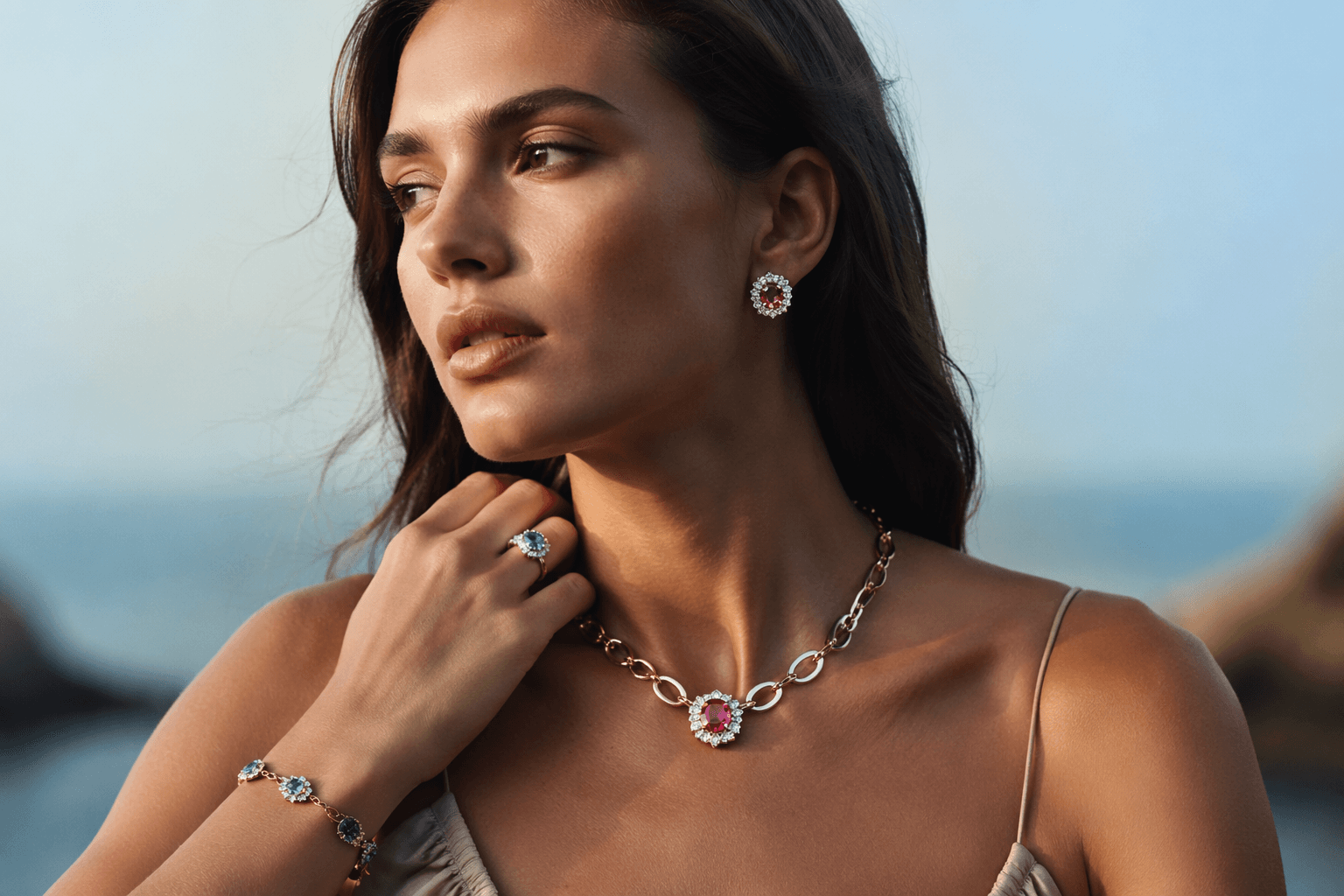
The clustered ring, in which a central stone of 3mm to 4mm is surrounded by up to six accent stones of 2mm, creates a bouquet effect that reads as deliberately designed rather than crowded. The key to keeping it from looking chaotic is treating the center stone as the protagonist: use the birth month of the wearer or the family matriarch at center, and arrange the remaining family stones as a supporting cast. Asymmetric clusters can be beautiful, but they require a skilled bench jeweler. Ask to see examples of prior work before committing.
The bezel-dot bracelet, in which individual gemstones are set flush in small round bezels spaced along a delicate chain or solid bar, offers the most wearable daily format for larger families. Each stone sits protected and flush with the metal surface, making this format well-suited to softer stones that would be risky in a ring. A bracelet of five to seven bezel-set stones in 3mm rounds is lightweight, graphic, and complete enough to wear without layering.
The Price Tier Conversation
Here is where design intent meets budget reality, and where choices genuinely change the total cost of the piece. Natural gemstones and lab-grown gemstones are chemically and optically identical. The difference is origin, and it is a significant one financially. Lab-grown colored gemstones typically cost 20 to 40 percent less than their natural counterparts. In the case of diamonds, the gap is even wider: lab-grown diamonds averaged around $1,000 per carat in 2025 compared to approximately $4,200 for natural diamonds of equivalent quality. That differential makes the April birthstone far more accessible as one stone among several in a family piece.
For a three-stone piece in 14-karat gold with natural gemstones in the 3mm to 4mm range, budget $400 to $800 from a reputable retailer. The same piece with lab-grown alternatives lands closer to $250 to $500. Moving to five or six stones in sterling silver with lab-grown stones, the entry point drops to $150 to $300, which is where the bezel-dot bracelet becomes genuinely accessible without sacrificing quality. At the high end, a custom clustered ring in 18-karat yellow gold with natural ruby, sapphire, and emerald can reach $2,000 to $4,000 or more depending on individual stone quality grades.
One further lever: stone placement changes cost more than stone count. Moving a stone from accent size (2mm) to center size (4mm or 5mm) can triple its price, because larger natural gemstones are exponentially rarer. If the piece includes an April diamond or a July ruby as the visual anchor, budget for the upgrade in that position and keep surrounding family stones at accent sizing. The hierarchy will read clearly on the piece, and the total price will be meaningfully lower than sizing everything up equally.
Production Time and Getting It Right
Custom multi-stone pieces are not impulse purchases. Most jewelers require two to four weeks for standard personalized designs, and up to six weeks for fully custom work involving hand-fabrication or specialty stone sourcing. If you are targeting Mother's Day, the commission window is mid-to-late April. Lead times extend when sourcing multiple natural stones simultaneously, particularly for May (emerald), July (ruby), or December (tanzanite), all of which require more sourcing time than more commercially available stones.
Come to your jeweler with the birth months listed in order, clarity about which jewelry type fits the stones' hardness ratings and the wearer's life, and a realistic budget range. The design conversation moves quickly from there. What takes the most time is not the fabrication. It is deciding who matters enough to be included, and how their story deserves to be told. A piece made from those decisions tends to be worn for thirty years. The breastplate of Aaron was meant to last a lifetime too.
This article was produced by Prism’s automated news system from verified source data, official records, and press releases, then run through automated quality and moderation checks before publishing. The system is built and supervised by the people who set the standards it runs under. Read our full AI policy.
Did this article answer your question?