The Complete Guide to Jewelry Care & Maintenance (useful birthstone care section)
Most birthstone damage happens at home, not in the wild — a hot shower can crack an opal, and everyday hand lotion quietly strips an emerald's protective oil treatment.

Twelve Stones and Three Millennia of Getting It Wrong
The oldest known birthstone system traces back to the breastplate of Aaron, described in Exodus: twelve gemstones set in gold, each representing one of the twelve tribes of Israel. Scholars identify them as sardius, topaz, carbuncle, emerald, sapphire, diamond, ligure, agate, amethyst, beryl, onyx, and jasper. Those gems were chosen for their symbolic power and rarity, not for their durability. Three thousand years later, the tension between a stone's beauty and its fragility remains the central drama of jewelry care, and most collectors are losing that drama quietly, one hot shower and one spritz of perfume at a time.
The vast majority of gemstones can be cleaned using warm soapy water and a soft brush. All you need is a little mild detergent mixed with some warm water in a bowl. But that rule has exceptions serious enough to ruin a stone permanently, and the exceptions cluster almost entirely around the birthstones people love most.
How to Read the Risk Ratings
Each birthstone below carries four risk indicators: Water, Heat, Chemicals, and Ultrasonic. A "High" risk means the hazard can cause immediate, irreversible damage. "Moderate" means cumulative exposure degrades the stone over time. "Low" means safe under normal conditions. Use these ratings to audit every piece in your collection before your next cleaning session.
The Fragile Four: Handle With Ceremony
These four birthstones account for the majority of at-home damage claims and deserve their own section before the full stone-by-stone guide.
Opal (October)
Water: High. Heat: High. Chemicals: High. Ultrasonic: Never.
Opals are among the gemstones you should never clean ultrasonically. The reason is structural: opals contain water, meaning they can crack if exposed to heat, dryness, or sudden temperature changes. That water content can reach up to 21% by weight in precious opal, which means the stone is essentially a hydrated silica gel set in precious metal. Heat from a hot shower, a hair dryer, or even direct sunlight can cause that internal water to shift, producing the crazing, a network of fine surface cracks, that destroys an opal's famous play-of-color permanently.
Common damage scenario: wearing an opal ring while washing dishes, then rinsing under cold water. The thermal shock alone can crack the stone.
- Safe cleaning: Wipe with a mesh cloth dampened in room-temperature water. Pat dry immediately. Do not use cleaners or soapy detergents.
- Storage rule: Wrap opal jewelry in a soft cloth and keep away from jewelry with harder gemstones, like sapphires. Store in a slightly humid environment, never in an airtight plastic bag.
- See a jeweler if: You notice any surface crazing, loss of play-of-color, or a bezel that appears to be putting pressure on the stone.
Pearl (June)
Water: Moderate. Heat: High. Chemicals: High. Ultrasonic: Never.
Pearls, with a Mohs hardness of 2.5 to 4, are among the softest gemstones and require gentle handling. To put that in perspective, a human fingernail registers approximately 2.5 on the Mohs scale. Your fingernail can scratch a pearl. That single fact reframes every styling decision, from which handbag to reach into while wearing a pearl ring to which surface to set a pearl bracelet on when undressing.
Keep pearls away from chlorine bleach, hydrogen peroxide, vinegar, ammonia, hairspray, perfume, and cosmetics, as these substances will damage the pearl surface. Acids are particularly dangerous: acids break down the crystalized calcium of the pearl. Even fruit juice and wine, if splashed onto a strand, can begin this erosion.
Common damage scenario: applying perfume after putting on pearls. The alcohol carrier in most fragrances dissolves nacre over time, dulling the surface irreversibly.
- Safe cleaning: Gently wipe pearls with a soft cloth to remove sweat, perfume, excess oils, or dirt before putting them away. For a deeper clean, use a microfiber cloth lightly dampened with lukewarm water and a drop of non-detergent soap.
- Storage rule: Wrap the pearls in linen, soft cloth, or place in a soft pouch. Never store in an airtight container, which dries out the nacre.
- See a jeweler if: The silk thread on a pearl strand shows any darkening or stretching. Restringing every one to two years, with a knot between each pearl, is standard professional maintenance.
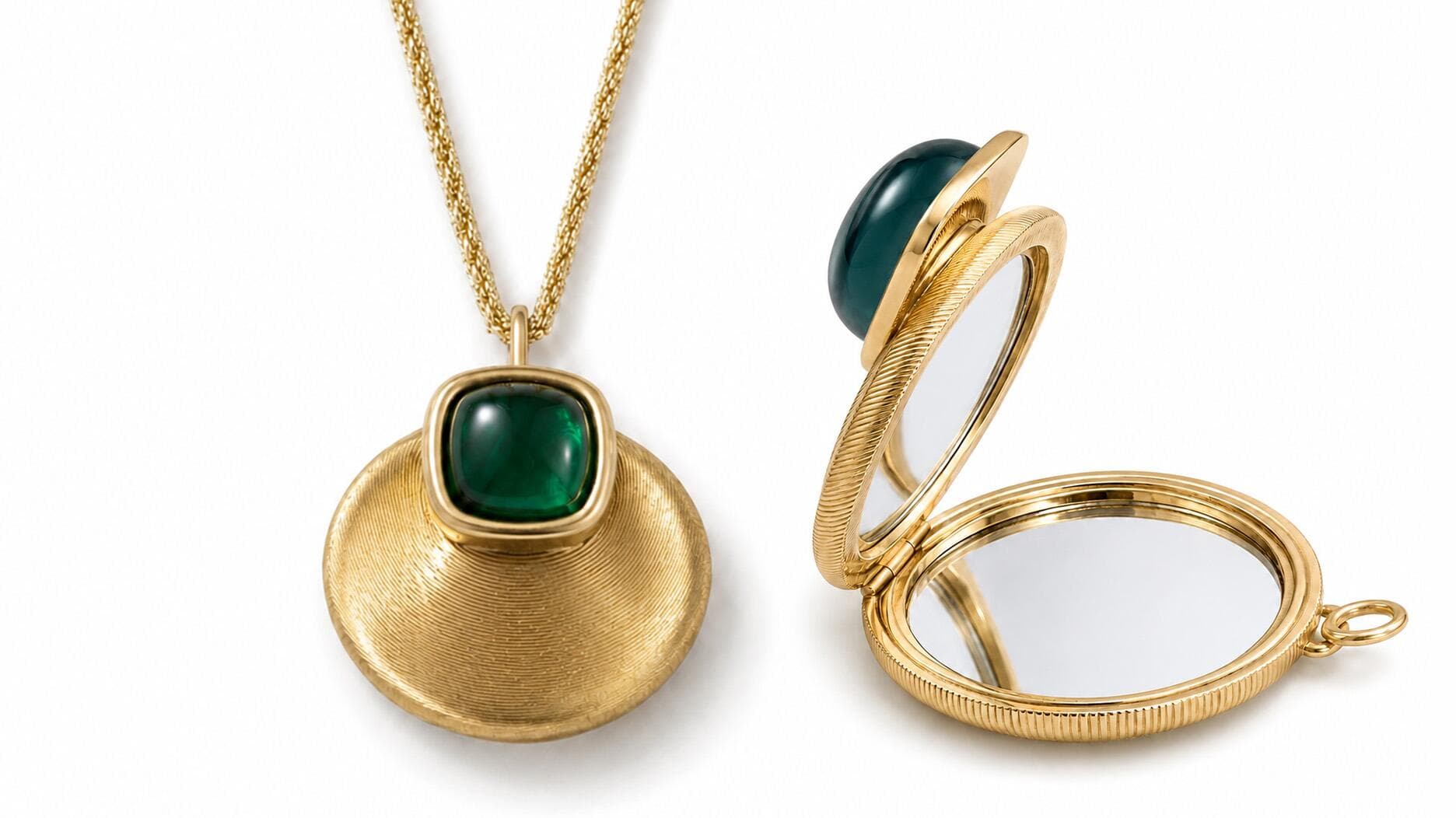
Emerald (May)
Water: Moderate. Heat: High. Chemicals: High. Ultrasonic: Never.
Those inclusions and treatments make emeralds more prone to cracking. More specifically: over 90% of commercial emeralds are fracture-filled with cedar oil, Opticon resin, or a synthetic substitute. These fillers enter the stone's natural fissures to improve apparent clarity. For emeralds, do not put these stones in ultrasonic cleaners or under harsh heat or pressure conditions, as these stones are considerably more fragile than other gemstones in their category. An ultrasonic machine does not simply fail to clean an emerald; it actively strips the oil filler from the fractures, leaving the stone visibly clouded with newly exposed inclusions.
Common damage scenario: cleaning an emerald ring in hot soapy water, which dissolves the cedar oil over repeated exposures.
- Safe cleaning: Clean in room-temperature water and use a soft toothbrush to gently remove dust from behind the stone. No soaking.
- Storage rule: Store flat or face-up, padded in a soft pouch. Emerald's natural inclusions, known in the trade as its "jardin," make the stone susceptible to chipping on edges, so it should not tumble freely against other pieces.
- See a jeweler if: Cloudiness develops or visible fissures open. A professional can re-oil the stone, a process that restores clarity without altering the gem chemically.
Tanzanite (December)
Water: Low. Heat: High. Chemicals: Moderate. Ultrasonic: Never.
Tanzanite, while stunning, is fairly soft and can chip easily. Its Mohs hardness sits between 6 and 7, but hardness alone does not tell the full story. Tanzanite has perfect cleavage in two directions, meaning a sharp blow from the correct angle can cleave the stone as cleanly as if it were cut by a skilled lapidary. Avoid ultrasonic and steam cleaning, as this uses high-frequency vibration and high heat that may affect the cleavage of your tanzanite.
Common damage scenario: wearing a tanzanite ring while moving furniture or working in the kitchen, where a single knock against a countertop can chip the table facet.
- Safe cleaning: Mild soap and warm water is the safest cleaning method for tanzanite jewelry. Make sure to rinse thoroughly and dry with a soft cloth.
- Storage rule: Keep tanzanite in a padded box compartment, away from diamonds, rubies, or sapphires, which can scratch it easily.
- See a jeweler if: Any edge chipping is visible under a loupe, or if the setting feels loose after an impact.
The Durable Birthstones: Still Not Indestructible
Stones at Mohs 9 to 10, including diamond, sapphire, and ruby, are safe for gentle soap, warm water, and a soft brush. Ultrasonic cleaning is safe in most cases. Ruby (July) and sapphire (September), both corundum at Mohs 9, handle daily wear in rings better than almost any other colored gemstone. Diamond (April) at Mohs 10 is the hardest natural substance on earth, though it can still chip along its octahedral cleavage planes under a direct sharp blow.
Garnets (January) range from 7 to 7.5 on the scale and are sturdy, but should still be cleaned with mild soap and water. Amethyst and citrine, the February and November quartz birthstones, sit at Mohs 7. Ultrasonic cleaners and steamers are generally safe with many kinds of quartz, though mild detergent and warm water is always the gentler first choice. Aquamarine (March) at Mohs 7.5 to 8 is one of the more forgiving colored stones, clean with warm soapy water and a soft brush, though never steam-clean a treated aquamarine. Peridot (August), which ranks between 6.5 and 7, cannot take hard wear like some others, and should never be cleaned with steam or an ultrasonic cleaner.
Metal Care: The Setting Matters as Much as the Stone
The metal holding your birthstone is not a passive actor. Gold, whether 14k, 18k, or 22k, is relatively resilient to mild soap cleaning, but gold vermeil, which is sterling silver plated with a minimum of 2.5 microns of gold, will wear through with repeated abrasive cleaning or prolonged soaking. Gold-plated pieces with thinner plating, typically under 0.5 microns, are even more vulnerable. Chlorine bleach attacks gold alloys at the molecular level, weakening prong settings over time. Acetone, found in nail polish remover, can dissolve certain adhesives used in bezel-set and glued settings, including doublets and triplets used in some opal and turquoise pieces.
For all plated and vermeil pieces: wipe clean with a soft dry cloth after each wear. Reserve water-based cleaning for solid gold or platinum settings only, and always remove jewelry before applying hand sanitizer, which typically contains 60 to 70% ethanol.
The Seasonal Checklist
Jewelry benefits from a twice-yearly review, ideally at the spring and fall equinoxes, when you rotate your wardrobe.
- Check all prong tips under a loupe or magnifying glass. A prong that is thin, bent, or shorter than its neighbors is a lost stone waiting to happen.
- Test all clasps, toggles, and box catches for secure closure.
- Inspect pearl and opal pieces for surface changes after a summer of heat and sunscreen.
- Have any emerald, opal, or pearl jewelry professionally cleaned rather than attempting it at home.
- Ask your jeweler to check the integrity of fracture-filled stones, particularly emeralds, after any chemical exposure.
- Resting pieces you wear daily for one month per year extends prong life and reduces metal fatigue at solder joints.
One Last Rule That Protects Everything
The single most protective habit in jewelry care costs nothing and requires no equipment: last on, first off. Put your jewelry on after hair, makeup, sunscreen, and perfume are fully applied. Remove it before washing hands, exercising, cooking, or cleaning. That sequence alone eliminates the majority of the chemical exposures, thermal shocks, and mechanical abrasions that end careers of beautiful stones. The breastplate of Aaron was never meant to go through a dishwasher cycle. Neither was yours.
This article was produced by Prism’s automated news system from verified source data, official records, and press releases, then run through automated quality and moderation checks before publishing. The system is built and supervised by the people who set the standards it runs under. Read our full AI policy.
Did this article answer your question?