Bucherer Launches Diamond Twist Collection, Refreshing Classic Styles for Modern Buyers
Bucherer's Diamond Twist ring sequences emerald, oval, and pear-cut stones along a spiraling 18K shank, creating a moving-light effect that sets it apart from its Classics line.
Before you dismiss twisted metal as a fleeting runway conceit, consider what Bucherer just did to one of its most serious diamond rings. The Swiss maison introduced Diamond Twist as a spring extension of its Classics Diamond Collection on April 1, and the design rethinking runs deeper than aesthetics.
The Classics line has always dealt in the language of precision: clean solitaires, channel-set bands, geometry that reads equally well in a boardroom or at a dinner party. Diamond Twist keeps the material vocabulary intact but redirects the architecture. Where Classics pieces hold their stones in structured, symmetrical formations, the Twist collection introduces a rotating silhouette where pavé-set diamonds follow the curvature of the metal as it spirals. Bucherer describes the result as an "illusion of fluid movement" that remains minimalist enough for both day and evening wear.
The distinction matters most in the ring, where Bucherer commits fully to the concept by combining three distinct cuts in a single band: seven emerald-cut diamonds totaling 2.31 carats, seven oval-cuts at 1.44 carats, and seven pear-shapes at 1.28 carats, all graded F/G color and VS clarity. That trio isn't arbitrary. Emerald-cuts reflect in broad, mirror-like flashes; ovals scatter light differently along their elongated plane; pears generate a directional flicker at the pointed tip. Arranged along a twisting 18K white gold shank, the three stone types don't compete; they sequence, producing a ring that catches and releases light as the hand moves in a way no single-cut design can replicate.
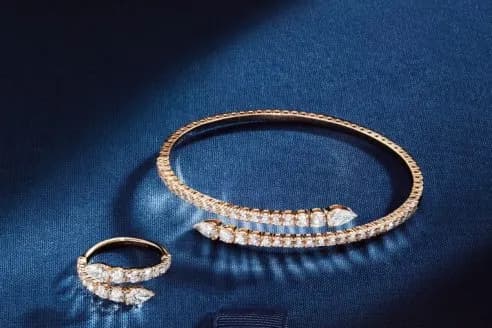
The collection extends across earrings, bangles, and necklaces, all crafted in 18K white or rose gold, maintaining the same pavé-twisted construction at different scales.
Day styling calls for restraint. The Twist bangle reads as texture against bare skin or over a slim sleeve cuff, which is why it suits the minimalist who finds standard tennis bracelets too static. The spiraling form catches light in motion rather than sitting still, rewarding the wearer rather than the room.
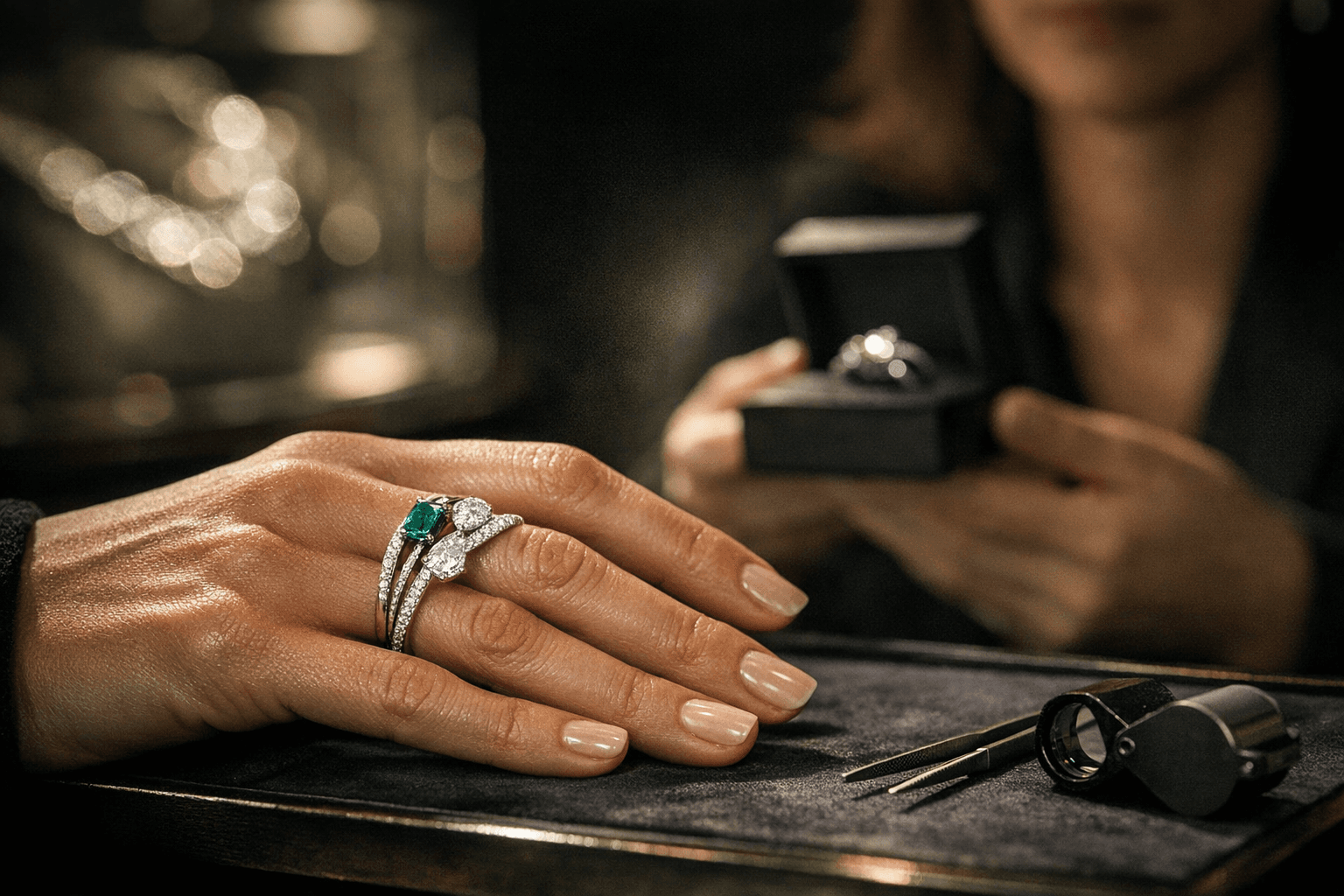
Evening changes the equation. The ring's 21 diamonds across 5.03 combined carats produce a presence that makes stacking redundant. Worn alone against a neutral nail or a clean metal cuff, the three-cut architecture handles the visual conversation without reinforcement.
For those who do stack, Twist pieces work best as anchors rather than additions. One Diamond Twist ring flanked by two narrow plain gold bands, or a Twist bangle bracketed by smooth-finished cuffs, keeps the spiral silhouette legible. Piling multiple textured pieces against each other collapses the effect entirely.
Minimalists who typically avoid pavé because of its decorative density will find the Twist easier to wear than expected: the spiral form distributes stones along a curved plane rather than presenting them face-on, softening the visual weight considerably. For maximalists, the rose gold variation reads more ornate, particularly in necklace form, where the twisted construction creates shadow and relief along the décolletage.
Bucherer, whose fine jewelry history stretches back to its 1888 founding, positioned the Diamond Twist drop as a deliberate move to introduce younger, style-driven buyers to its core diamond program. The collection is now available at selected boutiques and online.
This article was produced by Prism’s automated news system from verified source data, official records, and press releases, then run through automated quality and moderation checks before publishing. The system is built and supervised by the people who set the standards it runs under. Read our full AI policy.
Did this article answer your question?