How to Buy a Diamond: Cut, Color, Clarity, and Budget Explained
Cut beats carat every time: the one rule that separates a dazzling diamond from a disappointing one, plus the budget map every buyer needs in 2026.
Before you spend a single dollar on a diamond, know this: the average American engagement ring now costs $5,200, according to The Knot's 2024 Jewelry and Engagement Study, down from $6,000 just three years ago. That shift is real, and it matters. A softening market, the rise of lab-grown stones, and smarter online shopping tools have tilted the balance toward buyers. The question is whether you'll use that advantage well, or walk into a store and hand it right back.
This is a buying decision map for 2026. Not a glossary, not a tutorial on geology. A guide to the exact moments where buyers overpay, under-research, or simply make the wrong call first.
Start Here: Cut Is Not Negotiable
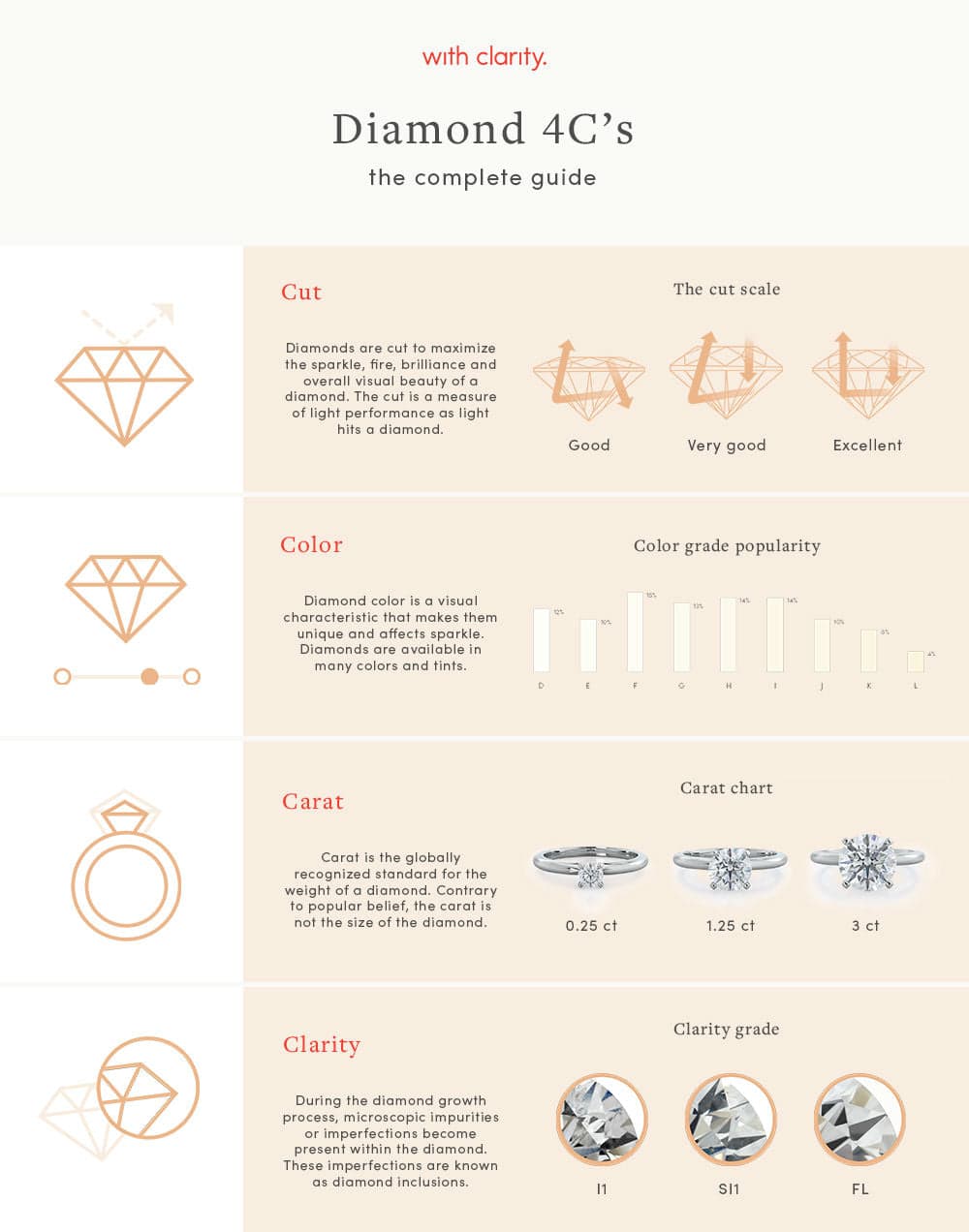
The single most important variable in a diamond's beauty is cut quality, and it is the one specification most salespeople will try to trade away when you're chasing carat weight. Don't let them. Cut governs how light enters and exits a stone: a poorly cut two-carat diamond will look duller than a perfectly cut one-carat. GIA founder Robert M. Shipley coined the phrase "the 4Cs of diamond quality" in the 1940s precisely to give buyers a framework that didn't rely on a jeweler's word alone. Of those four Cs (cut, color, clarity, carat), cut is the one that creates visible fire and brilliance. Always prioritize it.
For round brilliants, target GIA Excellent or AGS Ideal cut grades and go no lower than Very Good. For fancy shapes (ovals, cushions, pears, emeralds), there is no standardized cut grade on most certificates, which is exactly why you need to examine 360° video before committing to any stone you haven't seen in person.
🚩 Red Flag: A salesperson who says "the cut is fine, let's talk about the carat" is asking you to trade sparkle for size. That is almost always the wrong trade.
The Carat Trap: What the Number Actually Buys You
Carat is weight, not diameter. This distinction causes more buyer disappointment than any other misunderstanding in jewelry retail. A 1.0-carat round brilliant measures roughly 6.5mm across. A 0.90-carat stone cut to excellent proportions can measure nearly the same, and will often look larger face-up than a heavier stone with a thick girdle or deep pavilion. The visual difference between a 0.95-carat and a 1.0-carat stone is essentially zero; the price difference is not.
Work with millimeter measurements and face-up imagery alongside carat weight. Use online diamond comparison calculators that overlay two stones at actual scale. The numbers you want to optimize aren't just carats: they're table percentage, depth percentage, and girdle thickness. Those specs determine how much of that weight you can actually see.
Color: The H–J Sweet Spot
Diamond color is graded on a D-to-Z scale, where D is colorless and Z carries a warm yellow tint visible to the naked eye. The buyer's insight here is that the difference between a D and a G is largely invisible once a stone is set in a ring and viewed in normal light; the price difference is substantial.
The practical target range is H through J, depending on your metal choice. In a white gold or platinum setting, H color is the lowest grade that still reads as white-adjacent to most eyes. In yellow or rose gold, the warm undertones of the metal actually flatter an I or J stone, making the slight warmth disappear optically. Going all the way to D or E is a meaningful spend for a quality that exists primarily on paper.
🚩 Red Flag: If a vendor only shows you D–F stones "because they're the best," ask to see comparable stones in the H–I range side by side. If they won't, find a different vendor.
Clarity: Eye-Clean Over Everything
Clarity grades describe the presence of internal inclusions and surface blemishes. The GIA scale runs from Flawless down through VVS1/VVS2, VS1/VS2, SI1/SI2, and into I1–I3. The industry consensus among experienced buyers is consistent: target eye-clean stones rather than the highest clarity grade. An SI1 or SI2 diamond with no inclusions visible to the naked eye is, for all practical purposes, identical to a VVS1 when worn. The price differential, however, is enormous.
The key variable is placement of the inclusion. An SI1 with a crystal near the edge can be covered by a prong; the same grade with a black carbon inclusion centered under the table is a different stone entirely. This is why 360° imaging and loupe-quality video exist. Use them.
Lab-Grown vs. Natural: The Decision You Have to Make Consciously
Lab-grown diamonds are physically and chemically identical to mined stones. They are not simulants. They are not cubic zirconia. They are diamonds, grown in weeks rather than billions of years, and they are graded by the same labs (GIA, IGI, AGS) on the same 4Cs framework.
The price argument is stark. Lab-grown diamond prices dropped by more than $8,600 over five years, settling around $5,670 in 2025 for what would have cost over $14,000 in 2020. That collapse means a buyer who wants maximum carat weight and cut quality per dollar will almost certainly find more value in the lab-grown market.
What lab-grown diamonds do not offer is long-term resale value. Natural diamond prices, though softened, retain a secondary market that lab-growns currently do not. This is not a reason to avoid lab-grown stones; it is a reason to buy them as jewelry, not as an investment. If you're choosing a stone for what it looks like on a hand rather than what it might sell for in fifteen years, lab-grown is a rational choice.
Certification: Why the Lab Name on That Report Matters
GIA's 4Cs transformed the way diamond quality is determined and communicated, forever changing how diamonds are evaluated, bought, and sold. A GIA grading report is the industry's benchmark, and it should be the default expectation for any natural diamond purchase above $2,000.
IGI (International Gemological Institute) is widely used for lab-grown diamonds and is generally accepted as credible in that context. For natural stones, IGI has historically graded on a slightly more generous scale than GIA, which means an IGI G/VS1 may not be directly comparable to a GIA G/VS1. The problem is that having an inaccurate assessment of a diamond's quality would affect its value and the price you should pay for it.
AGS (American Gem Society) is respected, particularly for its cut grading system: AGS has a cut grade even for fancy shaped diamonds that are not round, and uses a 0-10 grading system with twice as many grades as GIA's Excellent-to-Poor system.
- GIA: Gold standard for natural diamonds; use as the benchmark
- AGS: Excellent for cut analysis, including fancy shapes
- IGI: Widely accepted for lab-grown; exercise more scrutiny for natural stones
- EGL: Not recommended; grading standards have been widely criticized as inconsistent
Certification Hierarchy at a Glance:
🚩 Red Flag: Any vendor who discourages you from asking for a GIA or AGS certificate, or who offers a significant price break on a stone with only a house-branded appraisal, should be avoided entirely.
Setting: The Decision That Should Fit Your Life, Not Just the Stone
The setting is not an afterthought. It determines how a stone looks on a hand, how safely it's held, and how practical it is for daily wear.
A four-prong solitaire (the Tiffany-style silhouette most people picture) maximizes light exposure and keeps the stone prominent. It is also the most vulnerable setting for an active lifestyle: prongs catch on fabric and can bend. A six-prong setting adds security at the cost of some light exposure.
A bezel setting, where a rim of metal wraps the stone's girdle entirely, offers the best protection for daily wear and suits rounder hand shapes beautifully. It reads as more modern and minimal than a prong solitaire. The trade-off is that it slightly reduces the stone's perceived size by obscuring the girdle.
Pavé bands, halo settings, and three-stone designs all affect how large the center stone appears. A halo of small accent diamonds can make a 0.75-carat center stone read as a full carat visually. If budget is a constraint, this is one of the few legitimate ways to achieve a larger visual without spending on carat weight.
Three Example Carts
Max Sparkle Under $5,000 (Lab-Grown)
A 1.5-carat oval lab-grown diamond, IGI-certified, in the F–G color range and VS2 clarity, set in a thin 14-karat gold pavé band. The oval outline maximizes face-up size relative to carat weight; the pavé adds sparkle without competing with the center stone. Budget leaves room for a quality setting and an independent appraisal.
Classic Solitaire Under $10,000 (Natural)
A 0.90-carat round brilliant, GIA-certified Excellent cut, H color, VS2 eye-clean clarity, set in a six-prong platinum solitaire. The near-1-carat weight avoids the price premium attached to crossing the one-carat threshold. H color disappears in platinum at this size. This is the configuration that will look right in thirty years.
Statement Stone Under $7,500 (Lab-Grown)
A 2.0-carat cushion-cut lab-grown diamond, IGI-certified, I color, SI1 eye-clean clarity, in a yellow gold bezel setting. The warm gold flatters the I color completely. The bezel protects the stone for daily wear. The cushion's larger facets show more color but also more warmth and fire than a round at comparable grades.
Before You Pay: The Independent Appraiser
If you are spending more than $5,000 on a single stone, engage an independent appraiser before the purchase is final. Not after. This is a certified gemologist with no financial stake in the sale, who can confirm the stone matches its certificate, identify any treatments or enhancements that weren't disclosed, and give you a replacement value figure for insurance. Many buyers skip this step and pay $150 to save $150, only to later discover a discrepancy worth multiples of that.
Once purchased, insure the piece separately from a standard homeowner's policy. A standalone jewelry rider or a specialist jeweler's policy (brands like Jewelers Mutual are well-regarded in the trade) covers loss, theft, and damage at documented replacement value.
The Skimmable Checklist
✓ Prioritize cut quality above all other variables ✓ Target H–J color for white metals; I–J for yellow/rose gold ✓ Choose eye-clean SI1 or VS2 clarity over top-grade stones ✓ Request GIA or AGS certificates for natural diamonds ✓ Use 360° video for every stone you haven't seen in person ✓ Compare millimeter face-up size, not just carat weight ✓ Decide lab-grown vs. natural before you start shopping, not during ✓ Match setting type to lifestyle, not just aesthetics ✓ Get an independent appraisal before finalizing any purchase over $5,000 ✓ Insure immediately with a specialist policy
According to The Knot 2024 Jewelry and Engagement Study, the average engagement ring costs $5,200, and that number has fallen steadily: from $6,000 in 2021 to $5,800 in 2022 to $5,500 in 2023. The market is moving in your favor. The buyers who lose ground are the ones who walk in underprepared, trade cut for carat, and mistake a glossy certificate from an unknown lab for an independent guarantee. The ones who come out well are the ones who understand, before they ever step into a showroom, that the stone they want isn't defined by weight; it's defined by what happens when light passes through it.
This article was produced by Prism’s automated news system from verified source data, official records, and press releases, then run through automated quality and moderation checks before publishing. The system is built and supervised by the people who set the standards it runs under. Read our full AI policy.
Did this article answer your question?