Antique Cushion-Cut Engagement Rings: What to Know About the Rare Diamond
True antique cushion cuts are rarer and more optically complex than their modern lookalikes. Taylor Swift's ring changed the demand curve; here's how to navigate it.
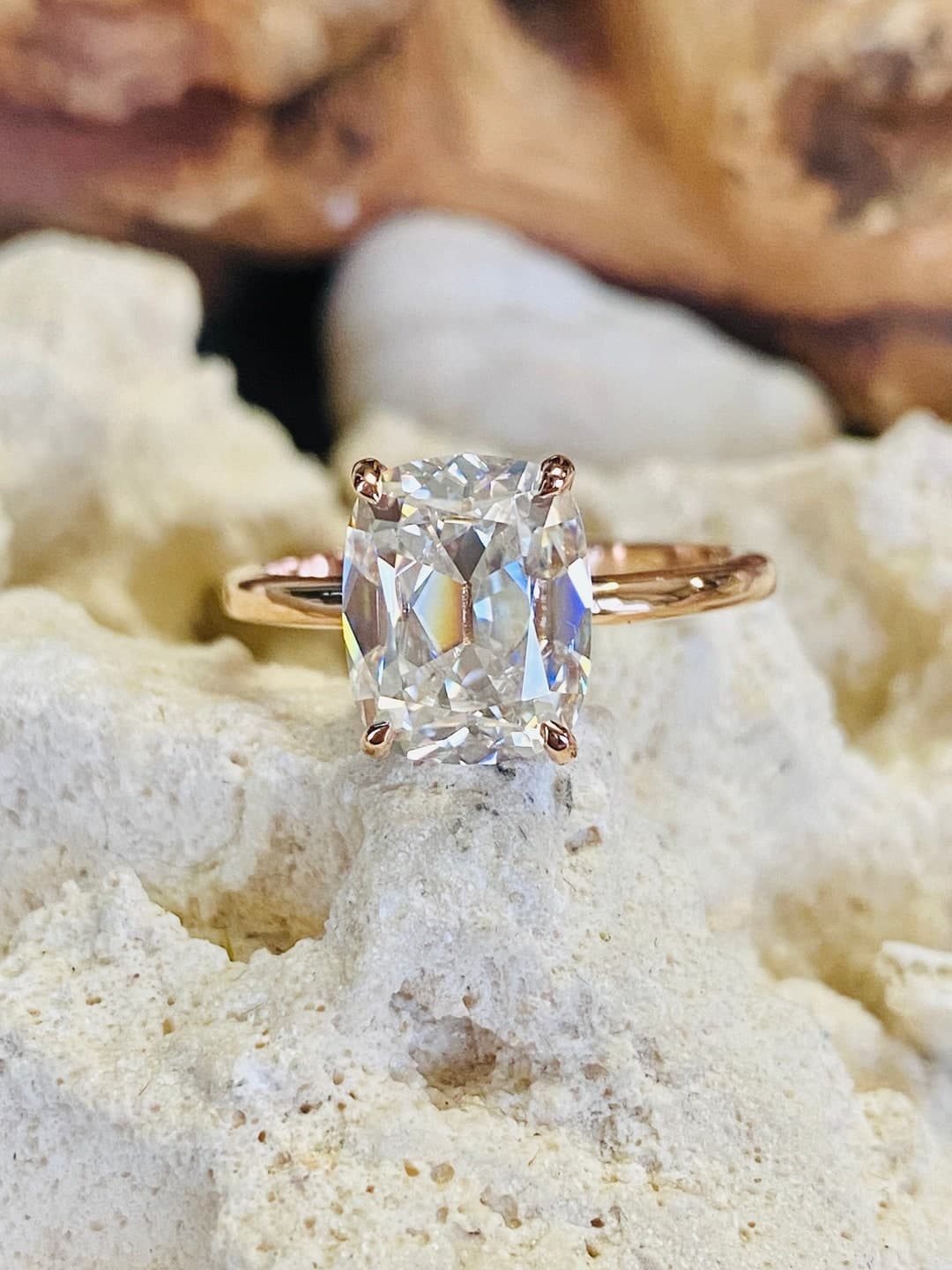
When Taylor Swift debuted her elongated old mine cushion-cut diamond, bezel-set in yellow gold on a tapered, textured band, the antique cushion cut moved from niche collector obsession to the most-requested stone shape on a generation of engagement ring mood boards. Dealers reported a notable uptick in interest in hand-engraved bands, with buyers specifically requesting the vocabulary of pre-20th-century diamond cutting. The celebrity demand spike is real, and it has consequences: it has drawn in reproductions, inflated premiums on genuine stones, and made the question of what you're actually buying more urgent than ever. An antique cushion cut is a specific, historically grounded object, not an aesthetic category. Getting one right means understanding what makes the cut optically distinct, why true antiques are in genuinely short supply, and how to authenticate a stone before it goes on your finger.
A Cut Born in Candlelight
The old mine cut was optimized for the diamond to shimmer under candlelight, while modern facet arrangements were designed for maximum scintillation under electric light. That foundational difference in intent explains everything that follows. An old mine cut has a squarish shape, a small table but large diamond-shaped facets on the crown, and large facets on the pavilion coupled with an open culet, the round facet visible at the very base of the stone. Both the old mine and its close relative, the old European cut, have a greater total depth compared to modern round brilliant diamonds.
The proportional specifics are worth knowing before you walk into any dealer. Old mine cuts have a smaller table, typically 40 to 50 percent of the stone's diameter, compared to 53 to 58 percent in modern cuts, and a more prominent crown that can account for 15 to 20 percent of total depth. The facet pattern follows what is called the "old brilliant" style, with triangular and kite-shaped facets arranged in a less systematic pattern than modern cuts, and the star facets on the crown are often irregular in size.
Technically, old mine cuts have the same number of facets as a modern round brilliant: 58. But that is where the similarity ends; the arrangement and proportions of those facets create an entirely different visual effect. The light performance prioritizes fire, meaning colored light dispersion, over brilliance, meaning white light return, making these diamonds particularly enchanting in intimate lighting conditions. The result is broader, slower flashes of color rather than the sharp, precise scintillation of a modern cushion. In warm ambient light, an antique cushion glows.
That warmth extends to color. As jewelry designer Stephanie Gottlieb has noted, "Antique cuts often naturally have warmer color tones, and part of their charm is how the cut and color play together to create this soft, romantic glow." The aesthetic appeal of warm tones is leading buyers toward antique cuts, and the resurgence of those cuts is helping people appreciate the beauty of warmer hues. A stone graded O-P on GIA's color scale, which would be penalized in a modern brilliant context, can read as honey-gold in an antique cushion, a feature rather than a flaw.
Why Genuine Antiques Are So Hard to Find
Antique cushion cut diamonds were made popular in the 19th century after the discovery of South African diamond mines, when diamonds moved from a stone reserved for nobility to one more broadly available. Sometimes referred to as old mine cut diamonds, in reference to stones that came from India and Brazil, they remain in high demand today.
The problem is supply. The pool of true antique cushions, stones cut during the Georgian and Victorian eras using hand-powered tools guided by the crystal's natural octahedral shape, is finite. Diamond cutters of the period followed the gem's natural octahedral shape as a guide, and the girdle was often the unpolished edge of the natural diamond crystal itself. That organic process produced stones with inherently inconsistent proportions: no two old mine cuts are quite the same. That inconsistency is part of the charm, but it also makes sourcing a matched pair for earrings or a flush halo setting genuinely difficult.
Then there is the re-cutting problem. Many Georgian and Victorian stones have been repolished or re-cut over their lifetimes, either to repair damage or to improve salability by modernizing their profile. Every pass of the wheel removes weight and, often, original character. The supply of untouched, provenance-clear antique cushions with intact period cutting is narrow and growing narrower as demand climbs.
Antique vs. Antique Style: How to Authenticate
The best indicators of a true old mine cut diamond are the open culet, the round facet on the very bottom of the stone visible through the table, and the squared-off cushion shape. Together with an unpolished or lightly polished girdle, these features are very difficult to replicate convincingly in a modern reproduction. A newly-cut "antique style" stone will have a more uniform girdle, more consistent facet sizing, and a culet that is either absent or far smaller than a period original.
Ask the dealer directly about restoration history. Any reputable dealer should disclose whether a stone has been re-cut, repolished, or re-tipped, and that disclosure should be in writing. If a seller is vague about provenance or dismisses the question, walk away. A stone described only as "old mine style" or "vintage inspired" without documentation of its origins is almost certainly a modern cut made to look historical.
Reading the Lab Report
On a GIA certificate, an old mine cut diamond will sometimes be referred to as an "antique cushion cut diamond" or a "brilliant-cut old mine diamond." That specific language on a GIA report is meaningful: it tells you the graders evaluated the stone as a period cut, not a modern reproduction. Request an up-to-date lab report for any stone you are seriously considering, and verify the report number directly on GIA's Report Check platform before committing.
A full GIA certificate for a cushion-cut stone will include the cutting style, color and clarity grades, measurements, and a facet plot. For antique stones, study the facet plot carefully: the irregularity of the facets should be visible in the diagram, and a perfectly symmetrical plot on a stone being sold as a true old mine cut should prompt questions. Also note fluorescence: many antique cushions carry medium to strong blue fluorescence, which can enhance their visual warmth under UV-rich daylight.
Face-Up Size, Light Performance, and Setting Decisions
Because old mine cuts carry significant weight in their depth rather than spread across the table, a one-carat antique cushion may measure slightly smaller face-up than a modern one-carat cushion. The trade-off is the light show: those broad, colored flashes read beautifully in photographs and in candlelit settings, even if they do not maximize measured brilliance under a grading lamp.
Your setting choice directly shapes both the visual size and the budget. Consider the trade-offs:
- Bezel settings: A low, continuous metal frame encircles the stone's girdle, offering maximum protection for an older, potentially more fragile diamond. It compresses the face-up profile slightly but gives a clean, modern-meets-antique look. Taylor Swift's ring uses a bezel combined with four small prongs, a hybrid that balances security with visual openness.
- Needlepoint prongs: Fine, tapered prongs allow the stone to breathe and show its full silhouette. They are the most traditional choice for period stones and are widely used by dealers who specialize in antique cuts. Check prong integrity carefully on any antique setting: worn or thinned prongs on an older mounting are a maintenance priority.
- Halo settings: A halo of smaller diamonds amplifies face-up size and can compensate visually for a smaller antique cushion, but it risks drowning the stone's idiosyncratic character in uniform sparkle. If you go this route, consider a single row of old-cut melee rather than modern brilliant-cut accent stones, which will clash optically.
- Solitaire settings: These let the stone's personality carry the ring entirely, which is the right choice if you have sourced a stone with strong provenance and distinctive visual character.
Yellow gold is not merely a trend preference here: it genuinely flatters antique cushions with warmer color grades by reflecting warm light upward into the stone. White gold and platinum create a cooler contrast that can make a J-K color antique stone look slightly grey.
Styling and Care
Chunkier bands and wide shanks suit the substantial depth of an old mine cushion, creating visual balance between the stone's mass and the ring's base. Slim modern bands can be stacked alongside an antique cushion ring for contrast, a pairing that has become popular precisely because the visual gap between eras reads as intentional rather than mismatched.
Conservation care is non-negotiable. If the stone is still in its original 19th-century setting, have a trusted bench jeweler assess prong height, shank thickness, and solder joints before the ring enters daily wear. Avoid ultrasonic cleaners and steam cleaning for older settings, which can loosen stones or stress compromised metalwork. A soft brush with mild soap and a professional inspection every six months will keep an antique setting wearable for another century.
What to Expect at Purchase
Larger antique cushions, particularly those above two carats with clean provenance and no re-cutting history, command a meaningful premium over modern equivalents. That premium reflects genuine scarcity, not marketing. A well-documented 3-carat antique cushion with a current GIA report, disclosed restoration history, and intact period proportions is a finite object. There are no more of them being made.
Specialists like Single Stone work almost exclusively with antique cushion cut and old mine cut diamonds from the 19th century, preferring the romantic quality of their faceting, and that curatorial depth is worth paying for. The alternative, an antique-style modern cut in a vintage-inspired mounting, is a perfectly legitimate ring. It is just not the same ring. Know which one you are buying.
This article was produced by Prism’s automated news system from verified source data, official records, and press releases, then run through automated quality and moderation checks before publishing. The system is built and supervised by the people who set the standards it runs under. Read our full AI policy.
Did this article answer your question?