Everything You Need to Know Before Buying a Diamond Engagement Ring
Before you buy a diamond engagement ring, know your 4Cs, your gemstone's durability tier, and whether custom or pre-designed fits your timeline.

Blake Lively's oval solitaire. Jennifer Lopez's reclaimed green diamond. The engagement ring has always been a cultural artifact as much as a piece of jewelry, and the decision of which one to buy carries real weight, both financially and symbolically. But between the vocabulary of gemology, the maze of settings, and the growing menu of stone options beyond the classic round brilliant, most buyers walk into a jeweler underprepared. Here is what you actually need to know before you spend a cent.
Start with the 4Cs: cut, color, clarity, and carat
The Natural Diamond Council's buyer primer frames the 4Cs as the foundation of any diamond purchase, and for good reason: they are the universal language jewelers and gemologists use to describe and grade a stone. Cut, color, clarity, and carat each measure something distinct. Cut is arguably the most consequential of the four because it determines how a diamond handles light. A well-cut stone reflects light back through the crown in a way that produces the brightness and fire most buyers are chasing. A poorly cut diamond, regardless of its size or clarity grade, can look flat and lifeless.
Color grades measure how much (or how little) yellow or brown tint a stone carries, running on a scale from colorless to visibly warm. Clarity refers to the presence of inclusions, the internal characteristics formed during a diamond's growth, and blemishes on its surface. Carat is the unit of weight, not size, though the two are closely related. Understanding the interplay between these four variables is the most important preparation you can do before entering a showroom, because a jeweler's first question will often be about which C matters most to you.
Not all stones are equal when it comes to daily wear
The conversation about engagement rings has expanded significantly beyond diamonds, with morganite, aquamarine, tanzanite, and opal all finding audiences among buyers who want color, character, or a lower price point. But the choice of stone has real consequences for longevity, and the durability tiers are not often explained clearly at the point of sale.
The most reliable framework divides popular engagement ring stones into three categories. Highly durable stones, including diamonds, moissanite, sapphires, and rubies, are usually safe for daily wear and most cleaning solutions are acceptable to care for them. These are the stones best suited to someone who works with their hands, forgets to remove jewelry before washing dishes, or simply does not want to think too hard about maintenance.
The middle tier requires more care. Emeralds, morganite, and aquamarine can be worn daily if they are in protective settings; however, avoid using chemicals to clean these gems as they can damage the color and luster. A bezel or halo setting that shields the girdle and edges of the stone is not just a design choice for these gems; it is a functional requirement for preserving the stone over years of wear.
At the fragile end of the spectrum sit opals and tanzanite. Both are genuinely beautiful, but they are not intended for daily wear. These soft stones are easily damaged and are not water-resistant. Too much use or exposure to hot and dry environments can cause them to crack. If an opal or tanzanite is calling to you, it may be better placed in a pendant or earrings worn on occasion rather than on a finger that meets surfaces, water, and temperature changes every day.
The practical guide from Valerie Madison jewelry offers a clear rule of thumb for buyers who are uncertain: "If you aren't sure how much maintenance and upkeep the ring will get, stick with a highly durable ring that can withstand daily exposure, most chemicals, and all typical environments."
Settings do more than aesthetic work
The setting is the architecture of the ring, and it shapes both the look and the protection level of the stone. For the softer middle-tier stones like emeralds and morganite, the choice of setting is not optional styling; it is the difference between a stone that survives a decade of wear and one that chips at the corner within a year. Protective settings enclose more of the stone's surface, reducing its exposure to impact. A bezel setting, for instance, wraps a metal rim around the entire circumference of the stone, while a halo adds a frame of smaller accent diamonds that both protects and visually enlarges the center stone.
For diamonds and other highly durable stones, the setting conversation is more about proportion, security, and visual effect. A four-prong solitaire maximizes light entry and keeps the stone prominent; a six-prong version adds security but slightly changes the silhouette. Pavé and channel-set bands add texture and brilliance at a lower price point than adding carat weight to the center stone.
Custom versus pre-designed: a real cost and timeline tradeoff
The distinction between walking into a store and pointing at something in the case versus commissioning a piece from scratch is more significant than most buyers realize. Pre-designed rings can be made in bulk with ready stock and lower labor, so they are usually less expensive than custom-designed rings. If you are working within a budget and a tight timeline, a well-made pre-designed ring is often the smarter choice.
Custom design, however, opens up possibilities that go beyond aesthetics. Custom allows for personalization, such as unique settings and ethical sourcing. If you want to specify a Fairtrade-certified gold band, request a stone with documented chain of custody, or incorporate a family heirloom diamond into a new design, the custom route is typically the only path that gives you that level of control. The tradeoff is time and money: custom work usually takes months or longer, so anyone considering this route needs to plan accordingly. As Valerie Madison puts it, "If you're looking for heirloom-quality gemstone engagement rings and your budget and timeframe (usually months or longer) allows, a custom ring adds an extra touch of thoughtfulness."
The ethical sourcing angle is worth dwelling on. The jewelry industry has made progress on transparency, with certifications like the Kimberley Process, Fairtrade Gold, and Responsible Jewellery Council membership providing some baseline assurance. But these schemes vary considerably in rigor. If provenance matters to you, the custom route puts you in direct conversation with the jeweler about where materials came from and what documentation exists. A good jeweler should be able to tell you the mine of origin for your diamond or the certification status of the gold; if they cannot, that is worth noting.
Questions to ask before you commit
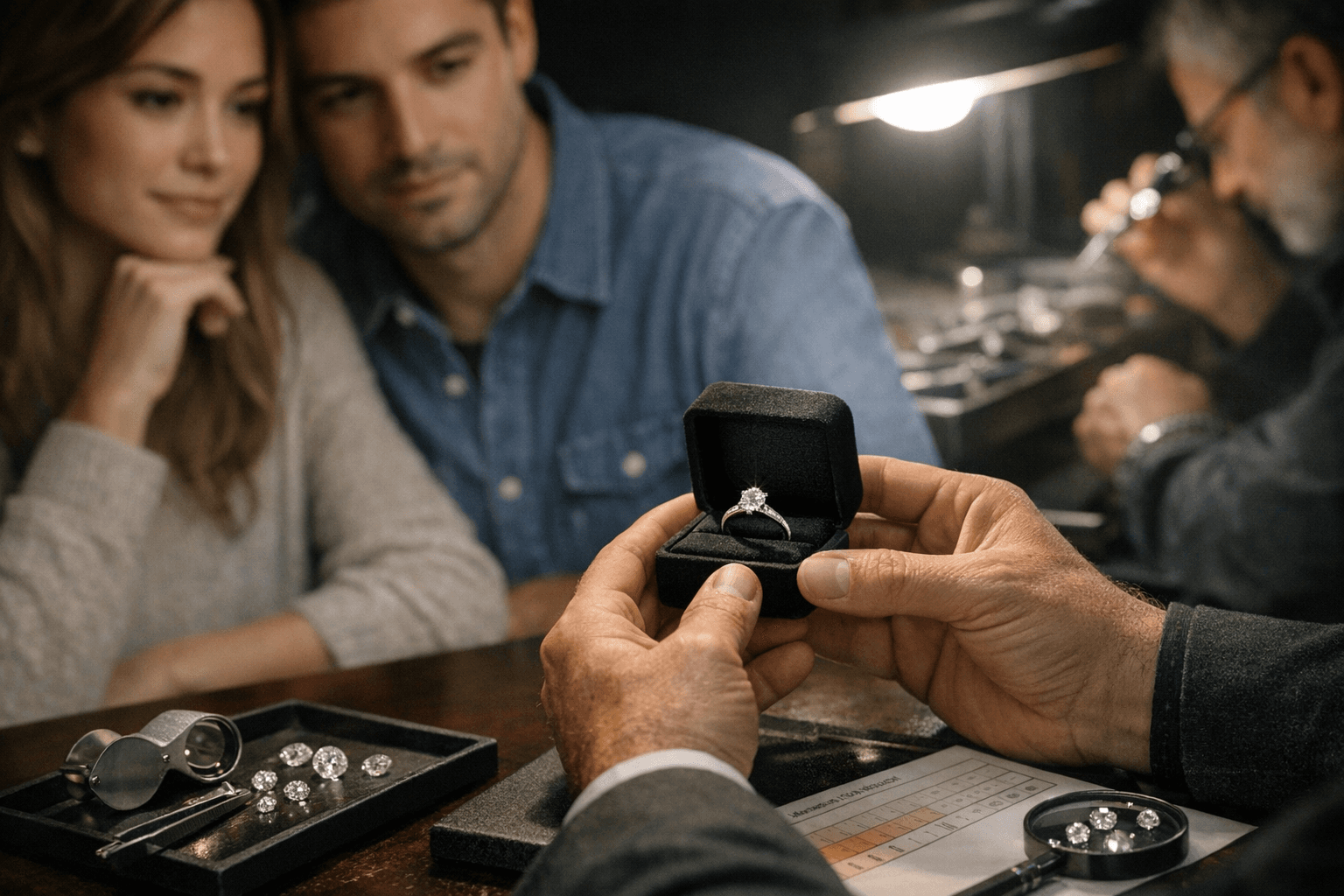
An engagement ring is a significant investment, and the questions you ask before buying are as important as any design decision. At minimum, ask your jeweler to show you the grading certificate for any diamond you are considering; a report from the Gemological Institute of America or a similarly respected lab gives you an objective, third-party assessment of the stone's quality. Ask about the metal: is the gold 14 or 18 karat, and how does that affect durability and color over time? Ask whether the setting can be resized, and whether prongs can be retipped if they wear down.
If you are considering a colored stone, ask specifically about treatments. Many emeralds, for instance, are fracture-filled with resin to improve their apparent clarity; this affects both value and care requirements. A reputable jeweler will disclose this information without prompting.
Care that matches the stone you choose
Proper care extends the life of your gemstone, no matter which kind you end up buying. Diamonds and moissanite are durable and naturally long-lasting, and they tolerate most cleaning approaches well, including ultrasonic cleaners in most cases. Emeralds and opals, by contrast, need regular, delicate care. Warm water and a soft brush are safer than any commercial cleaning solution for the middle and fragile tiers. It is also worth scheduling an annual check with your jeweler to inspect prongs, check for any loosening of the stone, and have the ring professionally cleaned and polished.
The ring you choose will likely be on your finger every day for decades. That longevity is the argument for treating this purchase with the same rigor you would apply to any significant, long-term decision: know the material, know the maintenance requirements, and know the provenance of what you are buying.
This article was produced by Prism’s automated news system from verified source data, official records, and press releases, then run through automated quality and moderation checks before publishing. The system is built and supervised by the people who set the standards it runs under. Read our full AI policy.
Did this article answer your question?