Hidden Halo Engagement Rings Add Secret Sparkle and Personal Style
A hidden halo gives the ring a private burst of sparkle, especially on oval stones, without the obvious bulk of a full halo or a larger center.
What a hidden halo really does
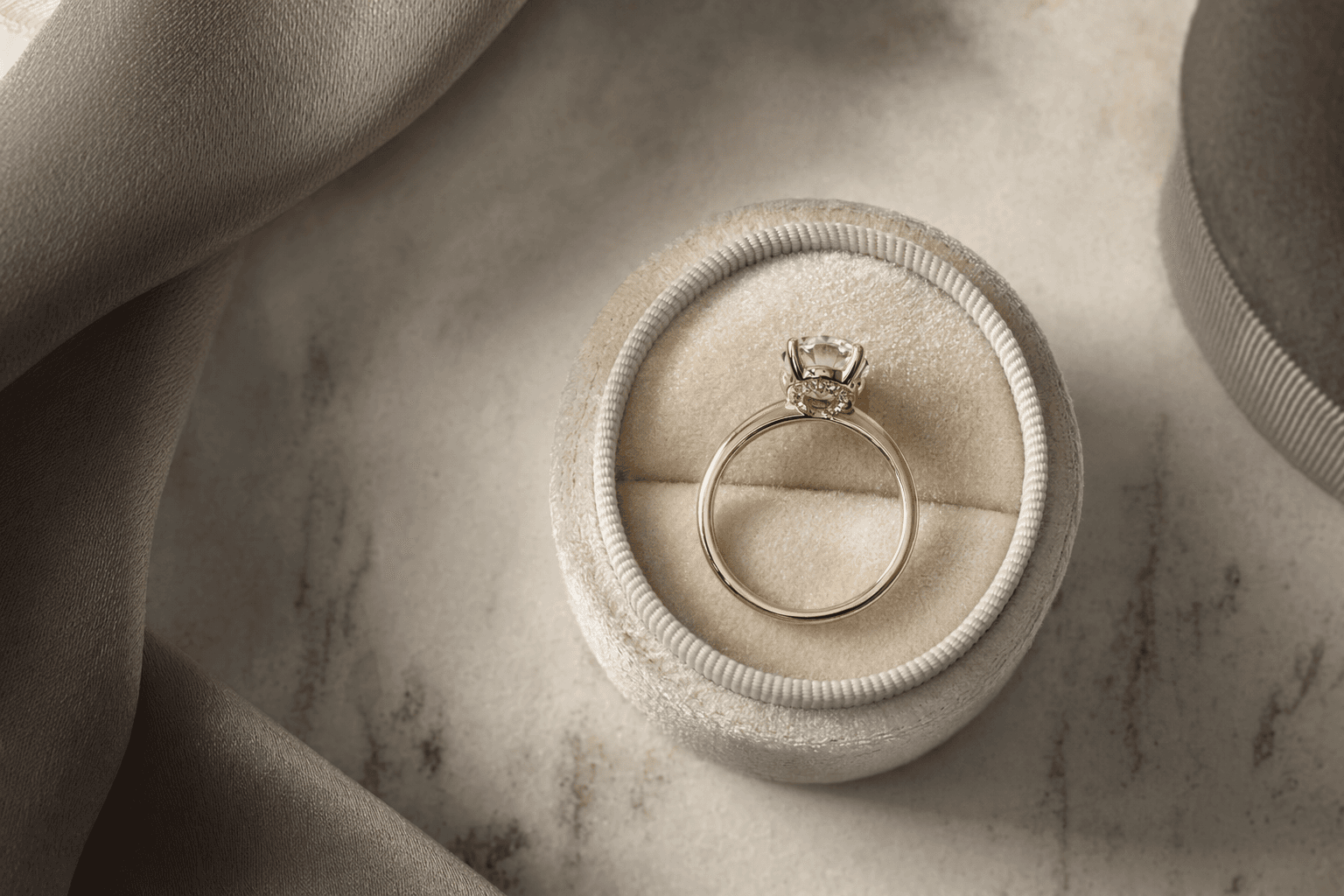
A hidden halo is the kind of detail that changes how a ring feels before it changes how it looks. Set as a band of delicate pavé in the basket under the center stone, it stays mostly out of sight from the top and shows itself when the ring is tilted or viewed from the side. That means the face-up profile stays clean, while the lower architecture catches light in a way that feels personal, almost like the ring is keeping a secret.
That is exactly the appeal. Emily Landmade, bespoke design director at Frank Darling, describes the effect as “secret sparkle,” and the phrase fits because the shimmer belongs to the wearer first. A hidden halo can be built with pavé diamonds, or, for a more intimate touch, a partner’s birthstone, which turns the underside of the ring into a private signature rather than a loud embellishment.
Why the view matters so much
The difference between a hidden halo and a traditional halo is not subtle once the ring is on the hand. A full halo sits around the center stone and reads from every angle, making the diamond appear larger from above and giving the ring a more obvious, dressed-up outline. A hidden halo keeps the top view cleaner, so the center stone remains the star, while the side view delivers the extra sparkle.
That is why this setting has become such a useful design cheat sheet for buyers who want more presence without a busier look. If the goal is a bigger-feeling ring without paying for a much larger center stone, hidden halo can be a smart middle ground, especially because it often uses fewer accent diamonds than a traditional halo. The result is sleeker, more modern, and less top-heavy, which is exactly what many ring shoppers want now.
The shapes that benefit most
The hidden halo works with any diamond shape, but it reads differently depending on the cut. An oval with a hidden halo feels classic with a twist: the elongated center stone already has a graceful line, and the concealed sparkle underneath adds dimension without interrupting that softness. The ring still looks polished from the top, but the side profile gives it a little lift and drama.
A radiant cut tells a different story. With its sharper geometry, the hidden halo feels more modern and more architectural, which makes the setting look intentional rather than decorative. That flexibility matters because the setting does not overwhelm the stone’s outline. Instead, it lets the buyer decide whether the ring should lean romantic, contemporary, or somewhere in between.
Why this style fits the moment
The broader engagement-ring market has moved away from rigid rules, and hidden halos fit that shift neatly. Consumers are increasingly drawn to rings with personal meaning and customization rather than designs that simply follow whatever is popular. Yellow gold is also surging, oval shapes remain among the strongest trends, and white metals are still deeply common, which shows how much room buyers now have to make a ring feel individual.
The Knot’s 2026 Real Weddings study, based on more than 10,000 U.S. couples who married in 2025, found that 48% wore a white-metal engagement ring, including 35% in white gold and 13% in platinum. That spread says a lot about the current mood: there is no single right answer, only the right combination of metal, shape, and detail. A hidden halo works inside that kind of freedom because it adds story without forcing the ring into one obvious aesthetic.
A setting with older roots and a modern finish
The hidden halo may feel current, but the halo idea itself has a long history. Halo rings trace back to the Georgian era, expanded in the Victorian period, and took on more geometric forms in the Art Deco 1920s. The hidden halo is a modern evolution of that tradition, taking the old instinct for sparkle and tucking it into the structure beneath the stone.
That evolution matters because it explains why the style feels familiar without looking dated. A classic halo announces itself at once; a hidden halo rewards closer looking. It is the difference between a ring that performs for the room and one that reveals itself in motion, when the hand turns and the basket flashes for a second.
A celebrity example that made the idea feel bigger
Lady Gaga gave the hidden halo a very public spotlight when she debuted a custom ring designed by Sofia Jewelry at the Venice International Film Festival in September 2024, then wore it again at the 2025 Grammy Awards. The ring is described as an oval-cut natural diamond estimated at 10 to 20 carats, with a hidden halo of white diamonds beneath the center stone and a value of up to $2 million. Even at that scale, the principle is the same: the hidden halo adds depth and radiance without changing the ring’s outward silhouette.
That kind of example has helped the setting feel less niche and more desirable. It shows how a hidden halo can support a center stone that is already dramatic, while still preserving a clean face-up look. The design does not compete with the diamond; it gives it a stage.
What to keep in mind before choosing one
The hidden halo is part of the ring’s structure, so it cannot simply be added later. Because the stones sit in the basket, the design has to be built into the ring from the start, and the basket needs a slightly thicker gallery rail to hold everything securely. That makes the setting a decision for the planning stage, not an afterthought.
For buyers, that detail is the real lesson. A hidden halo is not just a decorative flourish, it is a structural choice that changes how the ring catches light, how it wears from the side, and how much personality it carries without looking crowded. For anyone who wants secret sparkle, a cleaner top view, and a bigger impression without an obviously bigger center stone, it is one of the smartest moves in the modern engagement-ring vocabulary.
This article was produced by Prism’s automated news system from verified source data, official records, and press releases, then run through automated quality and moderation checks before publishing. The system is built and supervised by the people who set the standards it runs under. Read our full AI policy.
Did this article answer your question?