Marquise engagement rings return, vintage shape gains modern appeal
Selena Gomez's marquise ring helped revive a shape that stretches the finger, reads vintage, and now offers a sharper alternative to round solitaires.
Why the marquise is back
Selena Gomez’s marquise engagement ring from Benny Blanco did more than set off a wave of lookalikes. It put a once-niche shape, set here on a sparkly pavé band, back in the middle of the bridal conversation and gave the marquise a modern celebrity moment with real staying power.
The appeal is easy to understand. Marquise rings bring drama without bulk, and in a market still ruled by round solitaires, they feel like a deliberate choice. The Knot says marquise-cut diamonds made up about 5% of engagement rings in the US in 2024, while round solitaires still held the largest share at 28%. That gap is precisely what makes the marquise feel fresh now: it looks distinctive without abandoning the language of an engagement ring.
The cut’s vintage story is part of the draw
The marquise is not a trend invention. GIA says the shape was named in 1745 for the Marquise de Pompadour, mistress of Louis XV of France, because its outline was said to resemble the shape of her mouth. That kind of origin story matters in bridal jewelry, where symbolism and romance are part of the sale.
The cut also carries strong period associations. GIA notes that marquise diamonds were a favorite of the Edwardian era, when their elongated lines were compared to a racing yacht, and later enjoyed a surge in the 1970s, especially in bridal jewelry, before falling out of favor by the beginning of the 21st century. In other words, the marquise has already lived several fashionable lives. What feels new now is not the shape itself, but the way modern buyers are rediscovering its old-world drama.
That rediscovery is happening in a very digital way. Pinterest reported more than 3 billion wedding-related searches and more than 10 billion wedding ideas saved globally in one year, a scale that helps explain why a distinctive silhouette can suddenly feel ubiquitous. Once a celebrity like Gomez steps into the frame, the marquise stops reading as a niche antique and starts behaving like a shareable design language.
Why it flatters so well
The marquise has one of the clearest visual advantages of any fancy shape: it stretches. GIA says a marquise diamond can look larger face-up than a round diamond of the same weight, and it can make fingers appear longer and more slender. That elongating effect is the reason so many people respond to it instantly when they see it on the hand.
It is also why the shape appeals to shoppers who want something more directional than a round stone. A marquise does not just sparkle; it changes the proportions of the finger underneath it. The eye moves from point to point, creating a clean vertical line that feels elegant and slightly theatrical. For anyone who has wanted a ring that reads refined rather than expected, that is a compelling proposition.
What to look for before you buy
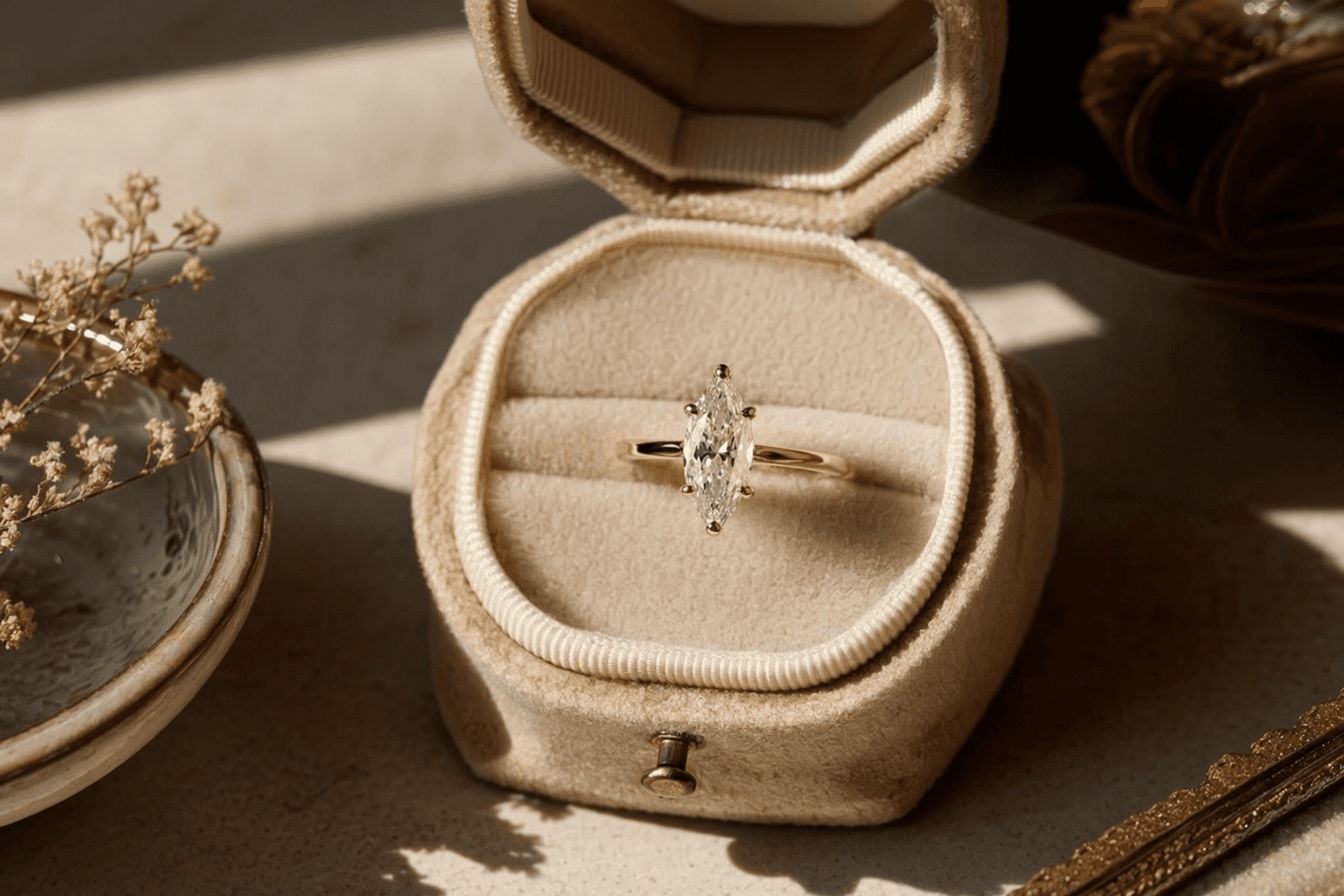
The marquise is beautiful, but it asks for attention. Its pointed ends are the whole point, and they are also the most vulnerable parts of the stone. The Knot says symmetry is one of the most important features to inspect, because the two points should line up perfectly. If the outline looks even and balanced, the ring will feel composed rather than awkward.
A second checkpoint is proportion. The Knot says experts generally consider a 1.85 to 2.00 length-to-width ratio the sweet spot for a marquise diamond. That range keeps the shape elongated without making it too skinny or too stubby. If the stone is too narrow, it can look severe; if it is too wide, it loses the sleek, almost blade-like profile that makes marquise so distinctive.
Then there is protection. The Knot recommends six prongs for a prong-set marquise to help guard the pointed ends. That is not just a technical detail. On a shape like this, the setting has to respect the architecture of the stone. Any shortcut at the tips can change both the look and the longevity of the ring.
Settings that make it feel antique or modern
The marquise can shift tone dramatically depending on the setting. A cleaner, more minimal mounting lets the shape itself do the talking and gives the ring a more antique mood. That approach works especially well when the metal is restrained and the silhouette is allowed to breathe, so the vintage lineage of the cut stays front and center.
A pavé band pushes the same stone into more modern territory. Selena Gomez’s ring does exactly that: the marquise center stone sits on a sparkling pavé band, which makes the ring feel current, glamorous, and highly camera-ready. Side stones and accent stones can have a similar effect, especially since The Knot says 51% of engagement rings in 2024 featured a clear diamond center stone with side stones and or accents, a sign that many shoppers are moving beyond the pure solitaire.
That shift matters because it shows where the market is going. The marquise does not need to be styled as a museum piece. It can read antique with a light hand, or it can feel sharp and fashion-forward when paired with more sparkle and structure. The cut is flexible enough to work in both worlds.
Why the revival makes sense now
The marquise revival is happening because it solves several desires at once. It offers the romance of a vintage shape, the practical illusion of greater size, and the flattering length of an elongated silhouette. It also gives buyers a way out of the round-diamond default without moving so far from tradition that the ring feels experimental.
GIA’s 2024 research on oval-, pear-, and marquise-shaped diamonds shows that the visual appeal of fancy shapes remains a live topic in the trade, with buyers, sellers, cutters, and appraisers all part of the conversation. That is exactly where the marquise belongs now: not as a novelty, but as a serious design choice with a long history and a clean modern payoff.
For shoppers, the best marquise is the one that gets the proportions right, protects the points, and matches the personality of the hand. In a category that still leans heavily toward round solitaires, the marquise stands out by doing something subtler and smarter: it makes a ring look intentional, elegant, and unmistakably chosen.
This article was produced by Prism’s automated news system from verified source data, official records, and press releases, then run through automated quality and moderation checks before publishing. The system is built and supervised by the people who set the standards it runs under. Read our full AI policy.
Did this article answer your question?