How to Design a Custom Engagement Ring: Costs, Timelines, and Expert Tips
Designing a custom engagement ring takes 4 to 12 weeks and costs anywhere from $400 to well into five figures — but "custom" alone doesn't add to the price tag.
When actress and style icon Carolyn Bessette-Kennedy slipped on a slim eternity band in 1996, she quietly made the case that the most personal ring is rarely the one pulled from a velvet-lined tray. That instinct has only deepened with time. Today, commissioning a custom engagement ring is one of the most intentional decisions a couple can make together — and it is far more accessible, and far less mysterious, than most people assume.
What "Custom" Actually Means
Custom engagement rings are made-to-order pieces designed specifically for you, allowing complete control over every detail, from the center stone to the metal type and setting style. The simplest version might involve nothing more than adjusting a band width or swapping a diamond shape in an existing design. The most complex might mean building a filigree-latticed platinum setting around a rare parti-sapphire sourced from Montana. Both qualify as custom. "Custom engagement rings offer complete personalization that ready-made pieces simply cannot match," as Colonial Jewelers puts it. "Rather than settling for what's available, you create something that reflects your partner's personality and preferences perfectly."
The Design Process, Step by Step
The journey from concept to finished ring follows a clear sequence, though the time each phase takes varies by jeweler and complexity.
1. Consultation: You define your budget, stone preferences, metal type, and setting style with the jeweler.
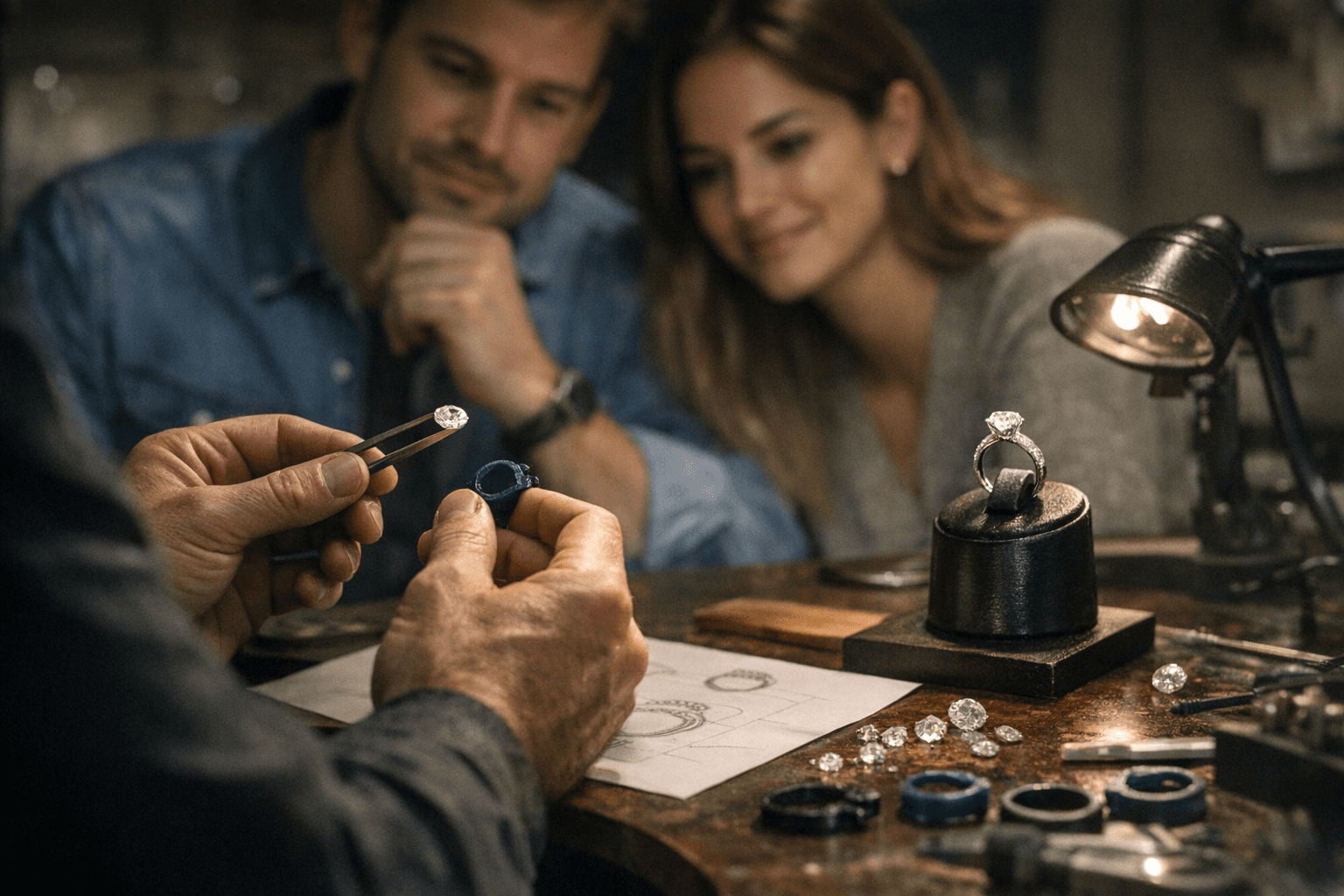
Bring images, sketches, even fabric swatches. Every custom ring starts with a detailed inquiry where clients share inspirations — family heirlooms, Pinterest boards, sketches. A thorough consultation dives into non-negotiables: metal preference, stone budget, lifestyle needs, and emotional significance.
2. Sketches and CAD Modeling: Using computer-aided design (CAD) software, the jeweler creates a detailed 3D model.
Approved sketches convert to precise 3D CAD models, and clients review 360-degree renderings to confirm proportions, stone placement, and engraving details. These renderings are so lifelike they feel like you're already wearing the ring, and most designers offer up to three rounds of revisions.
3. Stone Selection: This step often happens in parallel with CAD work.
Washington Diamond describes the full sequence as: "Design consultation → 3D modeling → stone selection → wax model review → crafting → final delivery."
4. Wax Model Review: Once the CAD image is approved, a wax model is cut, and you can inspect it before casting begins.
The ring is brought to life on a 3D printer, which grows a 1:1 wax prototype of your design layer by layer. This is your last chance to request physical adjustments before metal is poured.
5. Casting: A machine creates the ring's exact form out of wax or resin, and this pattern is then used in the lost-wax casting process, where molten gold or platinum takes its place.
The result is a piece that matches the digital model with incredible accuracy, capturing details finer than a human hand ever could.
6. Setting, Finishing, and Delivery: After casting, artisans set each stone by hand, polish the metal, and conduct a final inspection.
Before the ring ships, it goes through a full quality-control inspection, with every detail checked, including stone security, finish, engraving, and sizing.
How Long Does It Take?
This is where confusion is common, because different sources measure from different starting points. The short answer: budget for the full range, not just the workshop phase.
Most custom rings take about 6 to 8 weeks from the first conversation to delivery, including 1 to 3 weeks for stone selection, 1 to 2 weeks for CAD design and approval, and 4 to 6 weeks for craftsmanship and finishing. Colonial Jewelers puts the complete process, including initial consultations, design revisions, sourcing materials, and final production, at 4 to 8 weeks. For production specifically, after you've signed off on the final design, most jewelers need 3 to 6 weeks in the workshop for casting, setting, and finishing.
Design complexity shapes the timeline significantly:
- Simple styles (solitaire or subtle pavé bands): typically 3 to 5 weeks once the design is finalized.
- Moderate complexity (halo settings, shaped bands, or three-stone pieces): most finish within 4 to 6 weeks.
- Very detailed pieces (filigree patterns, fancy engraving, or special-shaped stones): 8 to 12 weeks, especially when rare gems need to be sourced.
External factors and peak seasons also influence the timeline. The holiday rush from November through February and the pre-summer proposal season from May through July are typically the busiest periods, so add buffer time if your proposal falls near either window. The practical advice from Colonial Jewelers, echoed by Gem Breakfast: start the custom design process at least 2 to 3 months before a planned proposal. Richter Phillips puts the minimum at one month, adding, "Earlier is always better, allowing time for creation, production, and setting."
What It Will Cost
Custom engagement ring pricing spans an enormous range, and that range is honest rather than evasive. Washington Diamond notes that custom rings "can start from $400 to $5,000+ depending on materials and complexity" — the low end typically reflects a simple band with minimal stone work, lab-grown stones, or non-traditional materials. Colonial Jewelers frames the fuller picture: custom engagement rings "can cost anywhere from a few thousand dollars to well into five figures, depending on your choices for the diamond, metal, and complexity of the design."
For a more concrete regional reference, Richter Phillips provides Cincinnati-specific estimates:
- $3,000 to $5,000: Custom settings with modest natural diamonds.
- $5,000 to $10,000: Mid-range custom designs.
- $10,000 and above: Larger natural diamonds or intricate detailing.
Gem Breakfast's custom solitaire settings start at $1,025, with complete custom rings beginning around $2,500. The final cost depends on your center stone, metal choice, and design detail, with no "custom tax" added to the price.
The average engagement ring cost in 2025 is about $5,500, which serves as a useful baseline, but individual budgets diverge widely based on stone choice and setting ambition.
What Drives the Price
Four variables determine almost everything:
- Center stone: The single largest cost component. A 1-carat diamond typically costs $3,000 to $7,000 depending on quality, while a 2-carat diamond can range from $10,000 to $25,000. In 2025, a lab-grown diamond of comparable size and sparkle to a mined diamond costs significantly less; on average, shoppers spend around $2,600 for a lab-grown center stone compared to $6,700 for its natural counterpart.
- Metal type: Platinum is the most expensive option. It's widely believed to be the most secure metal for prong settings, dense and heavy, highly resistant to tarnishing, hypoallergenic, and requires less maintenance over the years than white gold. For a classic solitaire, upgrading from 14k gold to platinum can add $500 to $800 to the total, depending on weight and design complexity. The Gemological Institute of America provides detailed guidance on how each metal affects durability, wear, and lifestyle, which is worth consulting if the choice between platinum and gold feels unclear.
- Design complexity: This is where personality really shows, and where pricing can climb. Custom engraving, Edwardian-style scrollwork, hidden birthstones, dual-tone metals, or floating halos all increase labor time and craftsmanship costs.
- Accent stones: Adding side diamonds or pavé detailing raises the price, though the driver is craftsmanship as much as materials. Setting dozens of tiny stones by hand is incredibly detailed work, so whether you choose lab-grown or mined for accents, don't expect a huge cost difference; it's the craftsmanship that counts.
One of the most persistent myths about custom jewelry is that the "custom" label automatically inflates the price. It does not. As Richter Phillips states directly: "Custom engagement rings often cost similar to pre-made rings because pricing is based on the diamond, metal, and materials — not simply the word 'custom.'"
Payment and Financing
Most jewelers request a deposit at the point of design approval, with the balance due before delivery. Gem Breakfast, for example, takes a 75% deposit at CAD approval, with the final 25% due before shipping. Design fees in some markets, which cover CAD work, wax modeling, and one-on-one consultations, generally range from $250 to $750, but many jewelers credit this fee toward the final purchase if you move forward. Colonial Jewelers recommends considering financing options if needed: "Many jewelers offer payment plans that make higher-quality pieces more accessible without compromising on the elements that matter most to you."
Should You Bring a Family Diamond?
Yes, with one caveat. Richter Phillips confirms: "Heirloom diamonds can be reset into a new custom setting if structurally sound." Before committing, ask your jeweler to inspect the stone for chips, fractures, or inclusions that could make it vulnerable to the heat and pressure of casting. A structurally sound stone can take on an entirely new design life.
Getting Started: The Practical Checklist
Before your first consultation, Colonial Jewelers recommends two concrete steps. First, establish a realistic budget before falling in love with specific designs. Second, start collecting images of rings that appeal to your partner: "Social media platforms, jewelry websites, and magazines provide endless inspiration." Pay close attention to setting styles (solitaire, halo, pavé), metal color, stone shape, and any personal flourishes — engravings, hidden details inside the band, birthstone accents — that would make the piece unmistakably specific to the person who will wear it.
When it comes to quality, custom engagement rings often surpass their mass-produced counterparts. Each element is hand-selected and carefully crafted by master jewelers, ensuring superior materials and an unparalleled level of detail. Unlike rings that are churned out in large quantities, a custom ring receives individual attention, resulting in a piece that is not only beautiful but also built to last a lifetime. That is, ultimately, the case for going custom: not extravagance, but precision. A ring designed from scratch around one specific person is the most direct way to ensure it never looks like it was meant for anyone else.
This article was produced by Prism’s automated news system from verified source data, official records, and press releases, then run through automated quality and moderation checks before publishing. The system is built and supervised by the people who set the standards it runs under. Read our full AI policy.
Did this article answer your question?