New Provenance Tools, Blockchain Tech Reshape Gem Trade Verification Standards
Swab tests, nanoparticle tracers, and blockchain are rewriting how the gem trade proves where a stone was born.

The question has always been the hardest one to answer with certainty: where, exactly, did this stone come from? A ruby described as Burmese, an emerald marketed as Colombian, a sapphire sold with a certificate of Kashmiri origin — these claims have historically rested on the authority of a gemological laboratory report and the reputation of whoever signed it. That is beginning to change in ways that matter profoundly to anyone buying an engagement ring in 2026.
A wave of new provenance verification technologies is reshaping the standards of the gem trade, and the implications extend well beyond wholesale markets. For the person standing at a jeweler's counter trying to decide whether a stone's story is worth its price premium, these developments represent something genuinely new: the possibility of independent, scientifically verifiable proof of mine-of-origin.
The Swab Test: A Simple Tool With Serious Implications
Among the most accessible of the emerging verification methods is the so-called swab test, a technique that collects microscopic environmental data from a gemstone's surface. The principle is elegant in its simplicity. Every mining environment leaves a chemical and biological signature on the stones extracted from it — trace elements, microorganisms, particulate matter specific to a particular deposit. A swab drawn across a stone's surface can capture that signature, which is then compared against reference databases built from samples collected directly at mining sites.
What makes swab testing compelling is its non-destructive nature. Unlike some earlier provenance methods that required removing material from a stone for analysis, a swab test leaves the gem entirely intact. For a dealer or a consumer, that matters: the stone being verified is the stone being sold, with no alteration to its weight or surface. The technique is still being refined and expanded in terms of its reference databases, but its growing deployment signals a broader shift toward empirical provenance verification rather than expert opinion alone.
Nanoparticle Tracers: Encoding the Mine Into the Stone
The approach taken by Provenance Proof, the traceability platform developed by the Gübelin Gem Lab, goes a step further by physically embedding information into a gemstone at the point of extraction. The technology uses nanoparticles — particles so small they are invisible to the naked eye and have no effect on a stone's optical properties — to encode a unique identifier directly into the gem. This identifier links the stone to a specific mine, a specific lot, a specific moment in the supply chain.
Gübelin's involvement here is significant. The Lucerne-based laboratory has been one of the most respected names in gemological certification for over a century, and its pivot toward physical tracer technology represents an institutional endorsement of a fundamentally new approach to provenance. Rather than relying solely on spectroscopic analysis and gemologist expertise after the fact, nanoparticle tracers create a chain of custody that begins at the mine itself. The stone carries its own proof of origin, embedded at the molecular level.
For engagement ring buyers, this has particular resonance. The colored stone market — rubies, sapphires, emeralds, alexandrite — has long been plagued by origin misrepresentation, because geographic origin can dramatically affect value. A Burmese ruby commands a premium over a Thai ruby of comparable quality. A Colombian emerald occupies a different market position than a Zambian one, however beautiful the latter may be. Nanoparticle tracing offers a mechanism to protect that premium with physical evidence rather than paper alone.
Blockchain: Building the Immutable Record
The third pillar of this new verification architecture is blockchain technology, which functions as the ledger that makes all of this traceability data permanent, shareable, and tamper-resistant. Blockchain rollouts are being targeted across segments of the gem trade as a way to record each step of a stone's journey, from mine to cutting center to trading house to retail jeweler to the consumer who ultimately wears the piece.
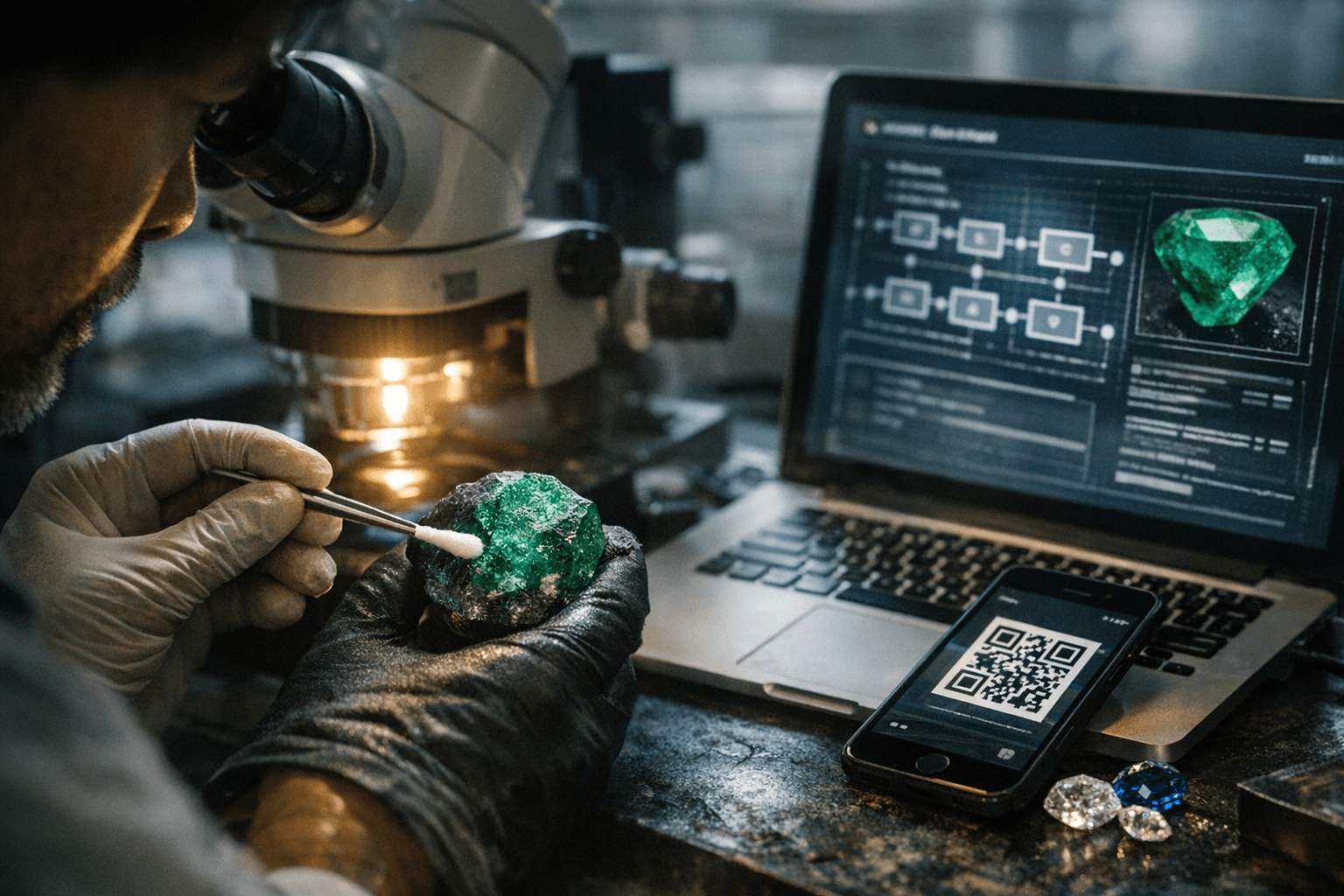
The appeal of blockchain for supply chain verification lies in its architecture. A traditional database can be altered, hacked, or selectively edited. A properly constructed blockchain creates a distributed record that no single party controls, meaning that a stone's documented history cannot be retroactively changed without detection. Every transaction, every transfer of custody, every test result can be logged as a block in the chain, creating what amounts to a permanent biography of the gemstone.
This matters for engagement rings specifically because the purchase is rarely made by someone with deep gemological expertise. The consumer is trusting, in sequence, the miner, the trader, the cutter, the wholesaler, and the retailer. Blockchain-based provenance tools allow that trust to be replaced, at least partially, by verifiable data. A QR code on a certificate, a scan from a smartphone, and suddenly the buyer can see a stone's documented history rather than simply accepting a seller's representation of it.
What This Means for the Buying Experience
The deployment of these tools does not yet mean that every diamond or colored stone available at retail comes with blockchain-verified, nanoparticle-traced provenance documentation. The infrastructure is being built; it is not yet universal. But the direction of travel is clear, and the pace of adoption is accelerating.
For anyone purchasing an engagement ring with a colored stone, it is worth asking retailers directly whether the stone has been verified through any of these emerging systems. Laboratories like Gübelin are issuing provenance documents that reflect their tracer technology, and those documents represent a meaningful upgrade over traditional certificates in terms of the evidence base they provide.
The pricing question is inevitable. Stones verified through these more rigorous systems will carry a modest premium, reflecting the cost of testing and documentation. That premium should be understood not as a markup but as what it actually is: the cost of certainty. For a stone that will be worn every day for decades, representing a commitment of both capital and sentiment, that certainty has its own value.
The Broader Stakes for the Trade
The gem industry has spent years under pressure to demonstrate that its supply chains are free of conflict financing, environmental destruction, and labor exploitation. Swab tests, nanoparticle tracers, and blockchain ledgers do not solve those problems by themselves, but they provide the evidentiary infrastructure that makes accountability possible. A stone whose mine-of-origin can be verified with physical evidence is a stone whose mining conditions can also be investigated and documented.
The technologies now being deployed are not merely commercial tools for protecting price premiums. They are the foundation of a more transparent gem trade, one in which the story a jeweler tells about a stone can be tested against independent evidence. That shift, still in its early stages in March 2026, will define what provenance means for the next generation of fine jewelry.
This article was produced by Prism’s automated news system from verified source data, official records, and press releases, then run through automated quality and moderation checks before publishing. The system is built and supervised by the people who set the standards it runs under. Read our full AI policy.
Did this article answer your question?