Oval Engagement Rings: Why This Timeless Cut Looks Larger Per Carat
Serena Williams's 14-carat XIV Karats oval stunner explains everything: this cut delivers more visible diamond per carat than almost any other shape on the market.
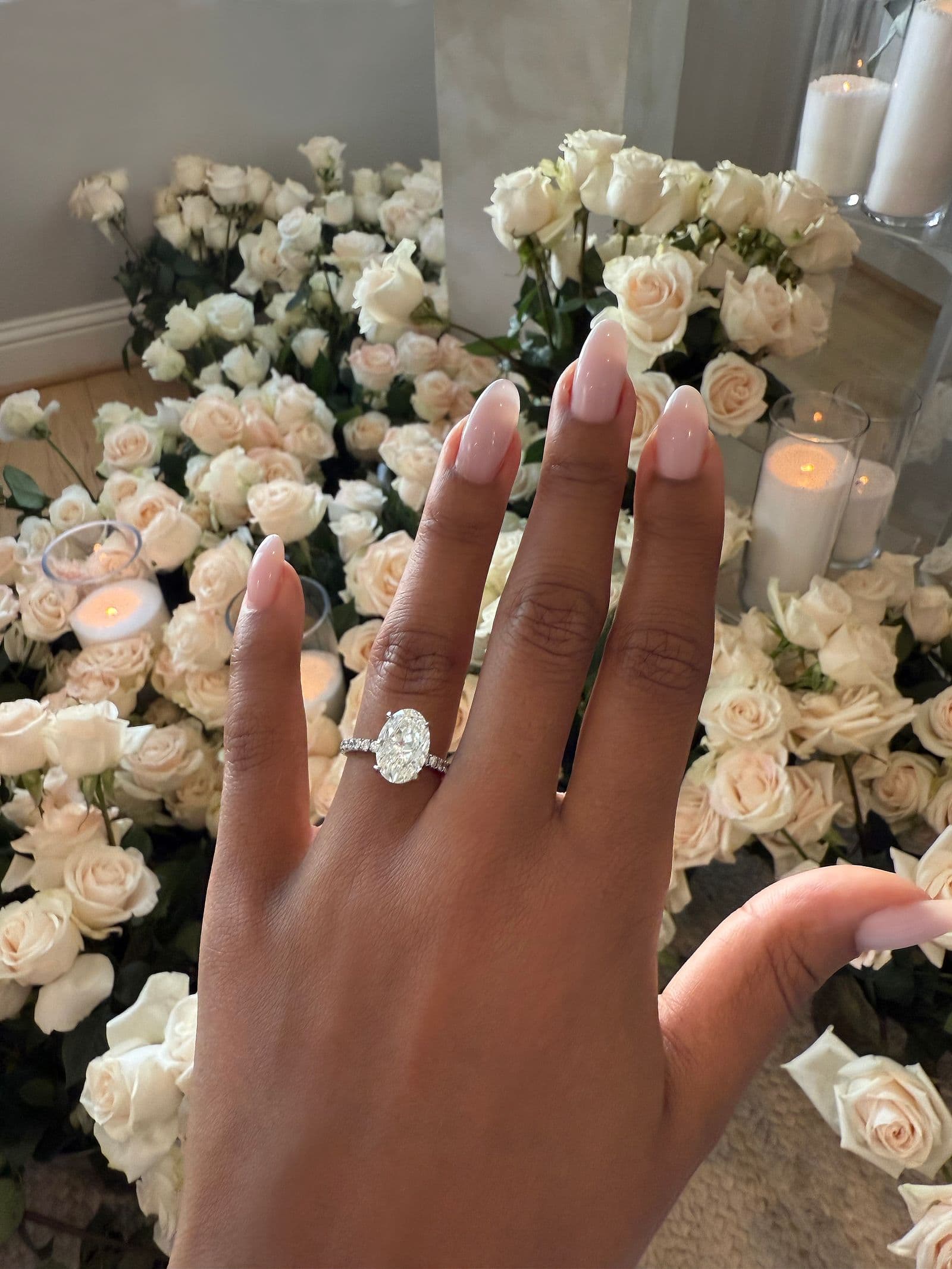
Serena Williams wore it to her New Orleans wedding with a curved band of three pear-shaped stones stacked alongside it, and the original ring, a 14-carat oval center flanked by two trapezoid side stones designed by XIV Karats, remains one of the most-studied engagement rings in recent memory. The reason it commands such attention has less to do with its extraordinary carat weight and everything to do with the cut itself: the oval is, by design, a shape that performs above its weight class.
That optical generosity is the oval's defining advantage. The elongated form spreads a diamond's mass across a greater surface area than a round brilliant of identical carat weight, so an oval simply reads larger on the hand. Céline Assimon, CEO of De Beers Jewellers, explains the mechanics precisely: "The elongated shape also creates an illusion of greater carat weight and makes the finger appear long and slender, which is very flattering." The brilliance is no trade-off, either. "The oval shape possesses a similar ability to reflect light and maximise brilliance as the round brilliant cut," Assimon adds, "and plenty of sparkle, because the shape is a classic with a contemporary twist."
What Makes the Oval Cut Exceptional
The oval is, at its core, a modified brilliant cut, which means its faceting pattern is engineered to maximize light return in the same manner as a round. What the shape sacrifices in perfect symmetry, it gains in personality. Jenny Chung Seeger, founder of Eliette and No.3 Fine Jewelry, captures the distinction well: "An oval has all the sparkle of a classic, round diamond, but with a little more attitude. They have a softer, more directional silhouette that elongates the hand in a really flattering way. There's a sense of movement to the shape, it feels romantic and modern at the same time."
That sense of movement is not merely poetic. The oval's elongation creates a directional pull across the finger that rounds and cushion cuts simply cannot replicate, and for hands of nearly any proportion, the effect is a quietly flattering one. Guy Burton, director at Hancocks jewellers, calls the oval "a classic and beautiful shape that has timeless appeal and is universally flattering," and the consistency of that verdict across gemologists, retailers, and designers is striking.
The shape also occupies an enviable position in jewelry culture: simultaneously classic and current. It is neither the staid conservatism of a round solitaire nor the self-conscious novelty of a pear or marquise. Vogue describes it as "a modern classic" that "can be set with a very fashion-forward edge," and the roster of stylish women who have chosen it, including Lady Gaga, Phoebe Tonkin, Hailey Bieber, and Kourtney Kardashian, confirms that the oval reads as effortlessly chic across generations and aesthetics.
The Celebrity Effect
Kourtney Kardashian's engagement to Travis Barker made the oval's cultural dominance impossible to ignore. When she confirmed the news on Instagram, she was wearing a staggering oval diamond on the fourth finger of her left hand, and her sister Kim documented the moment on her Instagram Stories. The image circulated widely, and for good reason: a well-cut oval on the hand is immediately arresting, its length catching light at angles that rounder stones simply cannot.
Serena Williams's ring remains the more technically instructive example. The XIV Karats design places the 14-carat oval at the center, flanked by two trapezoid side stones that anchor the composition without competing with the center stone's elongated drama. Then, at her New Orleans wedding, Williams added a curved band set with three pear-shaped stones to the stack, a detail that illustrates exactly how the oval's silhouette invites creative stacking and customization. Pear and oval shapes share a directional logic, and the two work in concert rather than in conflict.
Setting the Stone: What Works Best
The oval's versatility is one of its most practical virtues. The three settings most consistently recommended for the cut are the solitaire, the halo, and the three-stone, each of which honors the stone's proportions in a distinct way.
A solitaire setting places the oval in the most unobstructed context, allowing its surface area and light performance to dominate. A halo, in which smaller diamonds encircle the center stone, amplifies the perceived size further still, an especially effective choice for buyers working with a more modest carat weight. The three-stone configuration, as seen on Williams's ring with its trapezoid flanking stones, adds architectural weight and a sense of occasion without disrupting the oval's elongating effect.
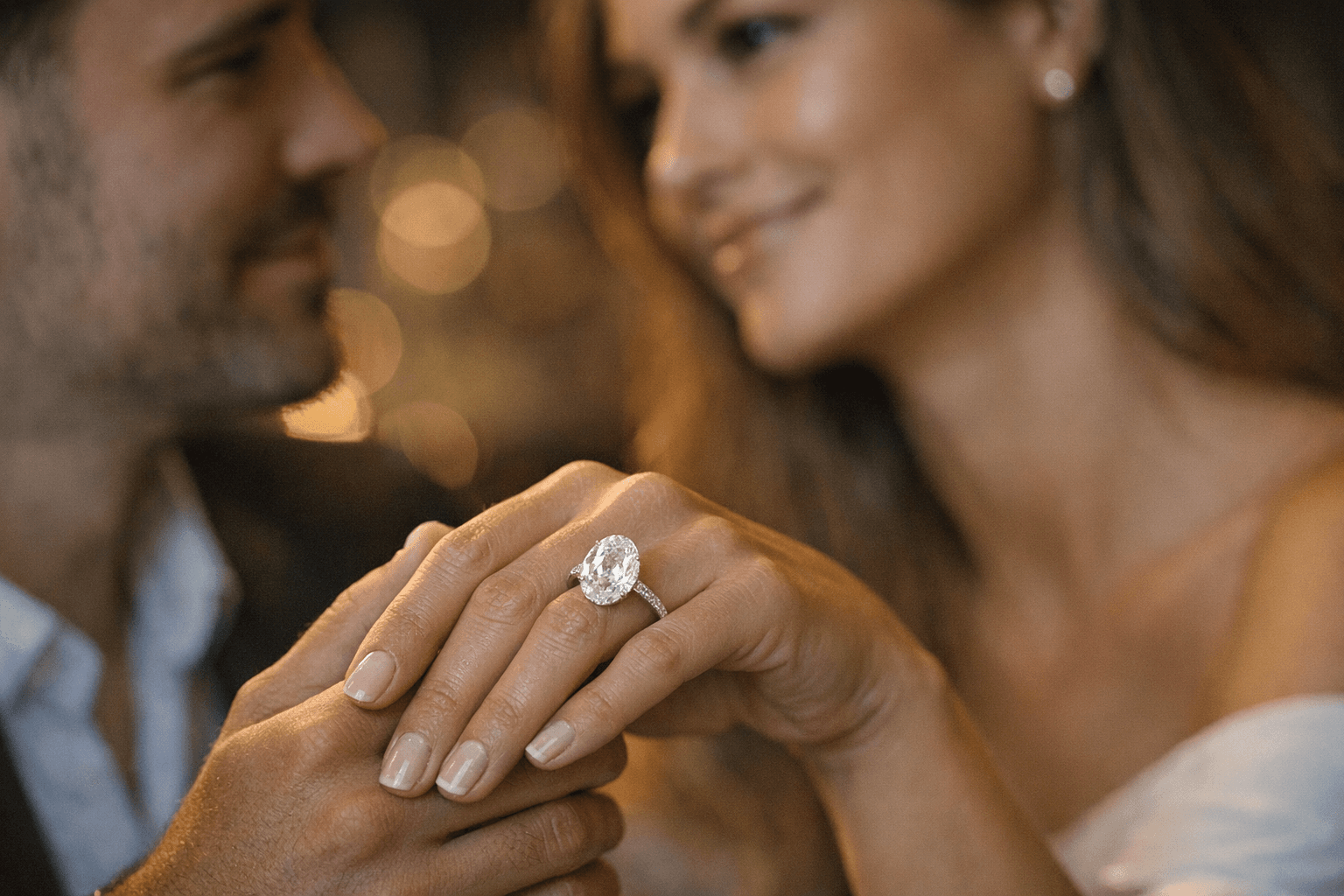
For buyers with a fashion-forward inclination, the oval's shape also adapts elegantly to east-west settings, in which the stone is turned horizontally across the finger, an approach that reads as distinctly contemporary without requiring any compromise in stone quality.
Pairing with a Wedding Band
The oval's distinctive silhouette raises a practical question that rounds never have to answer: how do you fit a straight band against a curved center stone? The solution is a contoured or curved wedding band, shaped to nestle snugly against the setting without leaving a gap. Thin pavé bands work particularly well in this role, their line of small diamonds echoing the center stone's brilliance without competing for attention. A plain, polished metal band is equally effective for those who prefer a quieter aesthetic, keeping the focus precisely where it belongs.
Navigating the Market
The price range for oval engagement rings is genuinely wide, which reflects both the flexibility of the cut and the diversity of the designers working with it. British Vogue's current edit of the shape spans from Grace Lee's triple diamond "globe" ring at £2,028, a more sculptural interpretation of the oval theme, to Katkim's floating oval diamond ring at £3,058, notable for its minimal setting that allows the stone to appear almost suspended. De Beers' oval-shaped diamond ring at £9,150 represents the house's characteristic combination of precise craftsmanship and institutional gravitas. At the upper end, Jessica McCormack's diamond oval ring at £28,000 speaks to the London designer's reputation for bold goldsmithing and stones selected for character as much as specification.
None of these prices should be read in isolation from the metal, the stone's individual quality, and the setting complexity. An oval's elongated shape means that color and clarity are visible across more surface area than in a compact round, which is a useful fact to carry into any conversation with a jeweler.
On Sourcing and Sustainability
The growing availability of laboratory-grown diamonds has made the oval cut newly accessible at lower price points. Both natural and grown diamonds are cut in the oval shape, and the optical differences between them are imperceptible to the naked eye. When selecting a stone, independently certified diamonds, whether mined or grown, offer the greatest transparency about provenance and quality grading. Any reputable jeweler should be able to provide documentation from a recognized gemological laboratory.
Why the Oval Endures
The oval has been chosen by enough culturally significant women, styled by enough serious jewelers, and praised by enough gemologists that its status as a modern classic is not a marketing claim but a verifiable fact. What distinguishes it from other "trending" cuts is the underlying technical logic: it offers more visible diamond per carat, more flattery per millimeter, and more design flexibility per setting than almost any alternative. The round brilliant will always have its authority. But the oval has something the round cannot offer: the suggestion of movement, of a stone with somewhere to go.
This article was produced by Prism’s automated news system from verified source data, official records, and press releases, then run through automated quality and moderation checks before publishing. The system is built and supervised by the people who set the standards it runs under. Read our full AI policy.
Did this article answer your question?