Dior layers sculptural stone necklaces in a couture nod to Indian craft
Dior’s stone necklaces turn layering into sculpture, stacking mother of pearl, rock crystal, and carved green onyx into a tactile couture statement.
Dior’s latest layering story does not rely on more chains, more shine, or more of the same familiar minimal stack. At the Musée Rodin in Paris, the house showed colorful layered stone necklaces that looked built, not merely worn, with mother of pearl, rock crystal, and carved green onyx creating a stacked surface of light, color, and volume.
A stack that reads like sculpture
The strongest shift in the show is how the jewelry behaves on the body. Instead of thin links disappearing into one another, the necklaces build outward through contrast, with opaque shell, clear stone, and carved green surfaces creating depth one element at a time. The result is closer to wearable art than classic adornment, and it gives layering a more tactile, couture-minded vocabulary.
That matters because the old shorthand for layered jewelry has started to feel tired, especially the idea that a stack becomes interesting simply by adding more of the same. Dior’s answer is to make the materials do the work. Mother of pearl brings iridescence, rock crystal catches light with clarity, and carved green onyx adds a dense, sculptural note that gives the whole composition weight.
Jaipur, Rajasthan, and the craft behind the stones
The necklaces were created by artisans in Jaipur and Rajasthan, a detail that shifts the conversation from styling to provenance. The pieces do not present themselves as abstract luxury objects; they carry a clear craft lineage tied to Indian making, with local hands shaping the stones into something that feels disciplined rather than decorative for decoration’s sake.
One layer of meaning comes from the green onyx itself. It was chosen to evoke the symbolic emeralds of Rajasthan, which places color choice in a regional frame rather than a purely aesthetic one. That is the sort of detail that separates a thoughtful material story from vague heritage language, because the reference is specific and legible: the color echoes a place, not just a trend.
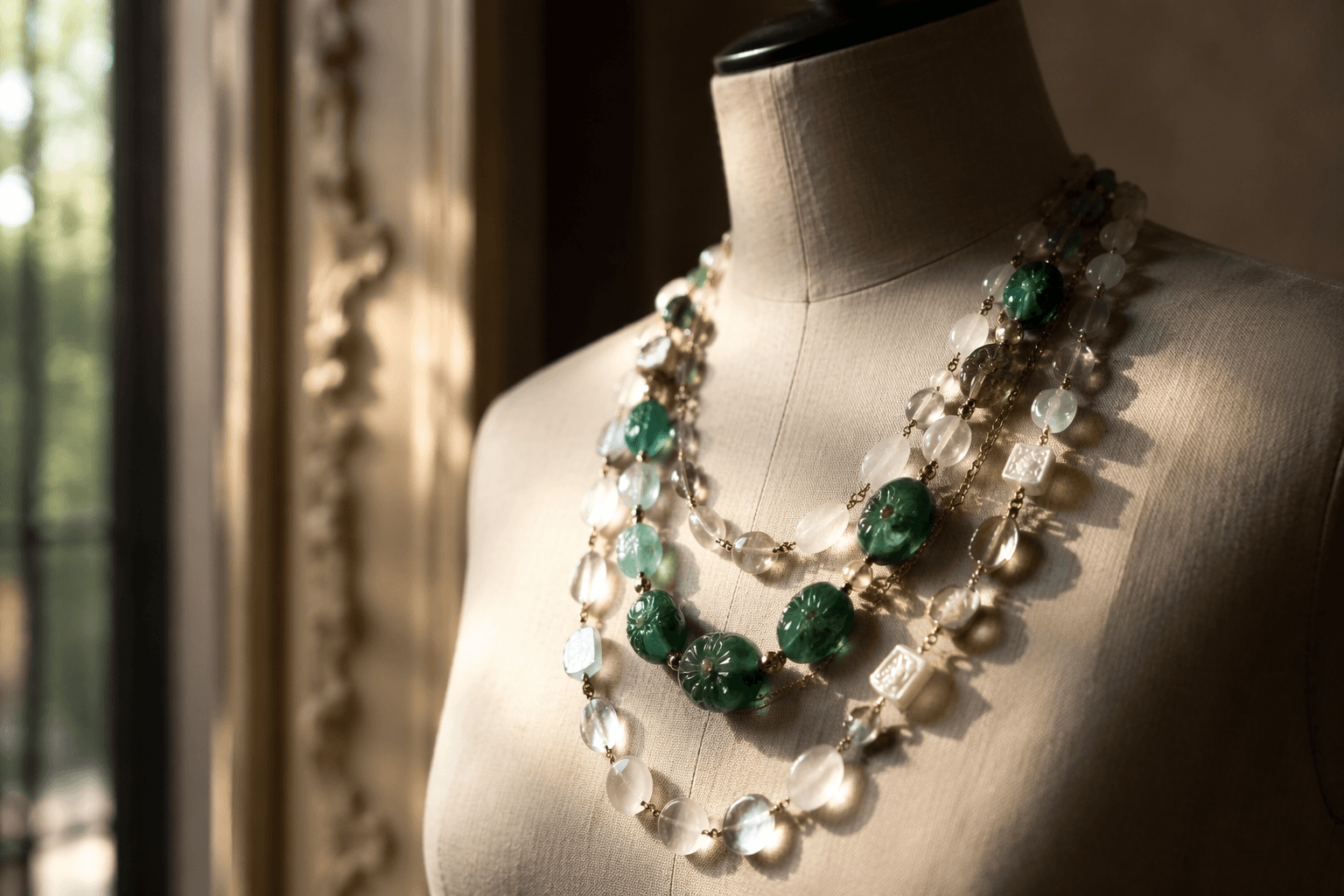
Some versions of the jewelry were also strung on hand-braided dori cords, a construction that reinforces the sense of craft rather than polish alone. The corded finish softens the formality of stone and makes the pieces feel more flexible, more intimate, and more connected to handwork. In a market crowded with generic layering pieces, that physical distinction matters.
Jonathan Anderson’s couture logic
Dior says the collection responds to the work of American sculptor Lynda Benglis, whose practice often begins with two-dimensional materials and transforms them into three-dimensional forms through knotting, pleating, or moulding. Jonathan Anderson used the same logic in the couture, working with hand-plissé, knotting, and draping to turn surface into volume. The jewelry sits inside that same argument, so the necklaces do not feel like an accessory added at the end; they feel like an extension of the garment’s construction.
That is why the layering reads as couture rather than costume. The show treats ornament as part of the dressmaking language, not a separate category of sparkle. The stone necklaces echo the folds and knots in the clothing, creating a visual rhythm where fabric and jewelry seem to share the same sculptural grammar.
Why this version of layering feels new
This is the sharper alternative to the thin, uniform layering trend that has dominated so much recent jewelry dressing. Dior is showing that stacking can be about contrast in texture, opacity, and volume instead of sheer quantity. A single necklace with shell, quartz, and carved stone can do more than a whole wrist of identical chains because each material gives the eye a different place to land.
The pieces also suggest a more deliberate way to think about investment jewelry. Stone layering of this kind depends on craftsmanship that can hold its form, on materials with visible character, and on a design language that tolerates asymmetry, density, and surface variation. That makes the look feel less disposable than trend-driven stacking, even when it is expressive and bold.
The same instinct appears across the rest of the collection, where antique chintz and indiennes textiles were worked into accessories such as the Petit Dîner and mini Lady Dior bags. Taken together, those details show a house building an argument about material heritage across categories, not just in the necklaces. The jewelry belongs to that wider system, where cloth, stone, and form are all pressed into a single couture conversation.
The wider Dior frame
This was Jonathan Anderson’s second haute couture show for Dior, and the setting sharpened the attention on how he is recasting luxury through craft. The show space stayed open to the public until July 12 during the exhibition Grammar of Forms, which paired pieces from the new couture collection with Dior archives and works by Lynda Benglis. That framing put the jewelry in direct dialogue with the house’s own history and with the sculptural ideas behind the clothes.
What emerges is not a louder version of layering, but a more considered one. Dior is using mother of pearl, rock crystal, carved green onyx, and hand-braided cord to argue that excess can be defined by texture, not just by accumulation. In this collection, layering is not about adding more. It is about making every surface count.
This article was produced by Prism’s automated news system from verified source data, official records, and press releases, then run through automated quality and moderation checks before publishing. The system is built and supervised by the people who set the standards it runs under. Read our full AI policy.
Did this article answer your question?