Fisayo Longe turns stacked gold rings into sculptural style statements
Fisayo Longe makes ring stacks feel architectural, not crowded. Her gold formula shows how one bold piece can anchor the whole hand.
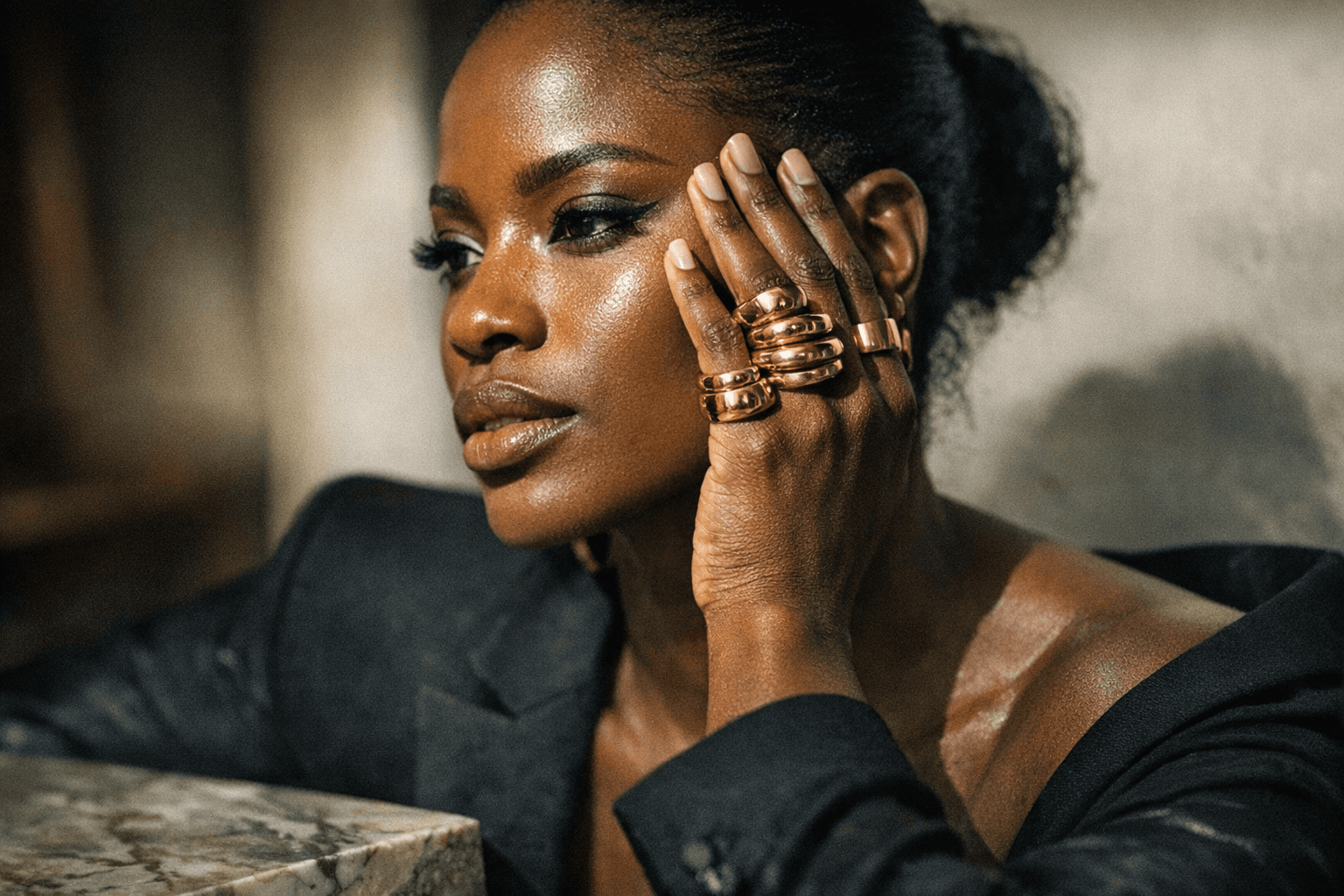
The power of one sculptural focal point
Fisayo Longe’s best jewelry lesson is that a stack should look designed, not assembled. In the LEURR Nigeria profile, her rings and gold accessories are framed as part of a larger visual language that favors visible logos, oversized earrings, and deliberate overstatement, all in sharp contrast to the softer language of quiet luxury. That contrast is exactly what gives her hand styling its force: the eye lands on one clear statement, then follows the rhythm of the pieces around it.
Kai Collective, the London-based contemporary brand she founded in 2016, was built after Longe had already spent years as a fashion and travel blogger. The brand says it was created to inspire confidence in women, and Longe’s own site describes her as a Nigerian entrepreneur who built Kai Collective and created Many Mentors to help others launch creative businesses. That background matters, because her jewelry never reads as decoration for its own sake. It feels like an extension of brand identity, personal ambition, and self-possession.
Why ring stacking feels current again
Ring stacking has become a retail category in its own right, with major fashion and jewelry retailers such as Tiffany & Co. and Nordstrom merchandising stacked and stackable rings as a distinct way to buy. That shift says something important: the look is no longer a styling accident or a niche habit. It is a recognized form of composition, with its own logic of proportion, spacing, and metal balance.
The style also has deep roots. The Metropolitan Museum of Art notes that Hellenistic jewelry included finger rings among many forms of ornament, and Britannica points out that rings have long carried meanings beyond beauty, serving as symbols of authority, fidelity, and social status. In other words, Longe’s gold-heavy stacks do not feel like a passing trend. They feel like a modern revival of a very old instinct to speak through the hand.
Three formulas that make the look work
The easiest way to copy Longe’s effect is to think like an architect, not a collector. Each piece should earn its place, and each finger should either reinforce the focal point or step back so the composition stays legible.
- The anchor-and-echo formula
Start with one sculptural ring, ideally on the index or middle finger, then support it with two slimmer bands on neighboring fingers. The oversized piece becomes the visual anchor, while the slimmer rings create a cadence that keeps the hand from looking overloaded. The result is maximalist, but the eye still knows where to land first.
- The gold-on-gold formula
Keep the metal tone consistent and let width do the talking. A broad, high-shine gold ring can sit beside finer bands with a different profile, but the shared finish prevents the stack from turning chaotic. This is the cleanest way to make statement gold feel luxurious rather than noisy.
- The loud-hand, quiet-hand formula
Let one hand carry the full story and leave the other nearly bare, or repeat only one restrained band on the opposite side. That asymmetry gives the larger stack room to breathe and makes the jewelry feel intentional rather than accidental. It is also the fastest way to keep a lot of ring weight from overwhelming the rest of the look.
How to keep sculptural stacking balanced
The secret to making stacked gold look expensive is proportion. When the widest ring is also the tallest or most dimensional, the surrounding bands should be slimmer and lower so the silhouette does not bunch up at the knuckles. Leave at least one finger unstacked, because negative space is what turns a cluster of rings into a composition.
Shape matters as much as volume. Smooth domes, softened edges, and polished gold surfaces read more sculptural than fussy, especially when paired with simple bands that act as visual rests. That is why Longe’s style feels more like wearable form than ornament piled on ornament. The pieces are doing different jobs.
Why Longe’s version stands apart
What makes Longe compelling is that she treats jewelry as part of a larger system of dressing. Her hand stacks speak to the same confidence as her broader style, where bold accessories are not an afterthought but a declaration. In a fashion moment that has leaned hard into restraint, her choice to wear gold loudly, visibly, and with control feels both personal and pointed.
That is the real lesson in her rings: stacking works best when it has hierarchy. One piece leads, a few pieces support, and the whole hand reads as a single gesture. In Longe’s case, the gesture is unmistakable, and that is what makes the gold feel sculptural rather than merely styled.
This article was produced by Prism’s automated news system from verified source data, official records, and press releases, then run through automated quality and moderation checks before publishing. The system is built and supervised by the people who set the standards it runs under. Read our full AI policy.
Did this article answer your question?