Jewelry-forward watches redefine wrist stacking, from rose gold to leather straps
Jewelry-like watches are taking the lead in wrist stacks, with rose gold, leather straps, cocktail watches, and wrap styles doing the best work as anchors.
Why the watch belongs in the stack now
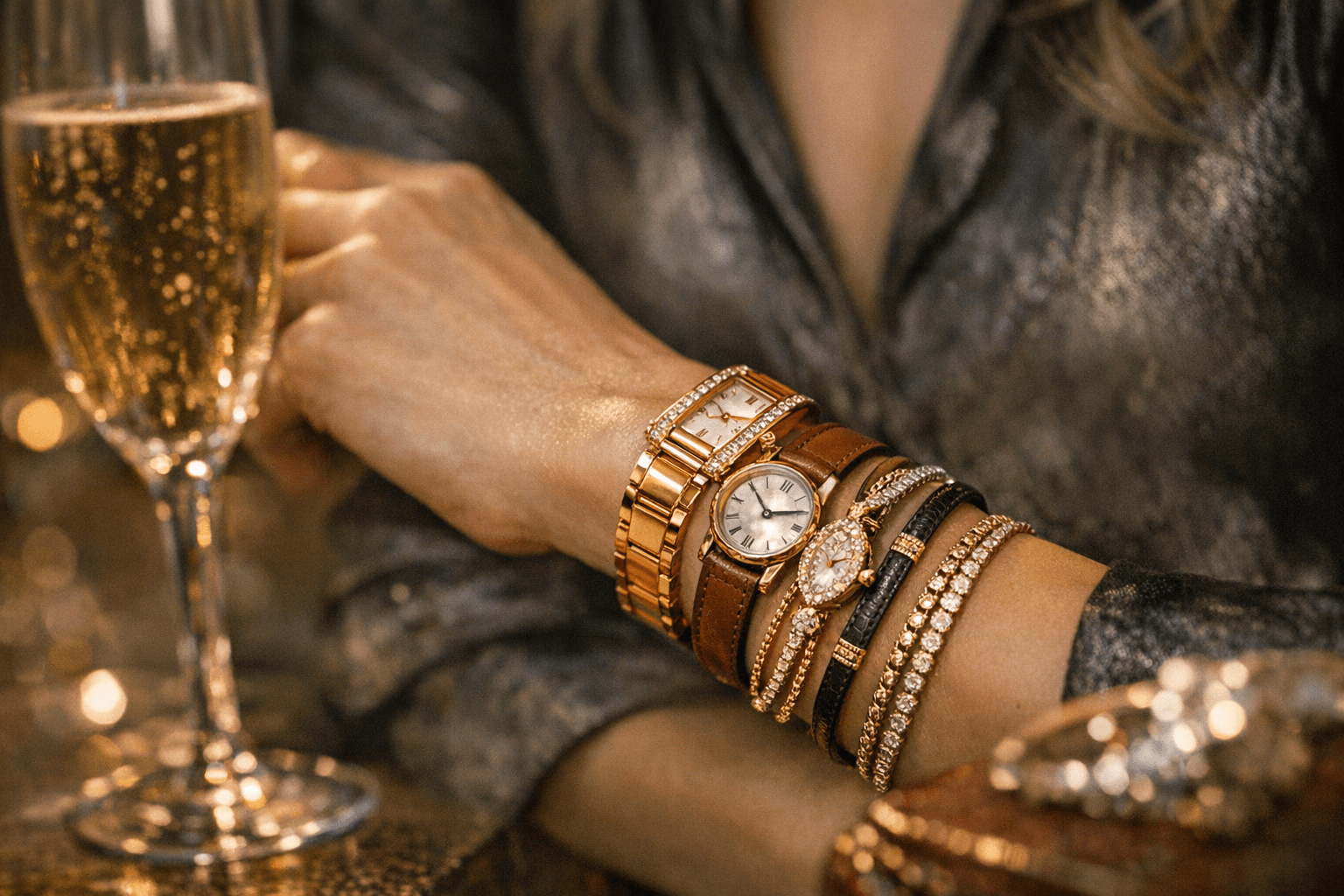
A good wrist stack starts with proportion, and this season the watch is acting less like a solo object and more like the anchor that gives the whole composition shape. That is why the most interesting 2026 styles are the ones that feel jewelry-forward first: rose-gold cases, leather straps, cocktail watches, and wrap styles that leave room for bracelets to breathe instead of crowding them out.
The shift makes sense in a luxury market where watches and jewelry already move together. McKinsey says personal luxury goods, including watches and jewelry, grew 5 percent a year between 2019 and 2023, while Deloitte’s 2025 Swiss Watch Industry Study drew on surveys of 111 senior executives and 6,500 consumers and identifies women and Gen Z as decisive growth engines. The message from the market is clear: the watch is no longer just a utility object, it is part of the styling equation.
Rose gold is the easiest bridge between watch and jewelry
Rose gold works in wrist stacks because it softens the line between timepiece and ornament. It reads warmer than steel, less formal than yellow gold, and more intentional than a generic silver finish, which makes it especially useful when you want bracelets, cuffs, and bangles to feel related without looking overly matched. If your stack already includes mixed metals, a rose-gold watch can become the bridge piece that keeps everything from looking scattered.
Rolex’s Everose gold is a useful example of how major houses are treating pink gold as a serious material story rather than a passing trend. Rolex says the alloy was introduced in 2005, patented by the brand, and used across its Oyster models in pink gold. That kind of specificity matters, because a named alloy carries more weight than vague “gold tone” language and gives the piece a clearer provenance in the way serious buyers now expect.
Leather straps make room for bracelets to do their work
The renewed interest in Carolyn Bessette Kennedy’s Cartier Tank Louis has helped pull leather straps back into the center of the conversation. Cartier says the Tank was designed by Louis Cartier in 1917, inspired by WWI tanks, and describes it as an icon of modern watchmaking. That history matters because the watch’s shape is already disciplined and architectural, which is exactly why it layers so well with jewelry.
Leather changes the geometry of a wrist stack. It reduces metal-on-metal friction, lets a cuff sit beside the watch without competing for shine, and gives bangles a softer visual neighbor than a full bracelet case. If the watch is your anchor, a leather strap is the quietest and often the smartest way to let the rest of the stack do the sparkling.
Cocktail watches and wrap styles are the most decorative options
Cocktail watches and wrap styles are the pieces that lean hardest into the jewelry side of the category. Their appeal is not just that they tell time, but that they read as adornment first, which makes them natural companions for slimmer bracelets or a single sculptural cuff. They are the watches that can make a wrist stack feel finished rather than assembled.
Wrap styles are especially useful when the rest of the wrist needs visual structure. Because they coil or extend around the wrist, they can serve as both a focal point and a framing device, which means you do not need to overload the hand with multiple competing pieces. A wrap watch tends to work best with fewer, cleaner neighbors, so the eye still lands on the overall composition instead of getting lost in shine.
How to build the stack around one watch
The easiest way to make a wrist stack look deliberate is to treat the watch like the lead instrument and everything else like accompaniment. A smaller watch case can support a stronger cuff, while a larger watch needs slimmer bracelets so the wrist does not feel crowded. The goal is balance, not symmetry, and the best stacks keep a little negative space between pieces so each one can register.
- Match metals when the watch already has a strong finish, especially with polished cases or bracelets.
- Mix metals when one piece can act as a bridge, such as rose gold with yellow gold or a leather strap with mixed bracelets.
- Keep textures varied, pairing a smooth watch case with a chain bracelet, a hammered cuff, or a round bangle.
- Stop before the stack starts to fight the crown, clasp, or buckle, because comfort is part of the look.
- Use one statement piece and let the rest stay slimmer, so the watch remains the anchor rather than just another participant.
That approach matters even more when you are layering around a watch that already has decorative force. A cocktail watch may only need one slim bracelet to feel complete, while a leather-strap Tank can support a fuller mix of bangles and cuffs. A rose-gold watch can often carry warmer neighboring pieces with ease, but a watch that already feels heavy on the wrist usually needs more breathing room, not more metal.
Why the trend is showing up now
Watches and Wonders Geneva 2026, running April 14 to 20 with 65 exhibiting brands, is the kind of showcase where these styling shifts become visible in real time. The industry is clearly leaning toward smaller, more wearable, more style-led watches, and that dovetails with the broader appetite for pieces that can do double duty as jewelry. When the fair floor, the retail floor, and the wrist all point in the same direction, the trend stops being theoretical.
The smartest 2026 wrist stacks are not about piling on as much as possible. They are about choosing one watch with enough presence to organize the rest, then building around it with the same care you would bring to a necklace stack or an ear stack: clean proportions, coherent metals, and one clear point of view. In that frame, the watch is no longer separate from the jewelry. It is the piece that gives the whole wrist its line.
This article was produced by Prism’s automated news system from verified source data, official records, and press releases, then run through automated quality and moderation checks before publishing. The system is built and supervised by the people who set the standards it runs under. Read our full AI policy.
Did this article answer your question?