Acrostic jewelry, the hidden language of gemstone initials
Acrostic jewelry turns gemstones into private messages, from REGARD to Eugène and Hortense, and its coded romance still feels made for modern gifting.
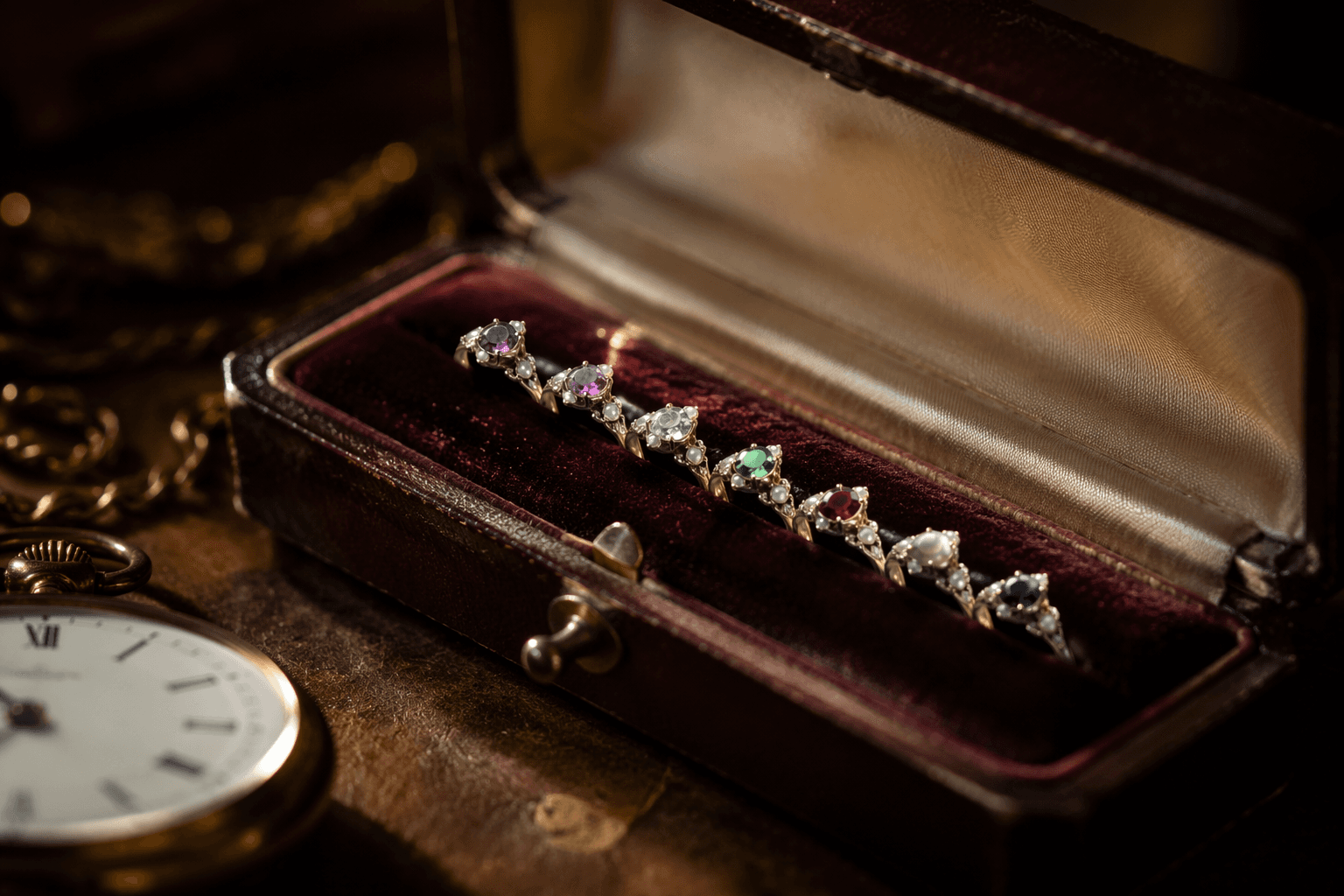
Acrostic jewelry speaks in gemstones the way a love letter speaks in code. Each stone stands for a letter, so a ring, bracelet, pendant, or locket can spell a name, a sentiment, or an intimate joke while still reading as a jewel first.
The secret alphabet behind the sparkle
The language is deceptively simple: the first letter of each gemstone forms a word. The best-known historic example is REGARD, built from ruby, emerald, garnet, amethyst, ruby, and diamond. Other favored words included DEAREST, ADORE, and SOUVENIR, which gives the form its special charge: the message is hidden in plain sight, but only if you know how to read it.
Jean-Baptiste Mellerio, the jeweler to Marie Antoinette and the French court, is credited with inventing the format. It took hold in Georgian England in the 1820s and 1830s, then remained fashionable through much of the Victorian era. That long run makes sense because acrostic jewelry does something few other styles manage so elegantly: it combines sentiment, gem knowledge, and the visual pleasure of color into one piece.
Why the code mattered in the Georgian and Victorian eras
Acrostic jewelry was never just decorative. It belonged to a culture in which rings, lockets, and small ornaments already carried private meaning, and where the choice of stone could say as much as a carved inscription. Napoleon Bonaparte was reportedly enchanted by the idea and commissioned acrostic pieces for family members, which tells you how quickly the format moved from novelty to courtly token.
The historical record around sentimental jewelry makes the appeal even clearer. The Metropolitan Museum of Art documents early American jewelry tied to courtship, marriage, death, and mourning, including lockets with hair beneath crystal and memorial details. The Victoria and Albert Museum notes that rings have served as love gifts and symbols of marriage since Roman times, and that medieval posy rings often carried affectionate inscriptions in Latin or French. In that company, acrostic jewelry reads less like a quirky side note and more like a refined chapter in a much older tradition of coded devotion.
How to read a piece like a jeweler
The charm of acrostic jewelry is that the meaning depends on the stone names, which means gemology matters. A ruby is not just a red accent, an emerald is not just green, and a diamond is not merely the bright ending to a sequence. Each contributes a letter, and the spelling has to work as a word or name, which makes the design both literary and technical.
That technical layer can get tricky with antique pieces. Some historical systems used older gem names, such as vermeil for garnet and jacinth for the stone corresponding to J, which means a modern eye may not decode an antique jewel correctly on first glance. That is part of the pleasure: an acrostic jewel can be read visually, emotionally, and linguistically at once. A collector does not just look at the stones, but at the logic binding them together.
- The sequence of stones is the message.
- Color alone is not enough, since the letter is tied to the gem name.
- Antique examples may use obsolete names that shift the spelling.
- Motifs can be layered, as with a pansy, a flower traditionally associated with thinking of you, tucked into an acrostic locket.
A few details are worth noticing when you encounter one:
That last detail shows how sophisticated the form can be. A single jewel might carry both a coded word and a symbolic flower, making the sentiment deeper without becoming obvious.
Joséphine, Chaumet, and the aristocratic seal of approval
Few names are as closely linked to acrostic jewelry as Empress Joséphine. Chaumet, founded in Paris in 1780 and later the official jeweler to Empress Joséphine, highlights acrostic bracelets that spelled the names of her two children, Eugène de Beauharnais and Hortense de Beauharnais, using colored stones matched to the alphabet. That detail matters because it shows acrostic jewelry at its purest: not merely decorative initials, but a private family message rendered in gems.
Joséphine’s bracelets also illustrate how the format can feel both intimate and formally luxurious. The stones had to be selected for color and letter, but the result still belonged to the language of high jewelry. That balance, between emotion and craft, is exactly why the style survives. The message can be personal, but the object still needs grace, proportion, and wearability.
The modern revival and why it feels current
Acrostic jewelry has never fully disappeared. GIA names contemporary designers including Jessica McCormack, Lulu Frost, Chaumet, Cartier, and Erica Weiner as part of its revival, which places the style squarely in the present rather than behind museum glass. Erica Weiner’s current Secret Message Acrostic Ring, Necklace, and Bracelet make that especially visible, since the idea is being sold today not as nostalgia, but as a living design language.
That endurance makes sense in a culture that prizes personalization, but often in ways that are blunt, oversized, or overly literal. Acrostic jewelry offers something more discreet. It lets a piece say “I chose this for you” without broadcasting the entire sentence to the room, and that subtlety is part of the luxury. The wearer gets the story; everyone else gets a beautiful jewel.
Why acrostic jewelry still works for love, family, and inheritance
The form is especially powerful for anniversaries, weddings, and heirloom redesigns because it can carry a name, a date, a private phrase, or a family bond without sacrificing elegance. A ring spelling a partner’s name, a bracelet encoding children’s initials, or a pendant built from a shared word becomes a jewel with narrative architecture. It feels deliberate because every stone has to earn its place.
That is what separates acrostic jewelry from generic personalization. A monogram can be direct, but acrostic jewelry is more poetic. It asks the maker to think like a designer and the giver to think like a correspondent, which is why the result can feel so charged. In a modern jewelry box full of initials, birthstones, and custom engraving, acrostic pieces still stand apart because they turn gemstone selection into a private language, and private language is one of the most enduring forms of romance.
This article was produced by Prism’s automated news system from verified source data, official records, and press releases, then run through automated quality and moderation checks before publishing. The system is built and supervised by the people who set the standards it runs under. Read our full AI policy.
Know something we missed? Have a correction or additional information?
Submit a Tip

