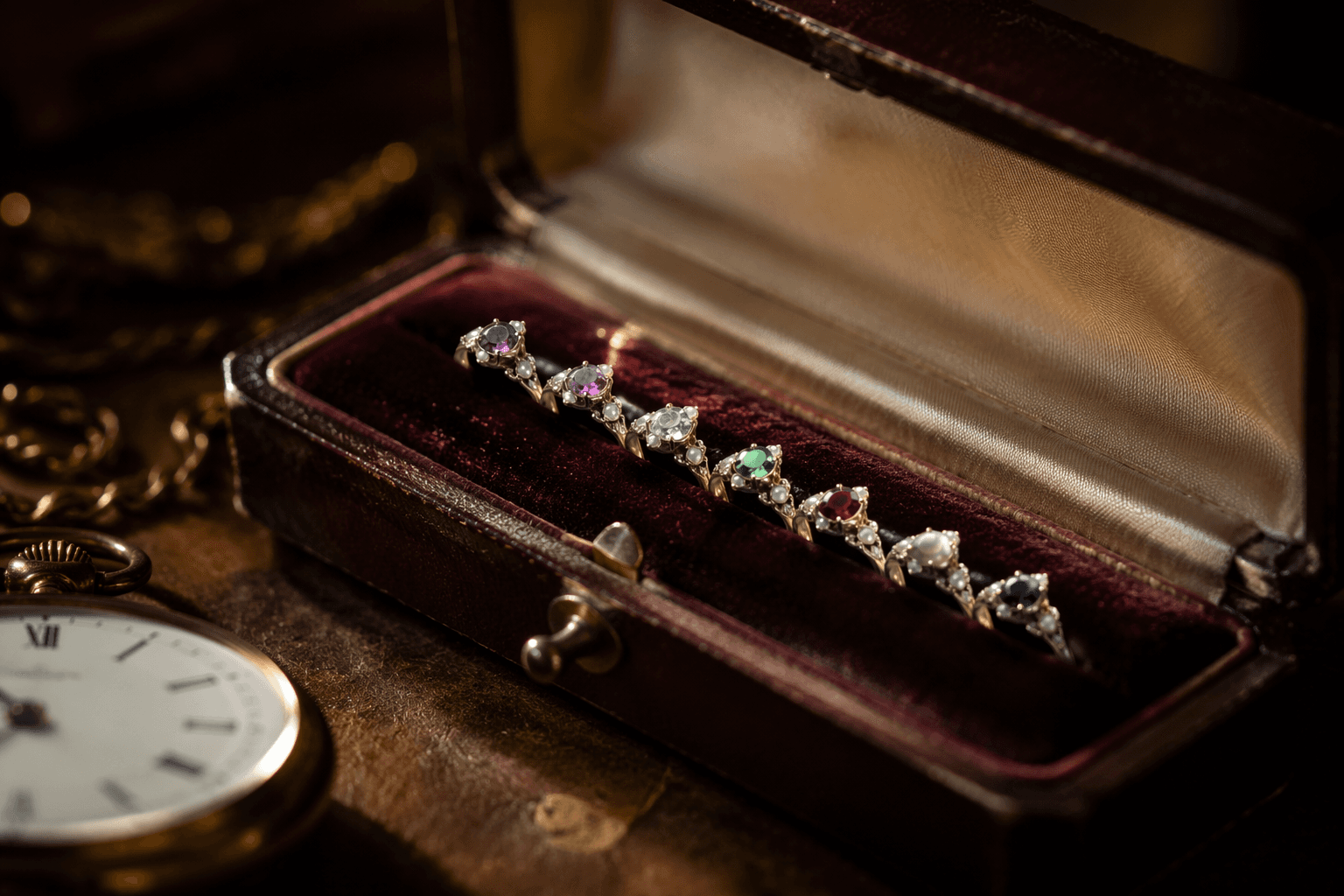
Treasure House Fair showcases heirloom jewels from Henry VIII’s era to today
A Henry VIII-linked ring, a Hamnet-era mourning jewel, and Rosior’s European-fair debut make provenance the star at Treasure House Fair.

Treasure House Fair returns to the Royal Hospital Chelsea with jewelry that reads like a compact history of Europe in metal and stone. The fourth edition, running from 24 to 30 June 2026, gathers roughly 60 to 70 dealers across art, antiques, design, jewelry, horology, and related fields, but the pieces most worth lingering over are the ones with names, dates, and documentary trails. Here, the selling point is not simply beauty. It is the evidence behind it.
A fair built on lineage
Treasure House positions itself inside a London summer art-fair tradition that it says reaches back to 1934, and the Royal Hospital Chelsea gives that claim real texture. The site is not a neutral convention hall but a historic London setting long associated with the city’s summer fair season, the kind of place where an antique jewel feels less like inventory and more like an artifact returned to public view. The fair also invokes Queen Mary as a royal patron of such shows, tying its contemporary ambition to a deeper British tradition of collecting, display, and connoisseurship.
That matters because the jewelry on view spans six centuries of European history. In a market crowded with marketing language about rarity, Treasure House leans on something sturdier: provenance, period context, and the ability of an object to survive long enough to be read again. The result is a fair that rewards slow looking, especially for buyers and collectors who care whether a jewel is merely old or meaningfully documented.
The historic jewels that anchor the room
The headline object for many visitors will be the ring linked to a confidant of Henry VIII. Tudor-era jewels carry a particular kind of charge because they sit close to power, court life, and the personal networks that shaped the period. A ring with that kind of association offers more than age alone, because it connects wearability, status, and named historical proximity in a single object.
Martyn Downer’s stand pushes that logic further with a Hamnet-era mourning jewel that was rediscovered four centuries after it was immortalized in a 17th-century family portrait. Mourning jewelry already speaks in a private register, using gems, inscriptions, and restrained design to hold grief in wearable form. A piece tied to portraiture adds another layer, turning the jewel into a bridge between image and object, between what a family chose to paint and what it chose to keep.
That combination is what makes the fair unusually rich for anyone drawn to heirloom jewelry. Antique rings, memorial jewels, and court-linked pieces do not rely on trend language. Their value lies in what can be traced, named, and placed in time. At Treasure House, the strongest historic jewels are not just decorative. They are proofs of survival.
A European debut beside old-master material
Rosior, the Portuguese jewelry maison, brings a contemporary note to the fair by making its debut at a European fair. That matters because it places a living maker beside historic material instead of separating the old from the new into different commercial worlds. For readers who collect with an eye to meaning, the contrast is useful: one side shows how jewelry has traveled through history, while the other shows how a maison today is still building identity through craftsmanship and presentation.
The fair’s exhibitor list reinforces that range. Martyn Downer’s focus on historic jewels and artifacts sits alongside Koopman Rare Art, where fine antique silver, gold boxes, and jewelry share space, a reminder that decorative arts rarely lived in isolation. In a setting like this, jewelry is not treated as a standalone luxury category. It sits among objects of use, ceremony, and display, which is exactly where many of the most interesting pieces belong.
That balance between antique authority and contemporary ambition is part of the fair’s appeal. Rosior’s presence shows that a European debut can still carry the language of rarity and connoisseurship, while the historic cases hold the persuasive weight of time. Together they keep the fair from feeling like a museum in a tent or a sales floor with a velvet rope.
How to read the fair like a collector
Treasure House is not only about looking at jewels in vitrines. Its public talks programme runs from 25 to 30 June and includes stand talks, panel discussions, and presentations from leading academics. That programming gives the fair an unusually useful structure for visitors who want context with their collecting. A jewel’s date, patron, or portrait history often changes how it should be read, and the talks offer a way to place the objects within larger histories of craftsmanship, patronage, and taste.
The fair’s format also encourages comparison. A ring linked to Henry VIII’s circle, a mourning jewel tied to family memory, and a contemporary Portuguese maison do not belong to the same century, but they do share a common question: what makes a jewel meaningful enough to preserve? At Treasure House, the answer is usually visible in the object itself, in the quality of its making, the precision of its association, and the kind of story it can carry without strain.
That is why the fair’s best jewelry does not depend on spectacle alone. It asks for attention, then rewards it with history that can be named. In a luxury market where too many pieces are sold on atmosphere, Treasure House makes the older argument that still matters most: the rarest jewels are the ones that can tell you exactly where they came from.
This article was produced by Prism’s automated news system from verified source data, official records, and press releases, then run through automated quality and moderation checks before publishing. The system is built and supervised by the people who set the standards it runs under. Read our full AI policy.
Know something we missed? Have a correction or additional information?
Submit a Tip