African Designers Revive Ancient Beadwork, Forging, and Carving Traditions in Modern Jewelry
Kenyan designer Ami Doshi Shah was the only jeweler invited from around the world to London Fashion Week 2019 — proof that Africa's ancient craft traditions are reshaping global fine jewelry.
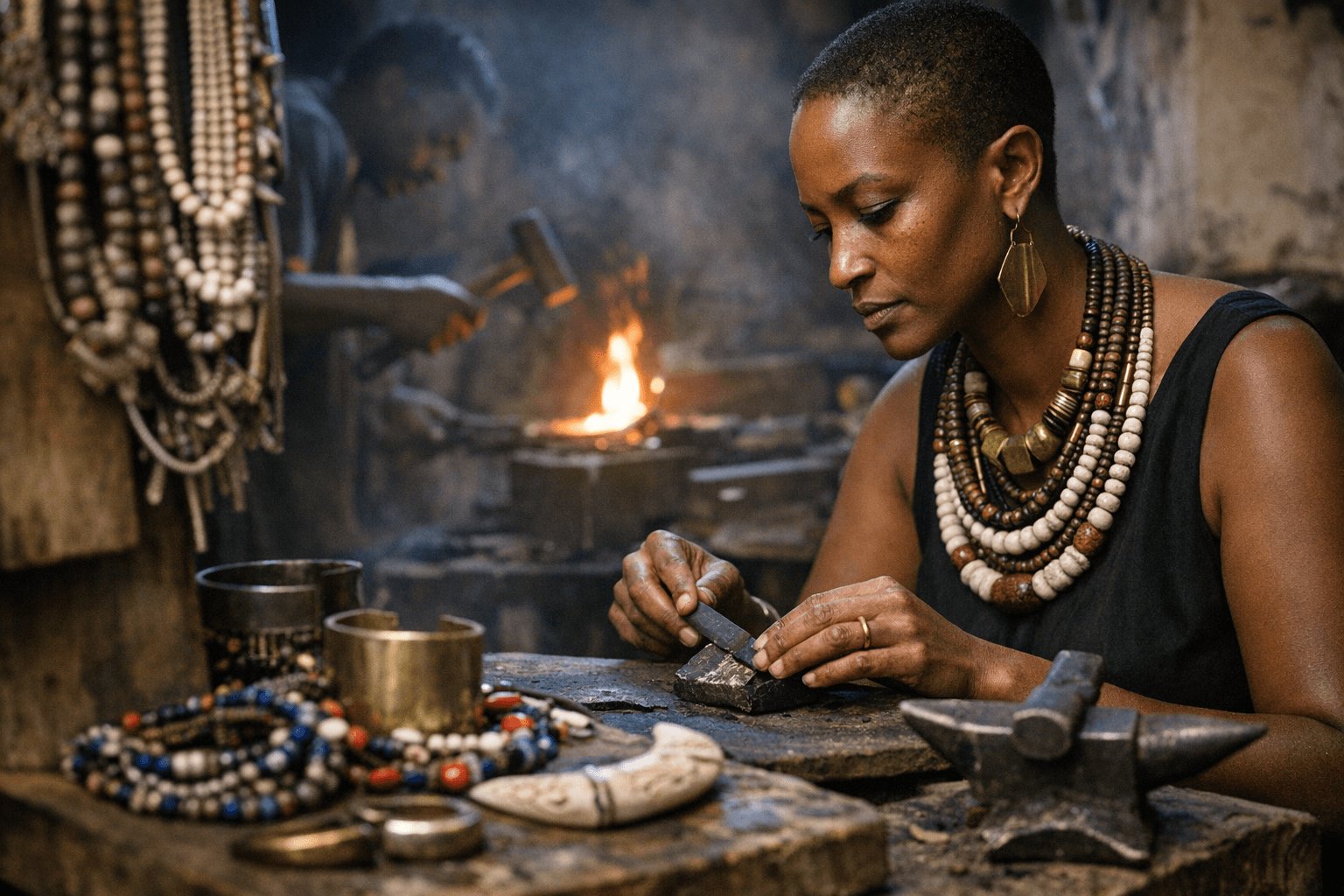
The oldest jewelry ever found on Earth came from Blombos Cave on the southern tip of South Africa: mollusc shell beads, pierced and worn, estimated at more than 75,000 years old. That fact alone reframes everything about "ancient jewelry traditions." Africa isn't a continent borrowing from older cultures. It is the origin point. And right now, a generation of African designers is making sure the world remembers it.
A Continent of Distinct Craft Traditions
Understanding what these designers are reviving requires knowing what those traditions actually are, and they vary dramatically by region.
West Africa is historically the kingdom of gold, with Ghana and Mali producing pieces fit for kings. Their lost-wax casting technique creates textures so detailed you need a magnifying glass to appreciate them fully. The process, known as cire perdue, involves sculpting a model in beeswax, encasing it in a clay mold, and then heating it to melt away the wax, leaving a cavity into which molten brass is poured. Once cooled, the mold is broken to reveal the final piece. Because each mold is destroyed after casting, the technique allows for detailed but entirely unrepeatable creations.
The lost-wax method of bronze casting in Nigeria and Benin was started by the Yoruba in the 13th century and has produced very intricate modelling of bronze pieces. Meanwhile, the Samburu and Maasai of East Africa create beaded collars, headdresses, and earrings that coordinate with their equally colorful clothing. The intricate artistry of Maasai beadwork embodies centuries of cultural heritage, spiritual beliefs, and female empowerment within East African societies, with archaeological evidence tracing this craft back to the first century BCE.
In South Africa, the story is just as layered. Beading is deeply intertwined with cultural and social practices, and different tribes, such as the Zulu, Xhosa, Ndebele, and San, have utilized beadwork as a means of communication, storytelling, and adornment, with beaded items carrying symbolic meanings as markers of status, marriage, initiation, or spiritual beliefs.
What the Traditions Are Made Of
African jewelry dates back thousands of years, with ancient civilizations like Egypt, Nubia, and the Benin Kingdom creating intricate pieces from materials like gold, beads, shells, and bronze. These adornments were not just decorative but also held deep cultural, spiritual, and social significance.
The material vocabulary is specific and intentional. Beads symbolize fertility, wealth, and protection, with the Maasai community's intricate beadwork renowned for its vibrant colors and patterns. Gold signifies royalty, power, and divine favor, especially in West Africa. Cowrie shells represent prosperity. Copper and brass are associated with healing and energy. Stones used by African artisans include turquoise, lapis lazuli, sapphires, emeralds and rubies as well as topaz, amethyst, rose quartz and moonstone.
Gold occupies a central position in Ghana's jewelry tradition, particularly among the Ashanti people. The Ashanti Kingdom, historically one of West Africa's most powerful empires, built its prestige on gold resources, and this wealth translated into intricate regalia worn by chiefs and royalty. Intricate pendants shaped like Adinkra symbols. Each piece communicates authority. Gold is not merely precious metal; it represents divine connection, prosperity, and political legitimacy.
The Designers Carrying the Craft Forward
This is where historical context meets urgent, living practice. The designers working in this space today are not simply referencing tradition, they are technically fluent in it.
Kenyan designer Ami Doshi Shah is among the most internationally recognized. Born in Mombasa to a family of South Indian heritage, she trained in Jewellery and Silversmithing at the Birmingham School of Art and Design in the UK, graduating in 2001 and receiving the Goldsmith Award for Best Apprentice Designer. After apprenticeships in Mumbai and Jaipur and a period in the advertising industry, Shah returned to Kenya to launch her eponymous practice in 2015. Her work transforms materials such as aged brass, salt crystals, sisal rope, and volcanic rock into striking pieces that feel both raw and refined. In 2019, she represented Kenya at a special program during London Fashion Week, and she was recognized as the sole jewellery designer invited from around the world.
Theresia Kyalo, also Kenyan, works in a register that is explicitly about the body as a site of cultural storytelling. For Kyalo, jewelry exists as the main event, with each statement piece telling unique stories inspired by culture and history. Acclaimed for her intricate designs, her label has gained a cult following and she was featured in Beyoncé's Black Is King. The designer spends time highlighting the unique relationship between Africans and jewelry, crafting a range of body pieces, with her experimental metalwork brand adorning and honoring each aspect of the human form.
Ivory Coast-based Lafalaise Dion works within an entirely different material world. The creative force behind her eponymous label, she transforms traditional West African materials into contemporary statement pieces. Based in Abidjan, she draws inspiration from the Dan culture of Côte d'Ivoire, particularly cowrie shells, using them in jewellery, clothing, hats, and beyond. Known as the self-proclaimed Queen of Cowries, she uses her creations to explore African spirituality and challenge the stigma it has faced over centuries. Her work gained global recognition when Beyoncé wore her 'Lagbaja' mask in Black Is King, and her 'Mami Watta' series became part of the V&A Museum's permanent collection.
In West Africa, Nigerian designer Adele Dejak uses reclaimed brass and eco-friendly supplies to make jewelry that appeals to contemporary and modern buyers. Her designs often feature bold, geometric shapes inspired by traditional motifs, intricate patterns reflecting detailed craftsmanship, and a mix of traditional and modern materials. Another Nigerian force, Gbenga Ayo-Dada has shaped accessory fashion through his innovative approach to design. Since picking up jewellery making in 2005 and pursuing professional training in 2007, he has turned his passion into a creative force that extends beyond necklaces, beads, and earrings to include statement bags, turbans, and belts. His jewellery has become a staple in Nollywood, featured in films such as The Wedding Party 1 and 2, while international recognition has taken him to London and Paris Fashion Weeks.
South African designer Katherine-Mary Pichulik takes a structurally radical approach. She established her eponymous jewelry company in Cape Town over a decade ago, and her creations reimagine rope as a symbol of emancipation and individual freedom. Local artisans produce the signature ropes from overruns of polypropylene rope, primarily from the yachting and sailing industry. Additional materials, like semi-precious stones and glass beads, are sourced from Ghana, ensuring sustainability and responsible operations.
Beadwork as Language, Not Just Decoration
One of the most important distinctions between African beadwork and its global imitators is that beading in its original context is a communicative system, not an aesthetic one. According to historians, beadwork served as a medium of communication and expression, with patterns and colors holding specific meanings. Beadwork expert Carol Wilcox noted that beads have been considered "an essential part of human expression, similar to language or music."
Through the hands of countless generations of women artisans, this craft has evolved from simple strung beads into complex artistic expressions that serve as historical records and social indicators. In contemporary Maasai society, beadwork continues to be a powerful medium through which women maintain their cultural identity while adapting to modern challenges and opportunities.
During the colonial era, beadwork gained new significance as a form of resistance and cultural preservation. Africans utilized beads to express their identity covertly and communicate messages within a society that restricted their cultural practices. This resistance continued through apartheid, where beadwork served as a powerful symbol of cultural pride, unity, and resilience. The patterns were never merely decorative.
Sustainability and Ethical Grounding
Jewelry is expected to reach a global value of around $330 billion by 2026. Also not lost on many is the complex relationship the global market has with sourcing raw materials. In an era of fashion focused on circularity and ethical production methods, designers across the continent are leading the way in championing operations that the rest of the world should emulate.
Designers are giving their works of art a feeling of modernism and sustainability by blending traditional materials like beads, shells, and precious stones with unusual elements like recycled metals and glass. Wise brands are now shifting toward authentic partnership norms: collaborations where communities are acknowledged, compensated, and involved in design and decision-making. Emerging best practices emphasize consent, equitable benefit sharing, and formal recognition of cultural knowledge. Supporting local artisans financially is critical for keeping these age-old traditions alive.
Why Provenance Matters When You Buy
For anyone building a jewelry collection that lasts, provenance is not a marketing detail. It is the difference between owning a piece and owning a story.
The modern resurgence can be attributed to a desire for more meaningful and ethical fashion choices. Unlike machine-made accessories, each beaded piece requires hours of meticulous handwork, making every piece unique. Modern designers are blending tradition with global fashion trends, creating export-ready collections that preserve authenticity while appealing to international aesthetics. The global African diaspora market further strengthens demand for culturally rooted jewelry.
In recent years, there has been a growing recognition of the importance of preserving and revitalizing traditional beading techniques. Efforts have been made to pass on knowledge and skills from older generations to younger ones through community workshops, cultural festivals, and collaborations with contemporary artists. This resurgence of interest in beadwork has also led to its integration into modern fashion, where designers are incorporating traditional beadwork into contemporary clothing, accessories, and artworks.
When you hold a piece by Theresia Kyalo or Ami Doshi Shah, you are holding something with a verifiable chain: locally sourced materials, named artisan communities, techniques with genealogies stretching back centuries. That is not a claim many jewelry brands anywhere in the world can make. African designers working in this space are setting a standard that the broader fine jewelry industry is only beginning to understand it needs to meet.
This article was produced by Prism’s automated news system from verified source data, official records, and press releases, then run through automated quality and moderation checks before publishing. The system is built and supervised by the people who set the standards it runs under. Read our full AI policy.
Did this article answer your question?