Aquamarine, March's Birthstone, Combines Gemological Depth With Cultural Meaning
Aquamarine's icy blue comes from a single trace element: iron. Here's everything you need to know about March's birthstone, from its beryl chemistry to its 2,500-year mythology and how to buy one wisely.
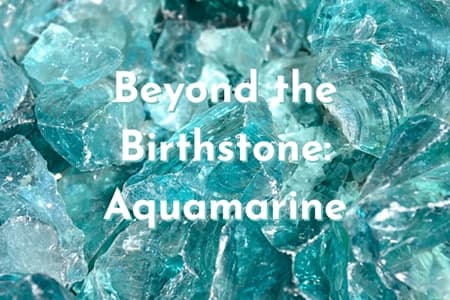
Pick up a fine aquamarine and the first thing you notice is the transparency: glassy, almost cool to the touch, the color of a shallow Caribbean bay on a windless morning. That quality is not accidental. It is written into the stone's chemistry, its crystal structure, and a mythology stretching back more than two millennia.
Inside the Stone: Mineralogy and Color
Aquamarine is a pale-blue to light-green variety of the beryl family. Its chemical formula, Be₃Al₂Si₆O₁₈, places it in the same mineralogical family as emerald, morganite, and heliodor — siblings that share the same hexagonal crystal architecture but diverge dramatically in color. Aquamarine is blue with hues of green, caused by trace amounts of iron found within the crystal structure. More specifically, aquamarine gets its coloring from trace amounts of ferrous iron, and while its palette can range from very pale light blue to a deep, almost sapphire-like blue, the higher the concentration of iron, the more intense the color.
The hexagonal crystal system is where aquamarine crystallizes, forming prismatic crystals with a hexagonal cross-section. These crystals can be microscopic to enormous in size and frequently feature faces with vertical striating. That structural generosity is one of aquamarine's great gifts to the jewelry world: aquamarine crystals are known to be large in size and relatively clean and well-formed, making them particularly valuable to collectors of mineral specimens.
It has a hardness of 7.5–8 on the Mohs scale, which makes it genuinely wearable. Diamond, ruby, sapphire, topaz, and chrysoberyl are the only popular gemstones that are significantly harder. However, aquamarine's tenacity is rated as brittle, which means the gem can be easily chipped upon impact, so bezel and protective prong settings are worth considering for rings worn daily.
Heat Treatment: What to Ask Before You Buy
Most aquamarines on the market have been gently heated, and this is worth understanding rather than fearing. Aquamarine typically doesn't undergo treatments except for heat. Aquamarines with a strong greenish undertone can be heated to remove the yellow component in its color, leaving a more pure blue. This is stable and permanent and is considered acceptable in the trade.
Here's the nuance: heating aquamarine does not improve its saturation at all. The only effect it has is to remove or diminish the yellow component, making the stone less greenish. The process is performed at relatively low temperatures; one standard approach heats stones at 400 degrees centigrade for one hour. Unheated stones do command a premium in the market, especially if they have good color.
Aquamarine is pleochroic, which means it shows different colors in different crystal directions. Heat treatment helps eliminate pleochroism in aquamarine, and savvy lapidaries cut aquamarine to minimize the effects of any pleochroism and to optimize its blue hues. Transparency about treatment is a baseline ethical standard: it is ethical to sell treated aquamarines as long as the treatments are fully disclosed to the buyer. Transparency about treatments is key to maintaining trust in the gemstone market.
The Four Cs and What Actually Drives Value
Aquamarine's most valuable color is a dark blue to slightly greenish blue. Color intensity is closely tied to size: the preferred aquamarine color is a dark blue to slightly greenish blue with moderate intensity and is most striking in gems of over 5 carats. Lighter stones are abundant; rich, saturated blue is genuinely rare, and price reflects that gap sharply.
Most faceted aquamarines are free of eye-visible inclusions. When inclusions do appear, they tend to be distinctive: standard inclusions in aquamarine include two-phase inclusions, which are trapped bubbles of liquid and gas. The visual property of chatoyancy is possible when the aquamarine has fine hollow rods running parallel to the length of the crystal, creating a rare cat-eye effect.
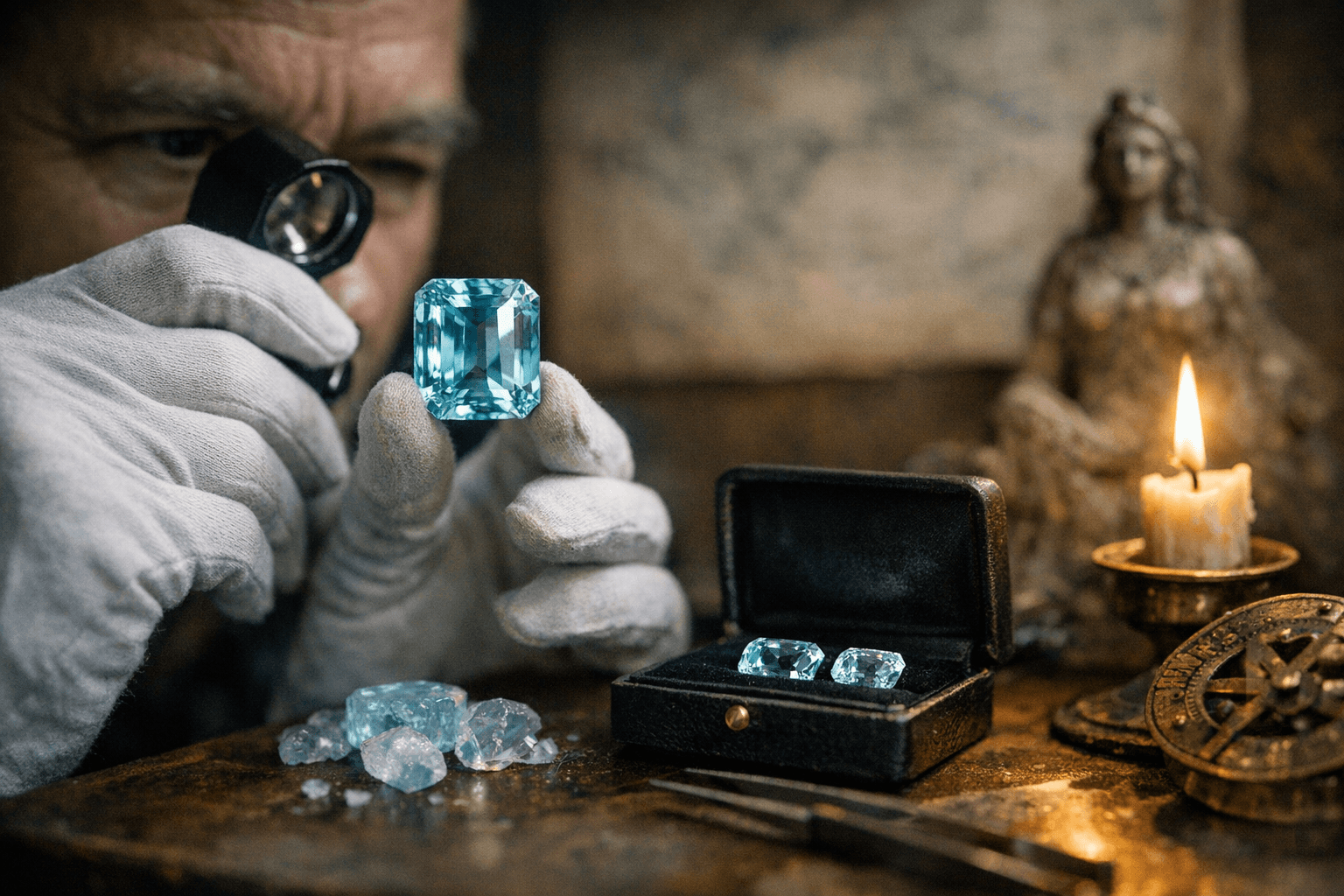
Aquamarines can be cut into almost any shape, but cutters often fashion them as emerald cuts or as round or oval brilliants. Many gem artists use aquamarine for one-of-a-kind designer cuts because these styles maximize the material's pure, even color and high clarity. The step cut, in particular, suits aquamarine's glassy transparency beautifully: light moves through the broad facets like water over a pane of glass.
For certification, note that GIA evaluates aquamarine but does not grade it. A GIA Colored Stone Identification Report assesses the characteristics of a mounted or loose aquamarine, including weight, measurements, shape, cutting style, and color, and indicates whether it is natural or laboratory-grown and names any detectable treatments. For stones above five carats or any purchase above $500, requesting this report is straightforward due diligence.
Where Aquamarine Comes From
Aquamarine mainly forms in granite pegmatites and hydrothermal veins, a process that takes millions of years and is associated with Precambrian rocks. Brazil is the most well-known source of high-quality aquamarine in today's gem market. Famed for its large, high-clarity specimens, Brazil produces the most expensive grade of aquamarine, which goes by the trade name Santa Maria. Santa Maria aquamarine is an intense blue in its purest, unheated form.
Beyond Brazil, aquamarine from Pakistan's mountainous regions is highly sought for its unique, icy blue hues and excellent transparency. Nigerian aquamarine is famous for its rich color saturation, often comparable to Brazilian stones. Other significant producers include Madagascar, Zambia, Mozambique, and Nigeria. Origin is worth knowing but, per GIA guidance, origin isn't an important factor in an aquamarine's value. Famous mines are well-regarded because they produce fine quality gems; however, gems aren't fine or valuable just because they come from famous mines.
2,500 Years of Cultural Meaning
The name aquamarine comes from aqua, Latin for "water," and marine, deriving from marina, Latin for "of the sea." The natural aquamarine gemstone first entered human consciousness around 480–300 BC, making it one of the oldest gemstones in existence.
The famous historian Pliny the Elder was the first to record the existence of aquamarine, writing: "The lovely aquamarine, which seems to have come from some mermaid's treasure house. In the depths of a summer sea, has charms not to be denied."
Sailors' mythology around aquamarine is among the oldest and most persistent. The ancient Greek ideas were almost identical to Roman ones, with aquamarine being associated with Poseidon for the Greeks and Neptune for the Romans. Both cultures believed that aquamarine would provide protection for sailors, which is why the Romans nicknamed it "The Sailor's Stone." Aquamarine was a highly esteemed amulet in Rome, thought to guard against spite and envy. Roman matrons regularly wore these jewels at dinners with the intention of deterring any ill-willed spirits.
Across other traditions, the stone carried different but consistently protective resonances. Beads made of aquamarine have been discovered with Egyptian mummies. In China, aquamarine was associated with the goddess Guanyin, the Great Compassionate One, protector of women and children, symbolizing mercy, compassion, and unconditional love. The custom of gifting aquamarine jewelry as wedding gifts grew in India, where a lot of aquamarine was mined in ancient times.
Medieval Europe found other uses: writers of the Middle Ages claimed aquamarine was the most popular and influential of the "oracle" crystals. When cut as a crystal ball, it was considered a superior stone for fortune telling. Nero, the fifth Roman emperor, used thin slices of aquamarine to correct his poor vision 2,000 years ago. Germans also used slices of aquamarine to correct shortsightedness, and the Germans called glasses "die Brille," derived from the word "beryl."
Famous Stones: From Eleanor Roosevelt to the Smithsonian
The scale aquamarine can achieve is genuinely staggering. Mined from a Brazilian pegmatite in the late 1980s, the magnificent Dom Pedro aquamarine was named for Brazil's first two emperors, Dom Pedro Primeiro and his son, Dom Pedro Segundo. Before cutting, the portion of the beryl crystal measured 23.25 inches long and weighed nearly 60 pounds. The obelisk, designed by world-renowned gem artist Bernd Munsteiner, stands 14 inches tall, measures 4 inches across the base, and weighs in at 10,363 carats. Munsteiner reportedly made hundreds of sketches before deciding on lozenge-shaped "negative facets" stepped along the two backsides of the obelisk. In certain lighting conditions, the gem gives the illusion of being illuminated from within. The former Smithsonian curator Jeffrey Post described it as an "ethereal glow." The Dom Pedro now resides permanently in the Smithsonian's National Museum of Natural History, 30 feet from the Hope Diamond.
In 1936, Brazilian President Getúlio Vargas gave a beautiful, 1,298-carat aquamarine to US First Lady Eleanor Roosevelt when she and President Franklin D. Roosevelt visited Brazil. The gem became known as the Roosevelt aquamarine. More recently, a well-known aquamarine returned to the spotlight on Meghan Markle's hand. She received the striking jewelry piece from Prince Harry during their wedding. The yellow gold cocktail ring belonged to Prince Harry's late mother, Princess Diana, and features a large, emerald-cut, pale blue aquamarine gem estimated at over 30 carats, surrounded by smaller diamonds.
Anniversaries, Birthstones, and Buying with Intention
Aquamarine became the official birthstone of March in 1912, when the Jewelers of America Association formalized a modern list of birthstones. It is also given as a present on the 19th wedding anniversary, a tradition rooted in the stone's longstanding association with happiness in marriage.
When buying, inspect stones in natural daylight, where aquamarine's truest color reveals itself. Always ask your seller if the aquamarine has undergone any treatment or enhancement and request gemstone certification from a reputable gemological lab. Be wary of sellers who advertise "100% natural" or "untreated" without providing proper certification. For care, use warm water, mild soap, and a soft cloth when cleaning. Avoid harsh chemicals, ultrasonic cleaners, and steam cleaning, as they can damage the stone.
Due to its relative abundance, aquamarine is comparatively less expensive than other gemstones within the beryl group, such as emerald or bixbite, but it is typically more expensive than similarly colored gemstones such as blue topaz. That pricing position makes it one of the most accessible fine gemstones in the world — one that combines genuine gemological pedigree, two and a half millennia of storytelling, and a color that no synthetic imitation has yet fully matched.
This article was produced by Prism’s automated news system from verified source data, official records, and press releases, then run through automated quality and moderation checks before publishing. The system is built and supervised by the people who set the standards it runs under. Read our full AI policy.
Did this article answer your question?