Birthstones by Month: The Meanings Behind Your Personal Gemstone
Each month's birthstone carries centuries of symbolism, from garnet's protective deep red to turquoise's vivid December close — here's what your stone actually means.
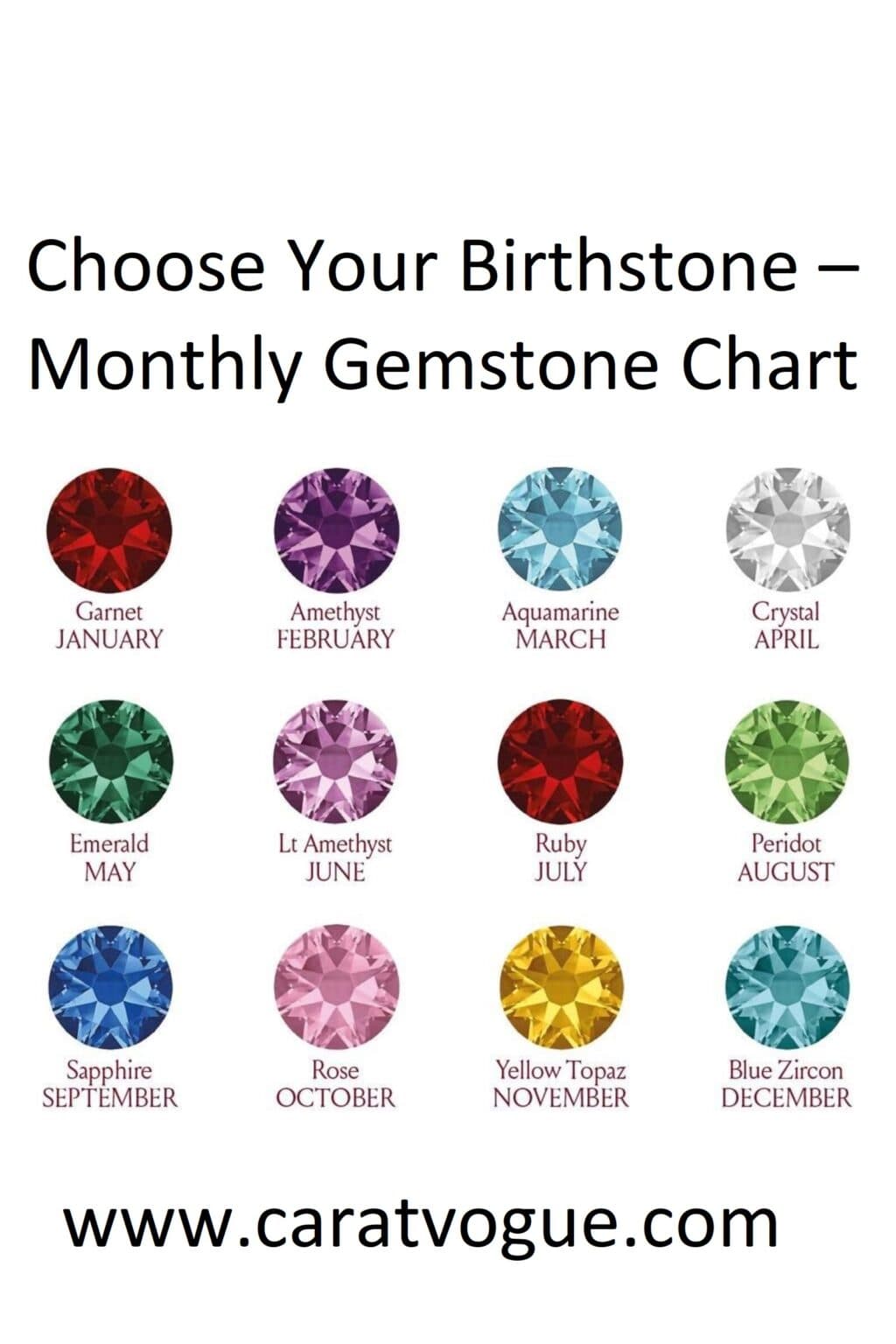
Birthstones are one of jewelry's most enduring forms of personal meaning. A single stone, chosen by the calendar accident of your birth, carries centuries of symbolism, cultural history, and gemological beauty. Whether you're drawn to the fiery depths of a July ruby or the cool blue calm of a March aquamarine, understanding what your birthstone represents transforms it from decorative detail into something far more intentional.
January: Garnet
Garnet, the birthstone for January, is most recognized in its deep burgundy form, though the mineral family actually spans a wide spectrum of colors. Historically, garnet has been carried as a talisman for safe travel and protection, and it also carries associations with friendship, trust, and commitment. The stone's silicate composition gives it a distinctive inner warmth, the way light seems to pool inside a well-cut garnet rather than simply reflecting off its surface.
February: Amethyst
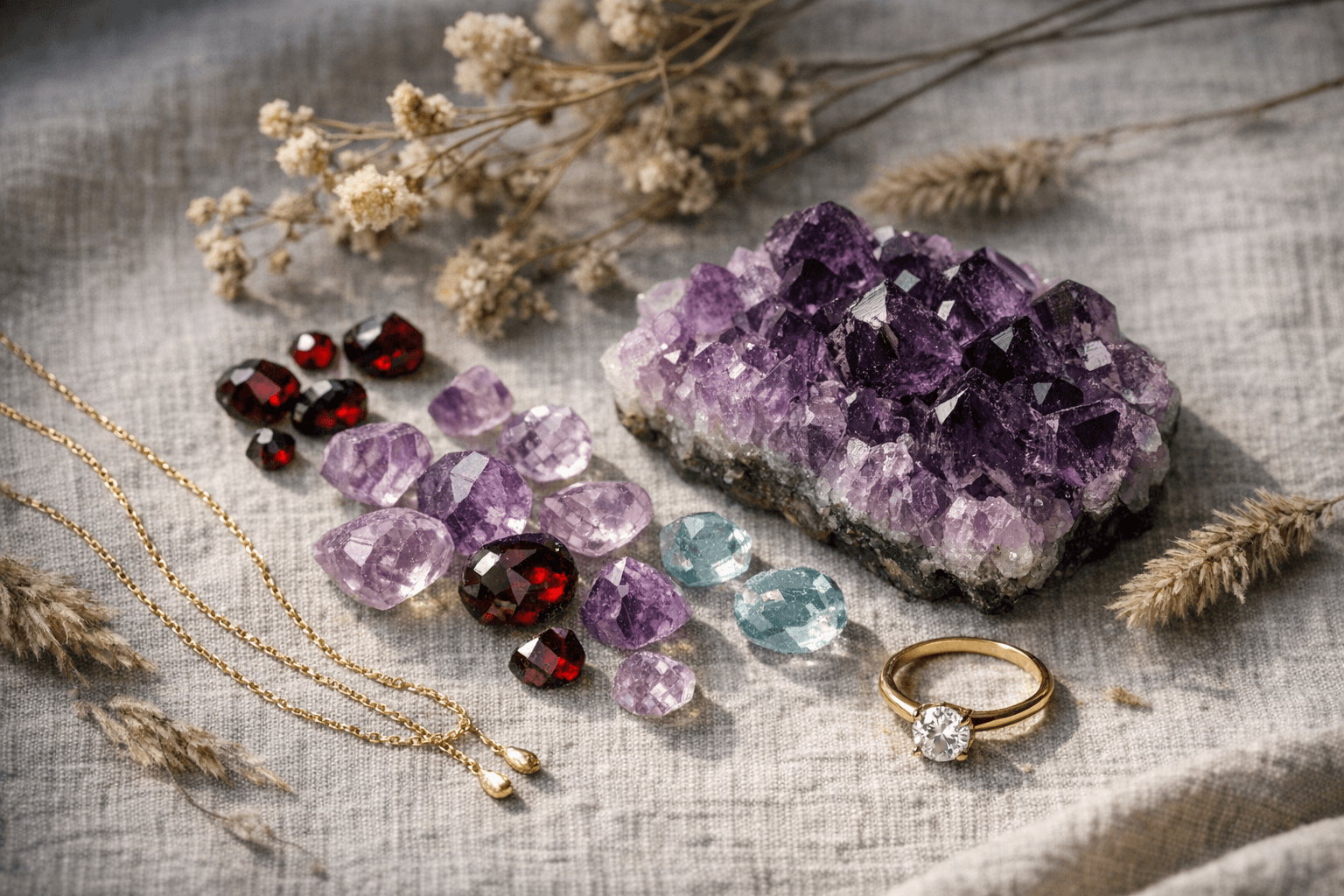
Amethyst's purple hues range from the palest lilac to a saturated violet-blue, and the stone has long been associated with clarity, peace, and spiritual growth. Ancient cultures believed amethyst could promote sobriety and strengthen the wearer's relationships, lending it a quality of emotional steadiness. For February birthdays, it's a stone that rewards close examination: the best specimens show a secondary blue or rose flash beneath the dominant purple.
March: Aquamarine
Aquamarine takes its name from the Latin for seawater, and the pale, luminous blue of a fine specimen justifies it entirely. The stone's traditional meanings include courage, calm, and communication, qualities that made it a favorite among sailors, who believed it offered protection on open water. March also claims bloodstone as an alternate birthstone, a dark green chalcedony flecked with red, which carries its own associations with health, bravery, and renewal.
April: Diamond
Diamond is the birthstone for April, and its symbolism, strength, clarity, and eternal love, aligns naturally with its physical properties. As the hardest natural substance on earth (rated 10 on the Mohs scale), diamond has always represented endurance. The stone's brilliance comes not from color but from its exceptional refractive index, the way a well-cut diamond fractures white light into its component spectrum. For those seeking an alternative, white topaz or cubic zirconia offer similar visual clarity at a fraction of the price.
May: Emerald
Emerald's deep green is one of the most coveted colors in all of gemology, and May's birthstone carries meanings that lean into that richness: growth, fertility, wisdom, and healing. The stone has been prized since antiquity, mined in Egypt as far back as 1500 BCE and treasured by both Cleopatra and the Mughal emperors. The finest emeralds display a saturated bluish-green with high transparency; most natural specimens contain inclusions called "jardin" (the French word for garden), which are considered part of the stone's character rather than flaws.
June: Pearl and Moonstone
June is one of three months with two recognized birthstones, and both carry a luminous, opalescent quality. Pearls have represented purity, innocence, and elegance throughout recorded history, formed through a biological process no other gemstone can claim. Moonstone, the alternate choice, displays a phenomenon called adularescence, a soft, billowing glow that seems to move beneath the surface, connecting it symbolically to intuition, new beginnings, and the rhythms of the moon.
When selecting birthstone pendants that set a pearl or moonstone alongside accent diamonds, the contrast between the stone's soft glow and the diamond's hard brilliance is visually striking. Theo Grace, which works in 14k gold, makes birthstone pendants in exactly this pairing, the warmth of the metal complementing both stones without overwhelming their quiet luminosity.
July: Ruby
Ruby is July's birthstone and one of the most commercially significant gemstones in the world. Its deep red comes from chromium, and the finest stones, historically sourced from Myanmar's Mogok Valley, can command prices that exceed equivalent-quality diamonds. The stone's symbolism centers on passion, vitality, and confidence, making it one of the few gemstones whose meaning aligns viscerally with its color. Protection is also part of ruby's traditional lore: ancient warriors carried rubies believing they would make them invincible in battle.
August: Peridot
Peridot is one of the few gemstones that forms in only one color: a distinctive yellow-green caused by iron content, ranging from a bright lime to a deeper olive. August's birthstone carries associations with good luck, protection, and joy, and it has one of the stranger origin stories in gemology: some peridot has been found inside meteorites, meaning the stone occasionally arrives from beyond Earth. Ancient Egyptians called it "the gem of the sun" and mined it on a volcanic island in the Red Sea.
September: Sapphire
Sapphire is September's birthstone and, after diamond, likely the most recognizable gem in the world. Its deep blue has become synonymous with loyalty, wisdom, and nobility, a symbolism reinforced by centuries of royal and clerical use. What's less commonly known is that sapphire comes in almost every color except red (which is classified as ruby): pink, yellow, white, and the rare Padparadscha, a delicate salmon-pink, are all varieties of the same corundum mineral. Blue sapphire's Mohs hardness of 9 makes it exceptionally practical for everyday jewelry wear.
October: Opal and Tourmaline
October offers one of the most visually complex birthstones in the calendar. Opal displays a phenomenon called "play-of-color," flashes of red, green, blue, and violet that shift with the angle of light, a result of silica spheres diffracting light within the stone's structure. It carries associations with creativity, hope, and emotional expression. Tourmaline, October's alternate stone, is among the most color-diverse minerals in existence, occurring in watermelon bicolor specimens (pink and green in the same crystal), deep indicolite blues, and vivid chrome greens.
November: Citrine and Topaz
November's birthstones share a warm, amber palette. Citrine, a yellow variety of quartz, has long been called "the healing quartz" and carries associations with joy, optimism, and abundance. Imperial topaz, the most prized variety, displays a rich orange with pink undertones and has historically been associated with strength and fortune. The two stones are often confused because of their similar color ranges, but topaz is significantly denser and heavier than citrine when held side by side.
December: Turquoise, Tanzanite, and Zircon
December has three recognized birthstones, more than any other month, each distinct in character. Turquoise, one of the oldest ornamental stones in human history, spans cultures from ancient Egypt to the American Southwest and symbolizes protection and good fortune. Tanzanite, discovered only in 1967 near Mount Kilimanjaro in Tanzania, is one of the rarest gem materials on earth and displays a trichroic shift from deep blue to violet to burgundy depending on viewing angle. Blue zircon, the third option, is often mistaken for a synthetic stone but is entirely natural, with a brilliance that rivals diamond and a long history predating the modern industry's confusion of it with cubic zirconia.
The depth of meaning embedded in these twelve stones, accumulated across cultures and centuries, is precisely what makes birthstone jewelry resist trend cycles. A garnet ring purchased as a January birthday gift in 2026 carries the same protective symbolism it did when medieval travelers set garnets into their traveling armor. That continuity is rare in any category of personal adornment, and it's what keeps birthstone jewelry at the center of the most meaningful gift-giving occasions.
This article was produced by Prism’s automated news system from verified source data, official records, and press releases, then run through automated quality and moderation checks before publishing. The system is built and supervised by the people who set the standards it runs under. Read our full AI policy.
Did this article answer your question?