Brooches Move From Heirloom Boxes to Oscars Menswear in Style Resurgence
Stylists at the 2026 Oscars declared the brooch's return, pinning it squarely on menswear and pulling it out of the heirloom box for good.
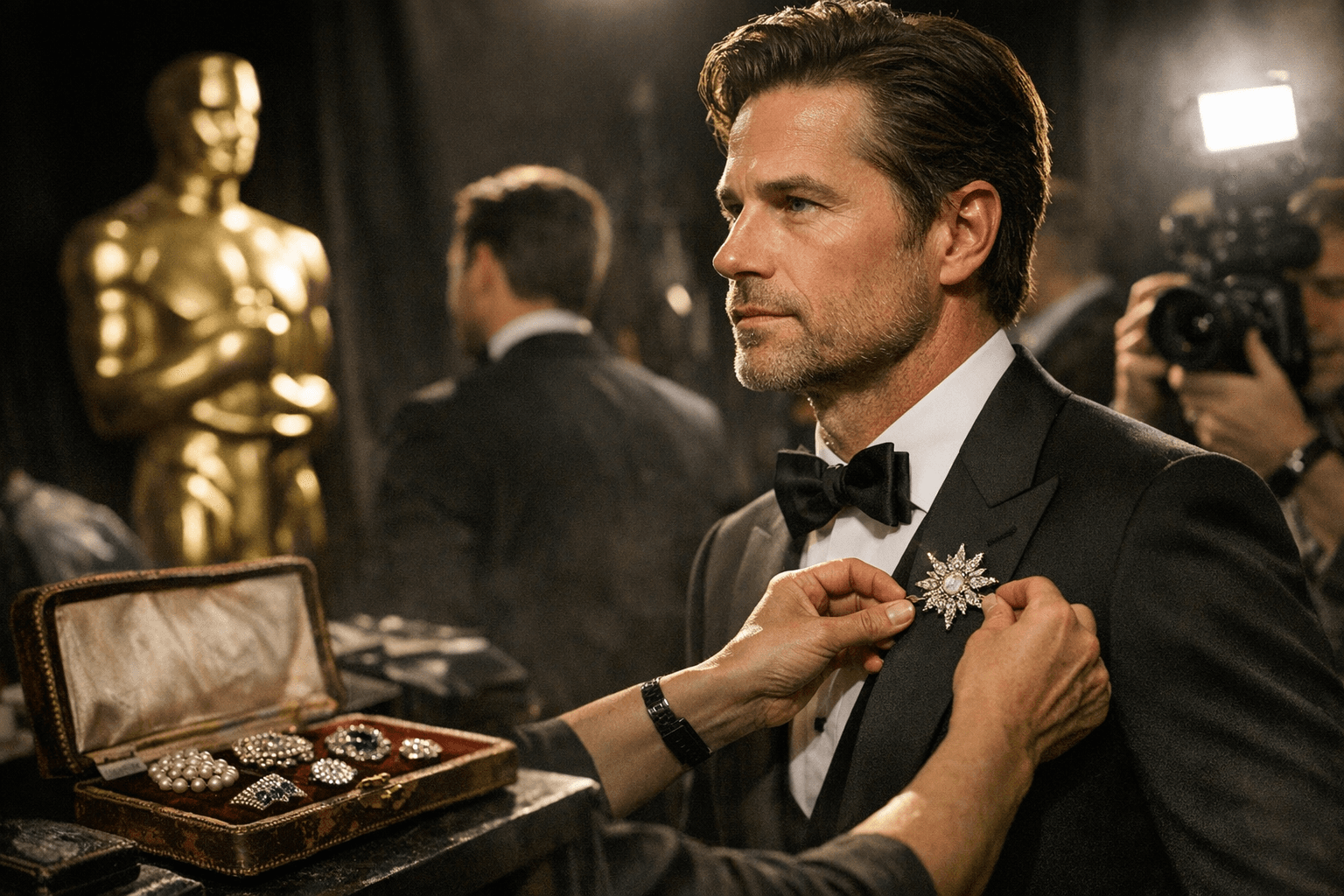
When the brooch appeared on the lapels of men at the 2026 Academy Awards, it wasn't a costume department flourish or an eccentric outlier. It was a signal. USA Today's coverage of the ceremony framed the moment clearly: the brooch, long sequestered in velvet-lined heirloom boxes and associated almost exclusively with a grandmother's Sunday best, had migrated into the most scrutinized fashion territory in Hollywood, and it had done so on men.
That migration deserves unpacking, because it didn't happen overnight, and it didn't happen by accident.
What the Oscars Told Us About the Brooch
The Academy Awards red carpet functions as a kind of accelerant. Trends that have been building quietly in editorial shoots and runway collections get compressed into a single evening, photographed from every angle, dissected by morning. The brooch's appearance in 2026 menswear at the Oscars did exactly that: it concentrated several years of slow-building accessory momentum into one undeniable moment.
Stylists quoted in USA Today's coverage spoke to the brooch's narrative function, noting that the piece carries a kind of expressive weight that a pocket square or a lapel pin simply cannot. A brooch is dimensional, it has history, and it requires a decision: where it sits on the body, what it says about the garment beneath it, and whether it whispers or announces itself. On a tuxedo lapel, that decision becomes a statement about the wearer's relationship to both tradition and reinvention.
The examples from the ceremony were not subtle. They were chosen to demonstrate the range of the form, from antique-style brooches with pavé stonework to more architectural, modernist pieces that read more like sculpture than adornment. In each case, the brooch functioned as the focal point of the look, which is precisely what a well-chosen piece of jewelry should do.
From Heirloom Box to Red Carpet: Understanding the Journey
The brooch's journey from storage to spotlight is a story about how objects accumulate and shed meaning across generations. For much of the late twentieth century, the brooch occupied an awkward cultural position. It was associated with formality of a specific, dated kind: the Queen's collection, the department store jewelry counter, the church hat ensemble. It was not unwanted exactly, but it was inherited rather than chosen.
What changed, as it so often does in fashion, was context. Vintage and estate jewelry markets began drawing younger buyers in earnest through the 2010s, and the brooch, available in extraordinary variety at estate sales and auction houses, became a logical entry point. A Georgian mourning brooch with a hairwork center, a mid-century enamel floral piece, a 1940s Retro-era gold bow set with synthetic rubies: these are objects with unmistakable design integrity, and they were accessible at price points that Edwardian diamond parures were not.
Simultaneously, menswear began its ongoing renegotiation with jewelry. Men wearing pearls, signet rings on every finger, layered chains: each of these represented a small expansion of the acceptable vocabulary, and the brooch was a natural continuation. It has historical precedent on men's clothing, from the medieval fibula that fastened cloaks to the Victorian stickpin that organized the cravat. Returning to it was not transgression; it was excavation.
The Brooch as Narrative Object
What the stylists at the Oscars understood, and what USA Today's coverage made legible to a broad audience, is that the brooch is not simply decorative. It is, among all jewelry forms, perhaps the most deliberately placed. A ring goes on a finger; a necklace falls where it falls. A brooch requires the wearer to choose its location on the body, to consider its orientation, to think about the relationship between the pin's weight and the fabric that supports it. This is active jewelry, in the sense that it demands engagement.
That engagement produces meaning. A brooch inherited from a grandparent and worn to an awards ceremony carries that lineage visibly. A newly commissioned piece from a contemporary designer carries a different kind of statement: a choice made now, about now. The heirloom box is not a repository of the past so much as a source of available meaning, and the current resurgence suggests that wearers, particularly men who have not historically engaged with this vocabulary, are ready to reach into it.
Gemological Considerations: What Makes a Brooch Worth Wearing
For anyone drawn to the Oscars moment and considering a brooch of their own, the craft details matter significantly. The brooch is a structurally demanding object. Unlike a pendant, which hangs freely, a brooch must be stable against a garment. The pin mechanism on the reverse is not incidental: a well-made brooch will have a sturdy, rollover catch that prevents accidental opening, a pin stem with sufficient length to pass through the fabric securely, and enough depth in the setting to distribute the piece's weight without pulling.
Estate and vintage brooches offer some of the most compelling options currently available:
- Retro-era brooches from the 1940s, typically in yellow or rose gold with bold, sculptural forms and synthetic or natural colored stones, represent a period of extraordinary American jewelry design.
- Art Deco brooches in platinum and old-cut diamonds offer geometric precision that reads as contemporary despite being a century old.
- Mid-century enamel pieces, often unsigned but expertly executed, deliver color and graphic confidence at relatively accessible price points.
- Victorian mourning and sentimental brooches, incorporating hairwork, seed pearls, and black enamel, have seen significant collector interest and carry a narrative density that newer pieces rarely match.
When examining any brooch, turn it over. The reverse reveals construction quality, hallmarks that can date and place the piece, and the condition of the pin mechanism. A damaged catch can be repaired by a skilled bench jeweler; a cracked enamel section or a missing stone in a complex pavé arrangement is more consequential.
Why Menswear Specifically
The Oscars are not the first instance of brooches appearing in menswear contexts, but they are, at this moment, the most visible. The question of why menswear specifically is worth considering carefully. Men's formal dress operates within a narrower chromatic and textural range than women's, which means that a single well-chosen accessory carries more relative weight. A brooch on a black tuxedo lapel is doing compositional work that the same piece might share, on a more embellished women's garment, with embroidery, beading, or print.
There is also something specific about the current cultural appetite for objects with provenance and legibility. The brooch, unlike a discreet stud earring or a plain band, is unambiguous: it is there to be seen, to be recognized as a choice, to be read. In a moment when meaningful luxury has become a significant category in fine jewelry retail, the brooch represents a form that has always been, by design, visible and intentional.
The heirloom box gave it a long rest. The Oscars gave it a reintroduction. What happens next depends on whether the men who saw those lapels on March 15, 2026, understand what they were really looking at: not a trend, but a tradition reclaimed.
This article was produced by Prism’s automated news system from verified source data, official records, and press releases, then run through automated quality and moderation checks before publishing. The system is built and supervised by the people who set the standards it runs under. Read our full AI policy.
Did this article answer your question?