Diamond Insect Jewelry Endures as Talisman, Storytelling Object, and Style Icon
From Egyptian scarabs to diamond-winged bee brooches worn by royalty, insect motifs in fine jewelry carry millennia of meaning; they show no sign of retreating.
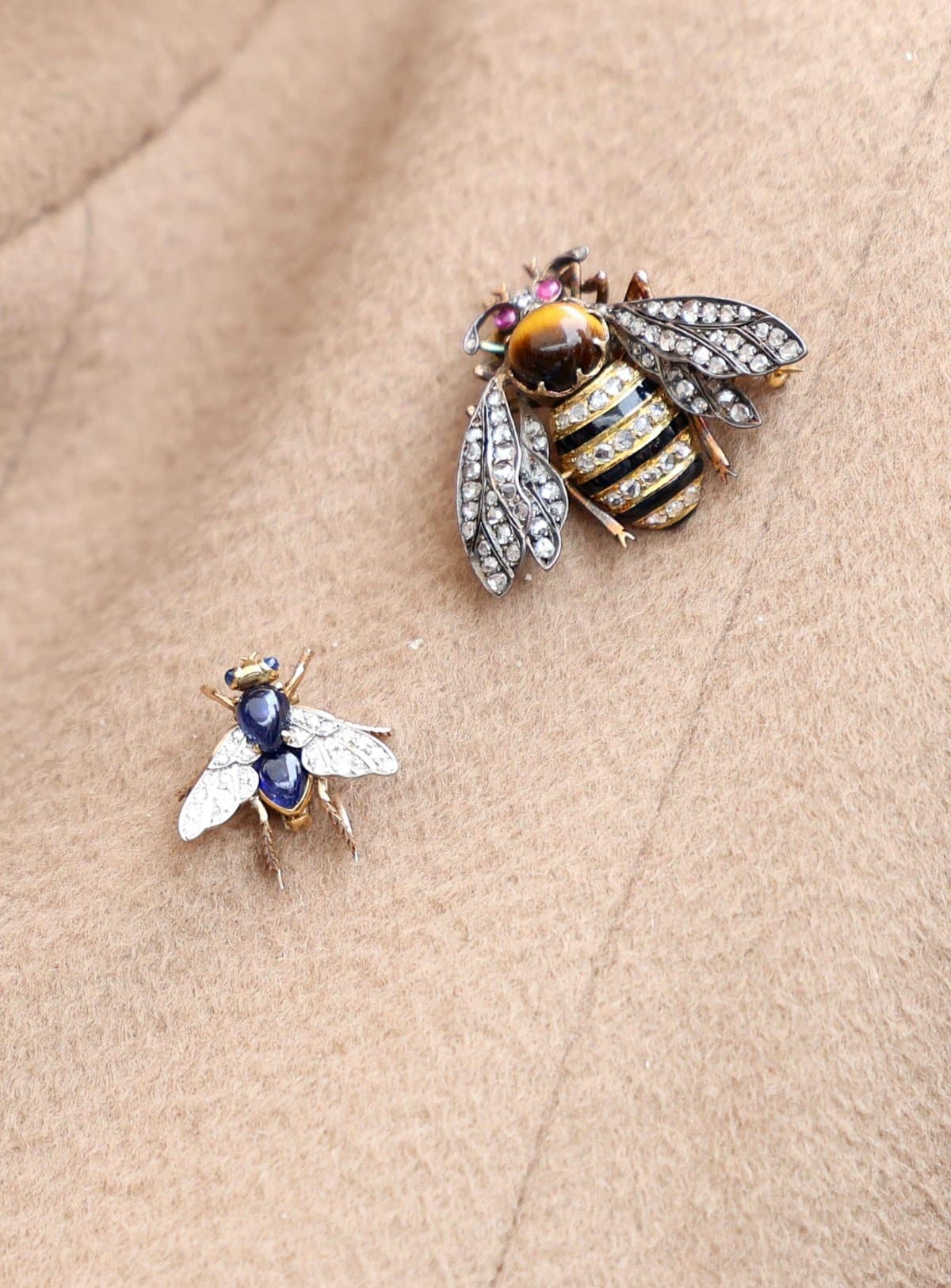
Two bee brooches with diamond wings: that was Queen Camilla's deliberate choice when she arrived at Shrewsbury Farmers' Market in 2024 to meet with the local Beekeepers' Association. The image was precise and entirely intentional. According to the royal family's website, Queen Camilla is a "keen beekeeper," producing her own honey from her home to sell for charitable endeavors. The brooches weren't decoration. They were biography rendered in diamonds.
This is precisely what insect jewelry does better than almost any other motif in fine jewelry: it transforms the wearer into a storyteller. From ancient Egyptian talismans to royal heirlooms and modern runway statements, insect jewelry has remained a powerful and enduring motif, one that resurfaces, generation after generation, on the fingers and lapels of those who understand that the smallest creatures can carry the largest meaning.
A Lineage That Begins in the Sand
The scarab is where it starts. In ancient Egypt, the dung beetle was sacred: a symbol of regeneration, rebirth, and the daily movement of the sun across the sky. Carved from lapis lazuli, faience, and eventually set with precious stones, scarab amulets were among the most ubiquitous objects in Egyptian adornment. They were worn by the living and buried with the dead, embedded into royal jewelry and traded across the ancient Mediterranean. That the scarab endures as a jewelry motif thousands of years later is not coincidence. It is testimony to the object's original power.
Victorian naturalism brought a different kind of fascination: the collector's curiosity applied to the body. In the mid-nineteenth century, entomology was fashionable science, and jewelers responded with astonishing literalism. Beetles, moths, and dragonflies were rendered in gold and silver, set en tremblant with tiny springs beneath their wings so that the stones shivered with the wearer's movement, mimicking life. Diamond-tipped antennae caught candlelight. The insects were both trophies and talismans, embodying a culture simultaneously enchanted and unsettled by the natural world.
Art Nouveau and the Argument for Transformation
Art Nouveau elevated the insect from naturalistic curiosity to high symbolism. René Lalique's dragonfly-woman corsage ornament, created around 1897 to 1898 and presented to international acclaim at the 1900 Paris Universal Exhibition, remains one of the most extraordinary objects in jewelry history: a figure in gold and enamel with open articulated wings enriched with diamonds, expressing that characteristically Art Nouveau collapse of boundaries between creature, woman, and jewel. The dragonfly, in this context, ceased to be merely decorative. It became an argument about transformation, about beauty that is temporary but made eternal through craft.
Lalique and his contemporaries understood something that still holds. Insects, rendered in fine jewelry, capture fleeting beauty in a form that endures for generations. These small creatures, often overlooked in nature, take on profound meaning when transformed into fine jewelry, and that philosophical charge remains fully intact today.
The Maisons and the Motif
The great houses never abandoned the insect. Powerhouse maisons including Boucheron, Cartier, Chaumet, De Beers, and Graff have each found ways to engage the motif across their histories and their contemporary collections. Chaumet's sustained dedication to the bee, visible in both its Bee My Love and Bee de Chaumet collections, reflects the house's French imperial heritage, rooted in Napoleon's use of the bee as a dynastic symbol, and then filtered through precision diamond-setting and modern wearability. At Cartier, the animal kingdom has been central to the maison's identity for over a century, with insects occupying their place alongside the panthers and crocodiles that have defined its high jewelry vocabulary.
What distinguishes each house's approach is craft: how the legs are articulated, whether pavé or prong settings are used on the wings, whether the form is anatomically precise or stylized into geometry. A bee brooch at this level is not a whim. It is an engineering problem solved with extraordinary skill, and the diamonds that fill those wings must be calibrated in size and color to read as light, not weight.
Independent Vision: Lauren Harwell Godfrey and Bibi Van Der Velden
Among the independent designers working most fluently within this tradition, Lauren Harwell Godfrey stands out for her intellectual approach to the motif. A GEM Award-winning designer known for work driven by storytelling, symbolism, and soul, Harwell Godfrey creates modern heirlooms in precious metals and gemstones designed to be both meaningful and collectible, with each piece reflecting her belief that jewelry can carry history, intention, and connection.
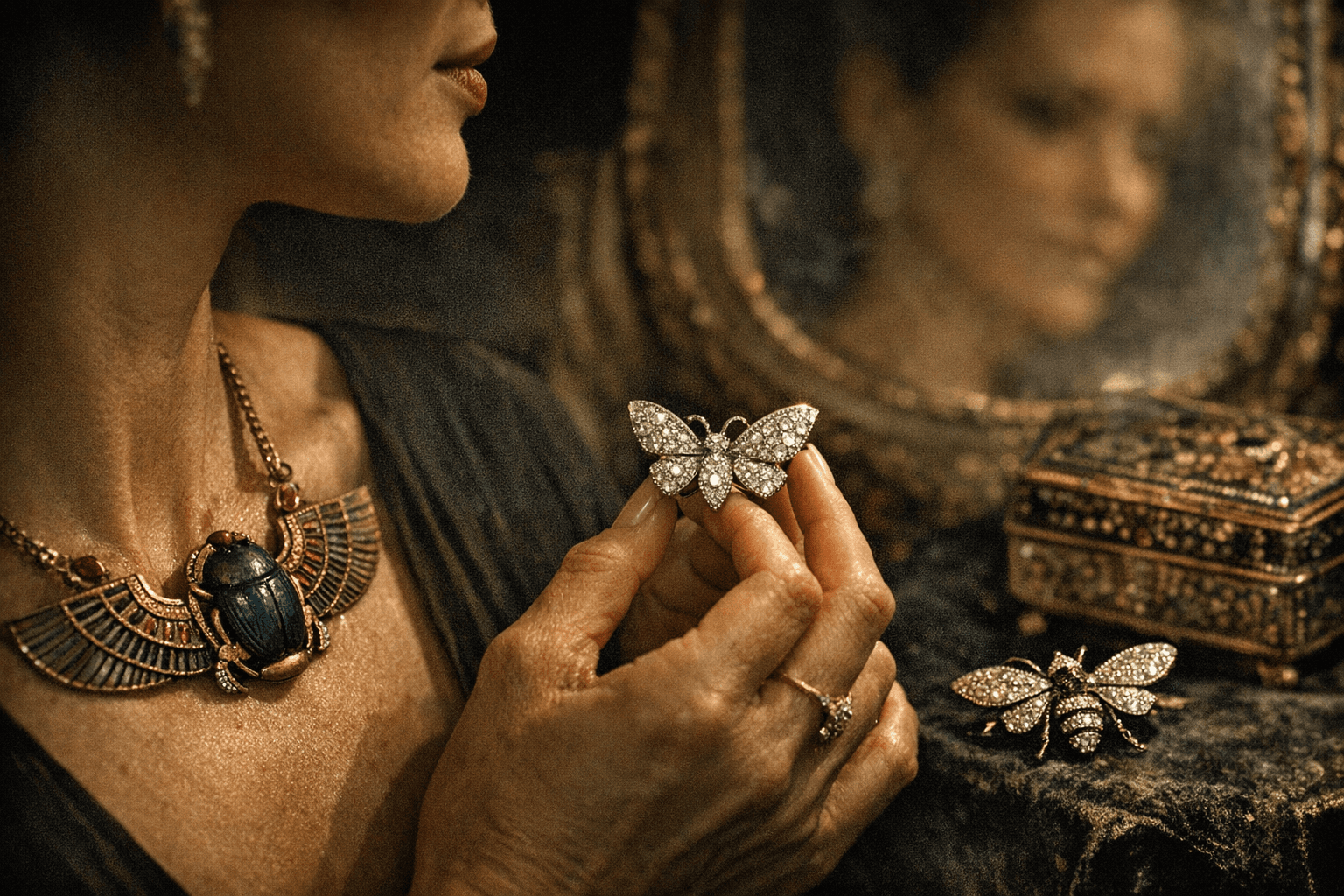
She arrived at insect jewelry through a specific revelation. "I became inspired to create diamond insect jewelry after touring Marion Fasel's Beautiful Creatures exhibition at the Natural History Museum," she told Only Natural Diamonds. "It was such a powerful reminder that insect motifs have existed in jewelry for centuries, across cultures and time."
The Beautiful Creatures exhibition, curated by Marion Fasel at the American Museum of Natural History in New York, brought together more than 100 jewels spanning the mid-1800s to the present, representing species from the realms of land, air, and water and encompassing the full sweep of jewelry's long love affair with the animal kingdom. For Harwell Godfrey, it confirmed what the historical record already suggests: insects are not a trend. They are a permanent language in fine jewelry, one that carries cultural and personal meaning across every era it touches.
Bibi Van Der Velden is another independent voice deeply engaged with the ancient symbolism of the motif. Her Scarab Fly Ring extends the Egyptian lineage into contemporary high jewelry, treating the scarab not as archaeological reference but as a living object with continued resonance.
Why Diamonds Belong on a Wing
The choice of natural diamonds for insect jewelry is not incidental. Diamonds carry their own symbolism of permanence and rarity, and when used to set the wings of a bee or the body of a scarab, they create a specific tension: the biological fragility of the creature against the geological endurance of the stone. Rendered in natural diamonds, insect jewelry becomes something lasting, capturing fleeting beauty in a form that endures for generations. It is this balance of delicacy and permanence that continues to draw designers, collectors, and wearers alike to the world of diamond insects.
There is also a technical argument. Diamonds, with their refractive index and exceptional hardness, translate wing veining and body iridescence better than any other stone. A pavé-set butterfly wing read under a spotlight becomes light itself. A single rose-cut stone placed at the thorax of a dragonfly brooch creates an eye that genuinely seems to watch you.
How to Choose and Wear Insect Jewelry
Understanding the history makes the wearing choices clearer.
- Setting choice matters for durability. Insect jewelry often involves fine structural elements: legs, antennae, thin wing profiles. Bezel settings protect stones along vulnerable edges; prong settings on wing surfaces offer maximum brilliance but require more careful wear. For a piece you plan to wear frequently, ask specifically about how the legs and appendages are finished and whether they are solid or hollow-form construction.
- Metal profile affects wearability. Low-profile insect brooches in yellow or rose gold snag less than high-set sculptural pieces. Yellow gold reads warm and antique-adjacent, well-suited to Victorian or Egyptian-idiom pieces; white gold and platinum amplify the icy brilliance of diamonds and work well for more contemporary, graphic designs.
- Context shapes legibility. A diamond bee brooch pinned to a tailored coat reads as wit and personal history, not costume. A dragonfly pendant at the décolleté of an evening dress is a pure Art Nouveau gesture, entirely appropriate at a dinner or performance. A scarab ring with pavé diamonds worn alone on a bare finger makes a collector's statement at any daytime occasion.
The instinct to dismiss insect jewelry as novelty misreads both its history and its emotional weight. These pieces survive centuries because they speak to something durable in human experience: the desire to carry meaning close to the body, to wear a symbol of transformation or resilience, to mark oneself as someone who notices what the world overlooks. Camilla understood it at a farmers' market in Shrewsbury. Lalique understood it at the Paris exposition in 1900. The ancient Egyptians understood it long before either. The diamond insect endures not because it is fashionable but because it is true.
This article was produced by Prism’s automated news system from verified source data, official records, and press releases, then run through automated quality and moderation checks before publishing. The system is built and supervised by the people who set the standards it runs under. Read our full AI policy.
Did this article answer your question?