Douriean Fletcher and Curators Discuss Afrofuture Jewelry Across Two Institutions
Self-taught metalsmith Douriean Fletcher, who designed jewelry for Marvel's Black Panther franchise, discussed her first major museum survey with curators from two institutions.
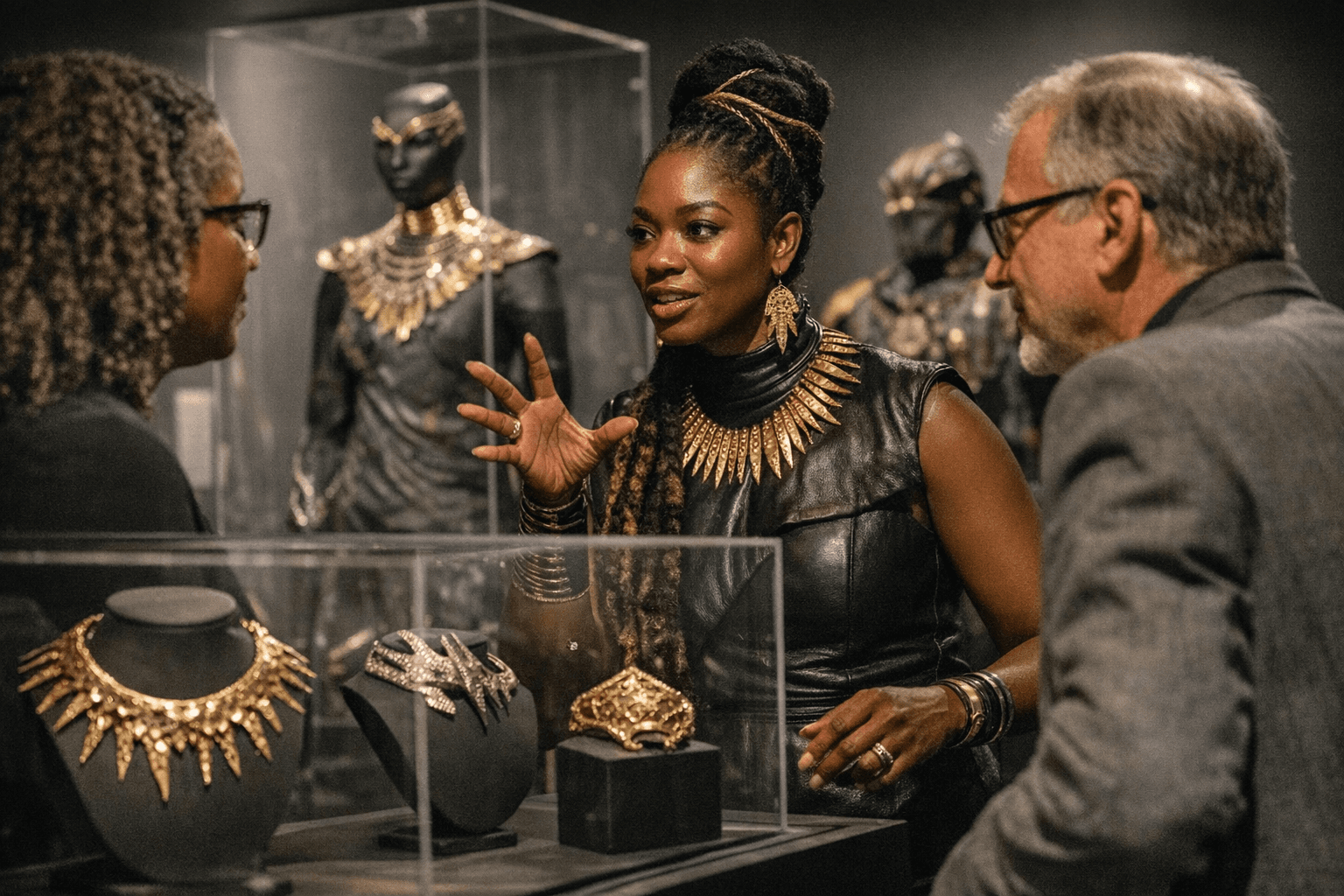
The show presents 75 works tracing Douriean Fletcher's evolution from self-taught metalsmith to a designer whose handmade adornments shaped the visual aesthetics of Marvel Studios' Black Panther film franchise. On March 12, 2026, Art Jewelry Forum brought that survey into sharp institutional focus with an AJF Live recorded conversation that placed the artist, her co-curators, and representatives from a second museum in the same frame for the first time.
The exhibition was co-curated by professor and design historian Sebastian Grant and Barbara Paris Gifford, MAD's Senior Curator of Contemporary Art, Craft, and Design. For the AJF Live session, the conversation expanded to include the Walters Art Museum's perspective, as the exhibition travels to Baltimore in April 2026, where it will be on view until August 2026. In addition to Fletcher herself, Gifford and Grant are joined by Dr. Christine Sciacca and Chandi Kelley of the Walters, to discuss the curatorial vision and what it means for this artist's work to move across institutions.
The stakes of that institutional journey are considerable. The Walters will present the exhibition from April 18 to August 9, 2026. The Walters presentation explores Fletcher's jewelry as a powerful narrative tool in art, Black identity, and visual storytelling through more than 100 works spanning the artist's life and career, including a dozen from the Walters Art Museum's collection hand-picked by the artist. That expansion beyond MAD's original 75 objects reflects how a traveling exhibition can deepen rather than simply replicate its first incarnation.
Crafted from brass, gold, and semi-precious stones, Fletcher's boldly sculptural designs articulate Black identity, embody spiritual meaning, and have helped define cinematic characters and imagined worlds. The exhibition documents and explores how ideas of Afrofuturism materialize in Fletcher's work, highlighting her research into African and African American jewelry design and efforts to build aesthetic and cultural bridges between Black communities, countries, continents, and histories torn apart by colonialism, slavery, and oppression.
Raised in Pasadena, California, Fletcher began making jewelry as a personal exploration of identity and cultural heritage. Her early work was shaped by her travels to South Africa, where she studied traditional forms of adornment and their role in community and ceremony. In 2016, she became the first jewelry designer to be included in the Motion Picture Costumer Union. That distinction, noted by co-curator Gifford during the MAD opening luncheon, cuts to the heart of what the exhibition argues: that the craftsperson whose hands translate mythology into metal has long gone unrecognized beside the director and costume designer.
A highlight of the exhibition is the jewelry Fletcher made for Queen Ramonda and the Dora Milaje from the blockbuster films Black Panther (2018) and Black Panther: Wakanda Forever (2022). These pieces, displayed with a selection of the films' costumes designed by Academy Award-winning costume designer Ruth E. Carter, offer a window into how adornment defines character, advances world-building, and represents Black sovereignty on screen.
Fletcher's own words capture the animating philosophy behind every piece. "My work channels Afrofuturism by honoring ancestral technologies while imagining new futures through adornment," said Fletcher. "Each piece is an energetic portal, rooted in a desire to remain connected to African cosmologies and designed to activate personal power, spiritual memory, and liberation across time."
The exhibition unfolds across three thematic sections: Fletcher's formative years and studio practice; her breakout film and television work, including pieces designed for major motion pictures; and her current artistic explorations. Visitors encounter elaborate brass and gold pieces inspired by ancestral traditions, iconic costume jewelry from blockbuster films, and Fletcher's most recent works, including her collection for luxury department store Bergdorf Goodman.
MAD's programming calendar reflected the same range. On October 5, Fletcher led an intimate beading workshop focused on mindfulness and community-making through craft. A second artist-led jewelry-making workshop, held on December 16, explored techniques using soft metals. On November 20, co-curator and design historian Sebastian Grant delivered a lecture on the intersection of jewelry and Afrofuturism. A virtual discussion between the artist and Anthony Francisco, former Senior Visual Development Artist for Marvel Studios, on February 26, delved into the process of designing iconic superheroes. The exhibition's film series also featured special screenings of Black Panther (December 18), Black Panther: Wakanda Forever (January 8), and Coming 2 America (date TBD), each introduced by original video commentary from the artist.
The Walters' own global collections of jewelry, which include extraordinary works from Ancient Egypt, Indigenous Latin America, and Ethiopia, position Fletcher's work alongside ancient precedents that her designs actively address and reimagine. That dialogue between a self-taught metalsmith working in brass and semi-precious stones and millennia of adornment history is precisely what the AJF Live conversation set out to examine, and what Baltimore audiences will encounter when the exhibition opens in April.
This article was produced by Prism’s automated news system from verified source data, official records, and press releases, then run through automated quality and moderation checks before publishing. The system is built and supervised by the people who set the standards it runs under. Read our full AI policy.
Did this article answer your question?