Empress Farah's 1967 Van Cleef & Arpels crown, set with Iranian gems
Van Cleef & Arpels' 1967 crown for Empress Farah Pahlavi, set with gems from Iran's treasury, weighs nearly 2 kilograms and marked the first female coronation in 2,500 years.

Van Cleef & Arpels' 1967 crown for Empress Farah Pahlavi is a singular object of state jewelry: made for the 1967 coronation and set with gems drawn from Iran’s treasury, the piece weighs nearly 2 kilograms and marked the first female coronation in 2,500 years. The crown’s sheer mass alone registers as a design decision, its weight lending a ceremonial gravity more often associated with regalia than with salon tiaras.
Commissioned for Farah Pahlavi at the height of imperial pageantry, the crown pairs Persian motifs with Parisian savoir-faire. Van Cleef & Arpels translated national emblematic forms into three-dimensional ornament, shaping a vocabulary that was simultaneously vernacular and couture. Craft choices voiced that dialogue: Iranian gemstones supplied the palette and provenance, while French technique determined proportions, mounting and finish.
The gemstones themselves trace a line from national treasury to personal regalia. Set with gems from Iran’s reserves, the crown carries explicit state materiality as well as aesthetic value. Its presence at a coronation that crowned a woman for the first time in 2,500 years anchored the jewel in a political as well as an artistic moment, making craftsmanship inseparable from ceremony.
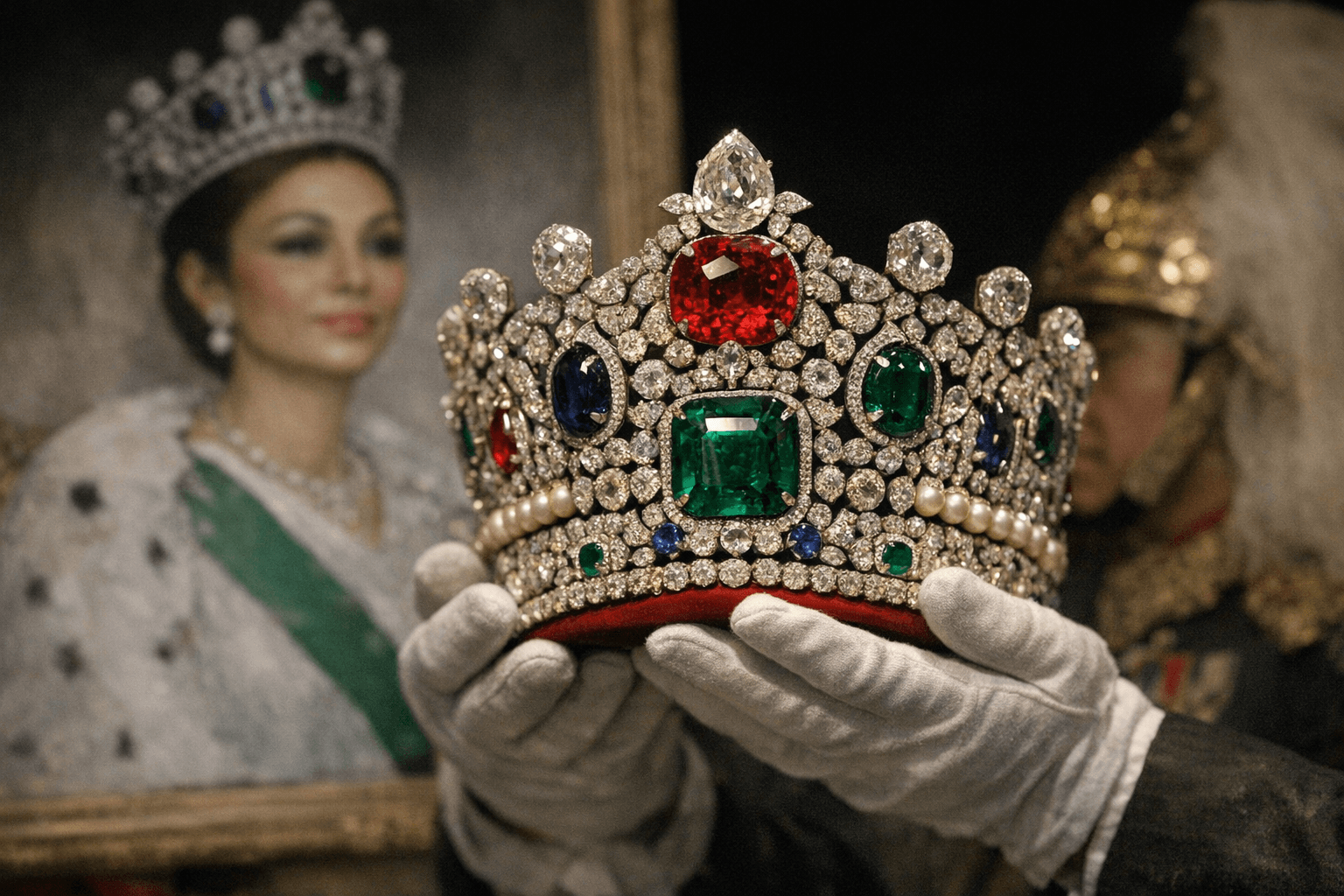
A highly engaged post on X today has refocused attention on the crown and on its survival after the upheavals that followed the monarchy. The piece remains preserved post-revolution, a fact that complicates its biography: it is at once a product of a 1967 state commission, an artifact of Van Cleef & Arpels’ midcentury output, and a survivor of seismic political change. That preservation amplifies questions about provenance, custodial care, and the ways national gems are redeployed in official jewelry.
For collectors and historians the crown is instructive precisely because of its certainties: the maker, the year 1967, the sitter Empress Farah Pahlavi, the Iranian treasury origins of the stones, the nearly 2 kilogram weight, and its survival after the revolution. Those concrete facts make the object a rare case study in how materials, makers, and monarchy intersect. As the conversation around the crown continues, its material heft and recorded provenance ensure it will remain a focal point for discussions about midcentury state jewels and the intersection of national identity and high jewelry.
This article was produced by Prism’s automated news system from verified source data, official records, and press releases, then run through automated quality and moderation checks before publishing. The system is built and supervised by the people who set the standards it runs under. Read our full AI policy.
Did this article answer your question?