Gen Z's Astrology Obsession Is Driving Demand for Zodiac Jewelry
From Co-Star screenshots to Sabyasachi's Navaratna-inspired high jewelry, Gen Z is wearing its birth chart — and the industry, from Beirut to Paris, is paying close attention.
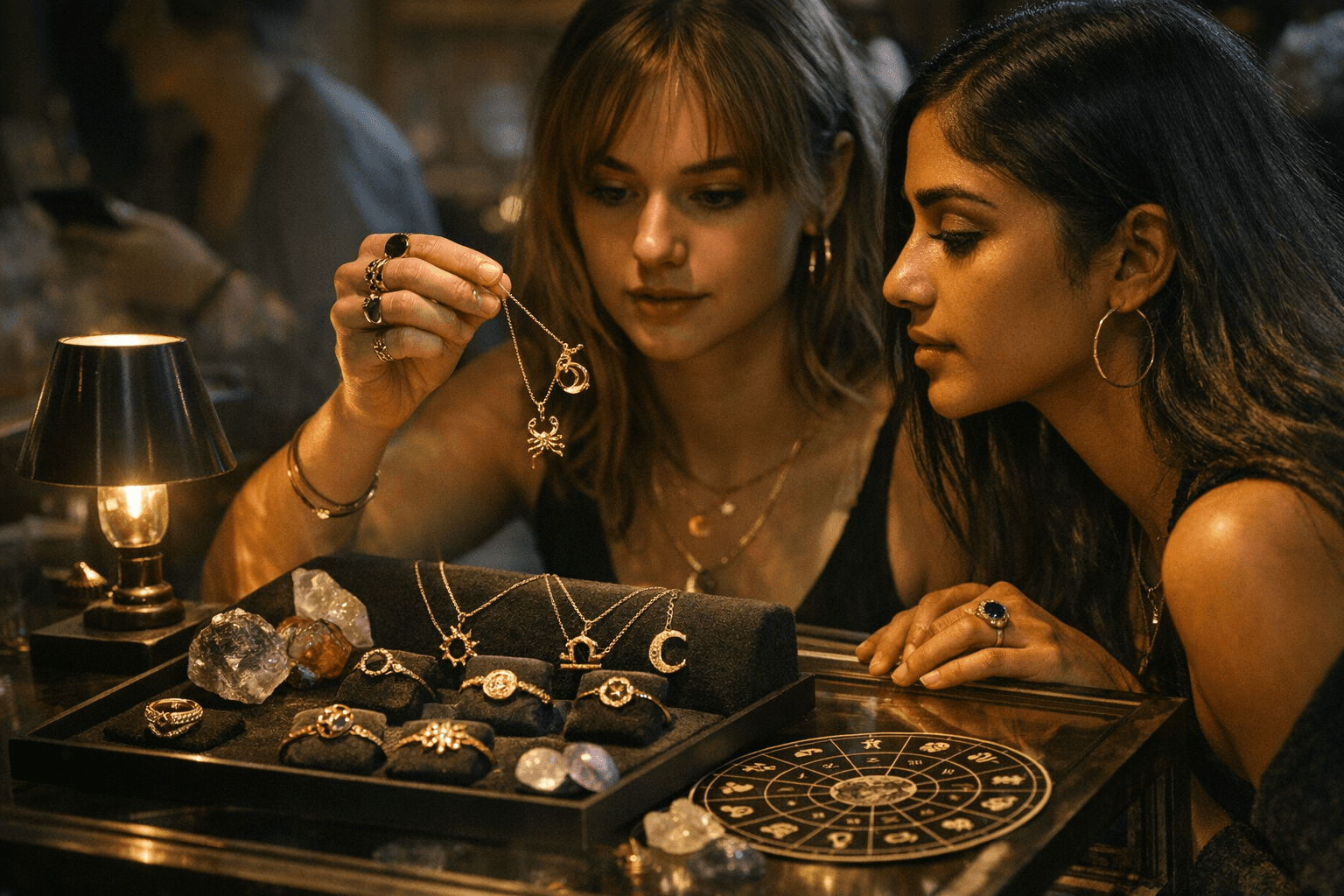
Ask someone their sign these days and you might get more than a one-word answer. Astrology has become "a significant part of digital culture," fueled by millions of screenshots shared from the horoscope app Co-Star and the rise of TikTok's #witchtok community, which has generated more than 6 million videos exploring spirituality, astrology and mysticism. That digital obsession has crossed into something you can hold in your hand, clasp around your wrist, and wear against your skin. Trends in the digital world have intertwined with the physical one — and the result is a zodiac-themed jewelry revival.
The impulse behind it is deeply personal. The revival of zodiac-themed jewelry speaks not only to self-expression, spirituality, and identity, but also to a desire for a personal emblem of distinction. "Not everyone has a family crest," as one observer put it, "but everyone has a birthday — and therefore a zodiac sign." For a generation that treats the birth chart as a kind of biographical shorthand, wearing your sign is less an act of superstition than a declaration of self.
The Generation Driving the Trend
The growing popularity of zodiac jewelry reflects younger generations', and particularly Gen Z's, broader interest in astrology and symbolism. Millennial and Gen Z jewelry designers have embraced the shift and are expanding their offer of astrology-themed jewels. What distinguishes this moment from prior astrological revivals is the velocity of the cultural signal: a Co-Star notification screenshot goes viral by morning; by afternoon, a designer has fielded a dozen DMs asking whether a Scorpio pendant can ship in time for a birthday.
Astrological, zodiac and celestial pieces are among the strongest-performing designs of the fine jewelry category at luxury retailer Mytheresa, according to its chief buying and group fashion ventures officer Tiffany Hsu. That kind of retail confirmation matters. When a multi-brand platform known for its curatorial rigor singles out a category as a top performer, it signals that this is not a novelty corner of the market — it is the market.
Milamore: When Personal History Shapes a Collection
Having grown up in Japan with Spanish-Filipino heritage, George Inaki, founder of the New York-based jewelry brand Milamore, was familiar with horoscopes and fortune tellers and their growing influence on his Gen Z-generation, yet was nonetheless struck by the prominence of astrology in the West. The culture shock, it turns out, became creative fuel.
"When I moved to the United States, people would often ask for my zodiac sign or make comments such as, 'No wonder he's a Libra,' or 'she's a real Scorpio,'" Inaki said. Those conversations prompted him to incorporate zodiac themes shortly after launching the brand in 2019.
While Milamore's core business is its signature Kintsugi collection, inspired by the Japanese art of repairing broken ceramics with gold, zodiac pieces have also proved popular, particularly among certain signs. "It's based on personality; it's not that all twelve signs sell equally, but that certain characters are more inclined toward astrology," Inaki said, citing Pisces, Virgo, Gemini, Libra and Scorpio clients as being more susceptible. That observation alone is a small masterclass in understanding the zodiac buyer: this is not a consumer who picks up any celestial charm indiscriminately. They know their chart, and they buy accordingly.
Van Cleef & Arpels: A Legacy Reborn for a New Generation
Luxury Parisian jeweler Van Cleef & Arpels may be best known for its signature Alhambra motif of a four-leaf clover, but it has also increasingly built a devoted following for Zodiaque: a collection of zodiac-themed medals, pendants and bracelets that interpret the twelve astrological signs. The history here is worth pausing on. The house first began sketching zodiac symbols as early as 1906, before unveiling a fully-fledged astrological collection in the 1950s, a line that reached peak popularity in the 1970s.
Each piece bears two distinct faces: one side depicts a sculptural representation of a Western Zodiac sign, while the reverse reveals its symbol and astrological dates in Roman numerals. The craftsmanship is exacting. Executed using the traditional stamping technique, some designs require up to eight strikes to achieve their remarkable precision, followed by meticulous hand-finishing that imparts a soft patina and luminous polish. A medallion, in other words, is never just a medallion.
A first relaunch in 2021, featuring new versions set with semi-precious stones such as malachite, turquoise and obsidian and priced at around £20,900 ($23,500), proved so successful that five years later it prompted the maison to broaden the offering once again. The latest iteration features the designs on yellow- and white-gold medallions, available as bracelets and necklaces and styled on both men and women, with prices starting from £2,290 ($2,740). That entry price is significant: it positions the Zodiaque bracelet as an attainable luxury, a calculated move to court exactly the younger customer who has been pinning Van Cleef pieces on a mood board for years.
Van Cleef & Arpels CEO Catherine Rénier has spoken directly to this versatility. "The Zodiaque offers remarkable versatility, effortlessly complementing a wide range of styles, and ensuring these pieces are universally cherished and can be worn across generations," she told Travel & Leisure.
L'Atelier Nawbar: A Global Appetite
Beirut-based L'Atelier Nawbar brings a fourth-generation jeweler's perspective to the trend. Tania Nawbar and Dima Nawbar, creative directors of L'Atelier Nawbar, note that growing interest in the zodiac isn't only coming from the West. "We also see strong interest across the Middle East and Asia," they told CNN. The house's zodiac medallions, celebrated for their refined interpretations of celestial iconography, underscore a critical point: astrology's appeal in fine jewelry is genuinely global, not a Western export but a shared human grammar that different cultures have spoken for centuries.
Sabyasachi and the Vedic Tradition
Perhaps the most philosophically layered entry in the zodiac jewelry conversation comes from Indian designer Sabyasachi, whose high jewelry collection does not merely nod to astrology but is rooted in it. In India, astrology is closely intertwined with local deities and spiritual practice, and that depth of belief informs how these pieces are conceived and worn.
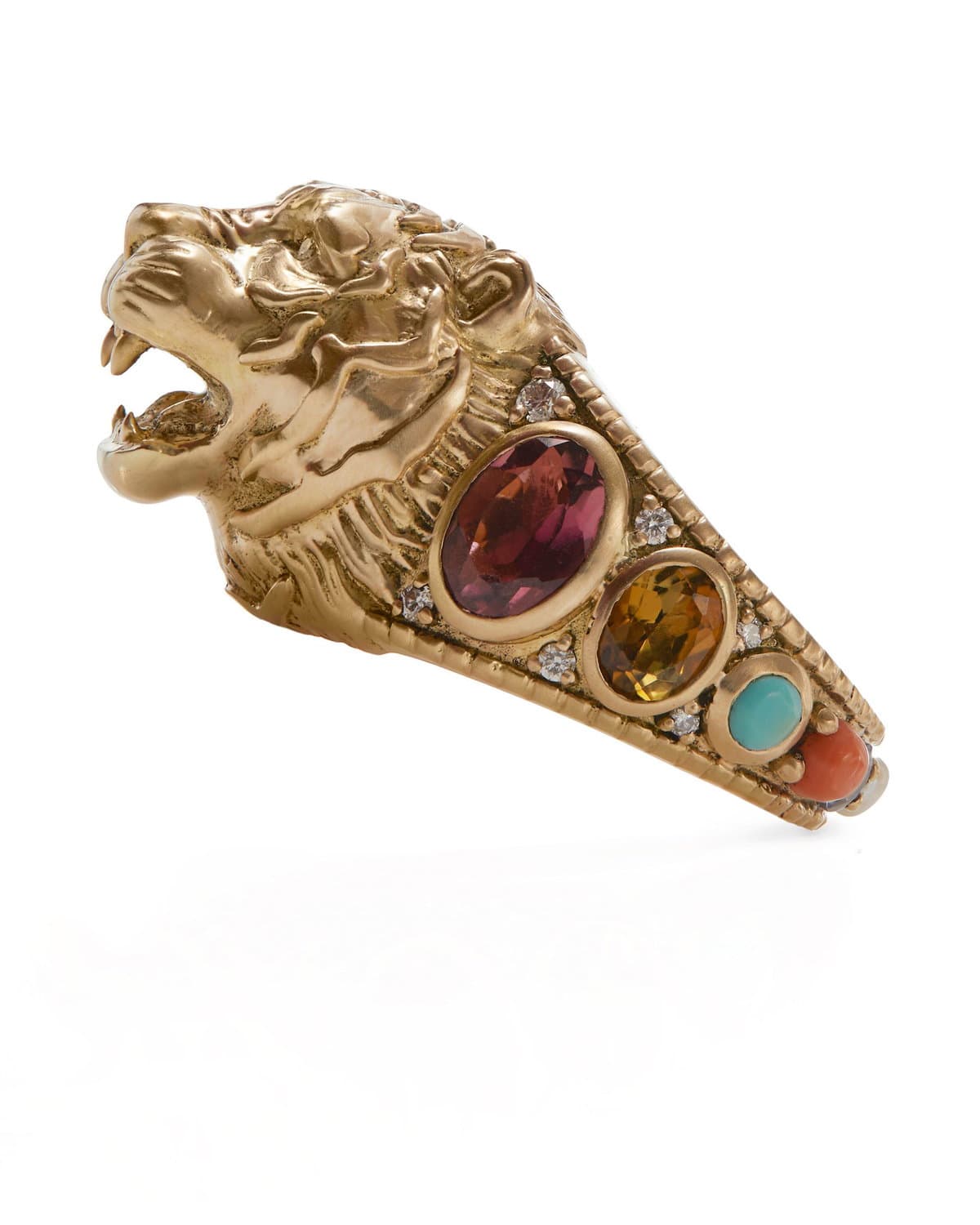
The standout example is the Arya Ring. Astrological, zodiac and celestial pieces are among the strongest-performing designs in fine jewelry broadly, but Sabyasachi's approach is more ancient and more precise. Crafted in 18k gold and featuring brilliant-cut diamonds and nine multicolored gems, it is inspired by the Navaratna, meaning "nine gems" in Sanskrit, each believed to carry specific powers in Vedic astrology. The Navaratna is not a trend. It is a centuries-old talismanic tradition in which each gem corresponds to a celestial body: ruby for the sun, pearl for the moon, coral for Mars, emerald for Mercury, yellow sapphire for Jupiter, diamond for Venus, blue sapphire for Saturn, hessonite for Rahu and cat's eye for Ketu. Wearing all nine is understood as an act of cosmic alignment, a ring that does not merely signal your sign but claims a relationship with the entire planetary system. That is a different category of meaningful jewelry altogether.
What It All Means
The zodiac jewelry revival is not a single aesthetic. It spans a $2,740 Van Cleef bracelet with its stamped gold medallion and Roman-numeral dates, a Milamore pendant rooted in Kintsugi philosophy, a Beirut-made charm beloved from the Gulf to Tokyo, and a Sabyasachi Navaratna ring that carries the weight of Vedic cosmology. What connects them is the buyer's desire for a piece that says something specific and true about who they are.
For some, the zodiac revival speaks to a desire for a personal emblem of distinction. As one voice in the conversation put it: "Not everyone has a family crest, but everyone has a birthday — and therefore a zodiac sign." In a market saturated with generic fine jewelry, the birth chart may be the most intimate design brief a customer can hand a jeweler.
This article was produced by Prism’s automated news system from verified source data, official records, and press releases, then run through automated quality and moderation checks before publishing. The system is built and supervised by the people who set the standards it runs under. Read our full AI policy.
Did this article answer your question?