Hawaiian Heirloom Jewelry Carries Identity, Family, and Island Memory Across Generations
Rooted in a gold bracelet made for Queen Liliʻuokalani in the 1860s, Hawaiian heirloom jewelry is a living archive of names, motifs, and island memory.
The Weight of a Name in Gold
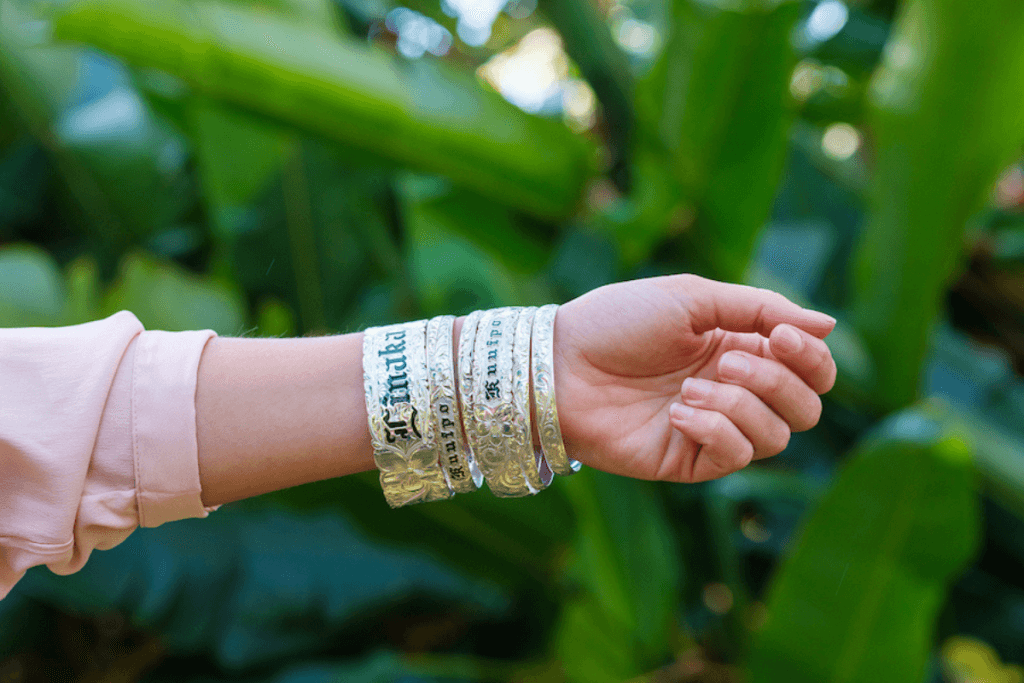
Some jewelry is made to be seen. Hawaiian heirloom jewelry is made to be read. Each bracelet, pendant, or ring in this tradition carries a name, a phrase, or a date hand-engraved in Old English script across 14-karat gold, flanked by maile vines and plumeria blossoms and filled with black enamel. The piece announces an identity, encodes a relationship, and begins a story that can outlast the person who first wore it by several generations. That is not sentiment; it is function. In Hawaiʻi, these bracelets are biographical documents you fasten at the wrist.
Where the Tradition Began
The origin story of Hawaiian heirloom jewelry reaches back to the 1860s, when Victorian mourning jewelry, popularized in England after the 1861 death of Prince Albert, made its way across the Pacific. In 1862, news of Prince Albert's death reached Hawaiʻi, and the style of gold-and-black-enamel mourning jewelry that was gaining popularity in England quickly caught on in the islands. High Chiefess Liliʻu Kamakaʻeha, who would later become Queen Liliʻuokalani, ordered a gold bracelet in the style of traditional Victorian black-enameled mourning jewelry bearing the Hawaiian phrase "Hoʻomanaʻo Mau" (Lasting Remembrance), featuring designs that included feather capes to represent Hawaiian royalty.
The tradition deepened in 1887. That year, Queen Liliʻuokalani returned from Queen Victoria's Golden Jubilee inspired to design pieces featuring Hawaiian flowers and plant designs, using Old English lettering enameled in black to inscribe phrases such as "Hoʻomanaʻo Mau" (Lasting Remembrance), "R.Naiu" (Royalty, the Lofty Ones), and "Liliuonamoku" (Liliʻu of the Islands). The bracelet was simultaneously a personal talisman and a political statement: a sovereign encoding her own name and the names of her people in a form borrowed from a queen she admired, then transformed into something distinctly Hawaiian.
One of the Queen's first recipients was Zoe Atkinson, a headmistress and socialite who helped plan royal galas at the palace. The chillingly prophetic words "Aloha Oe" ("Farewell to Thee"), also the title of the Queen's famous composition, were enameled onto Atkinson's bangle; the inside inscription read: "Liliuokalani Jan. 5 '93." Just twelve days later, the Hawaiian monarchy was abolished. That bracelet's inscription now reads differently in hindsight: a queen marking an ending she may have sensed coming, pressed into gold.
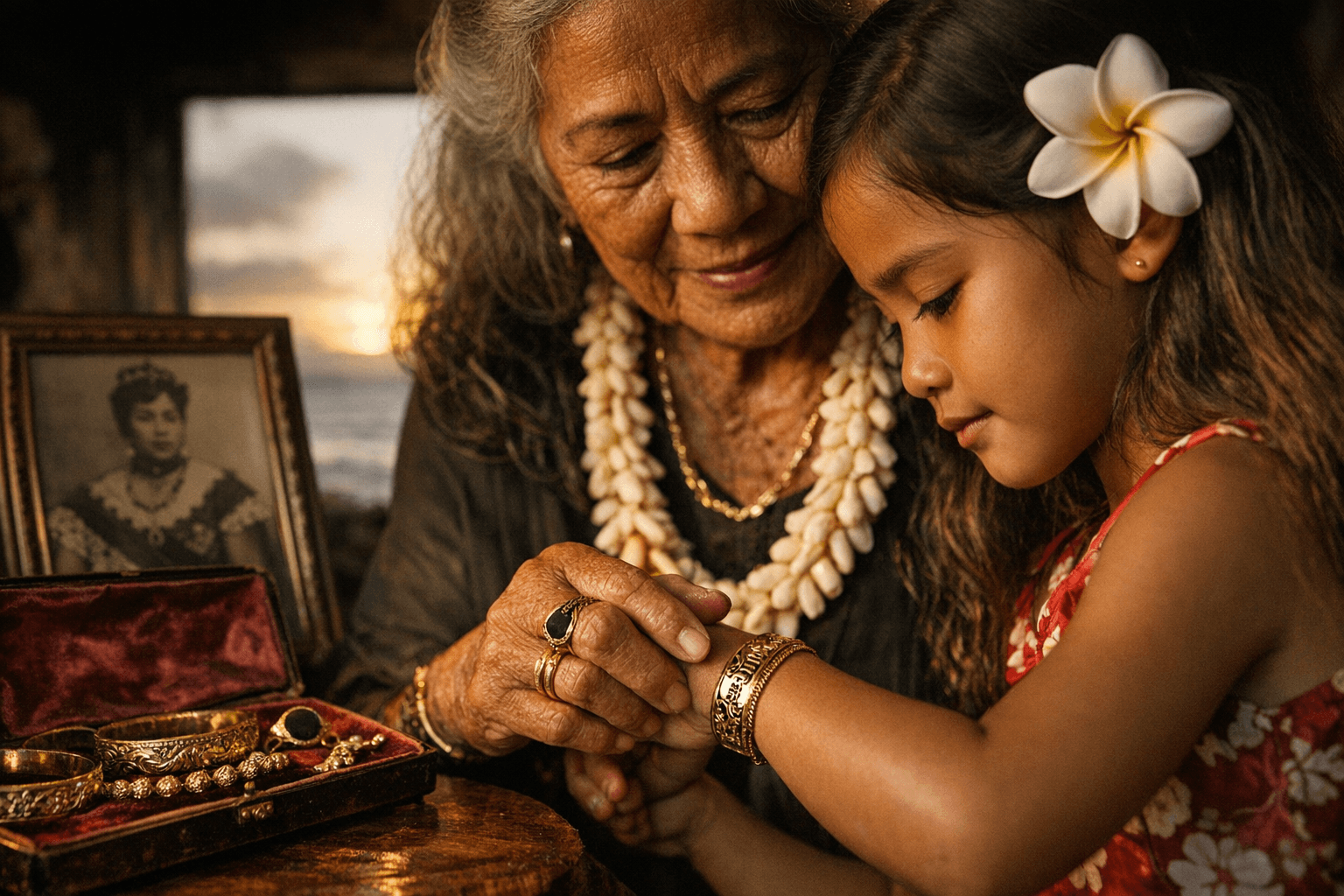
Atkinson wore her bangle to school, and her students were immediately enchanted. Mothers began ordering bracelets for their daughters, and the tradition of giving heirloom jewelry as a birthday or graduation gift was born. Grandmothers often wore the pieces themselves until the girls were old enough to receive them, folding the object into a long relay of care.
What the Motifs Mean
The visual grammar of Hawaiian heirloom jewelry is precise. The Maile leaf signifies love and respect, the plumeria flower embodies positivity and new beginnings, and the honu, or sea turtle, symbolizes luck and protection. Maile-style designs replicate the sacred maile vine traditionally used in ceremonial lei, and when rendered in precious metals, the open-ended entwined leaf pattern symbolizes respect and honor.
While many designs and custom motifs exist, the most consistently popular engraved patterns remain the Old English scroll and the maile leaf. The scroll work itself carries meaning through its density and variation: each jeweler historically attempted to distinguish their hand from competitors, and those differences became signatures you can still trace from piece to piece today.
The script is as deliberate as the flora. Names are engraved in Old English lettering, sometimes in English, sometimes in Hawaiian. Popular Hawaiian phrases include "Kuʻuipo" (Sweetheart), "Kuʻualoha" (My Love), and simply "Aloha." The inside of the bracelet often carries a second, private inscription: a date, a message, a name that only the wearer can read when she slides the piece off her wrist.
The Object as Living Archive
The heirloom bracelet's cultural power is most visible in what happens to it over time. Maui Divers describes these pieces as "delicate time capsules, holding in them the history of Hawaiʻi and the memories of each wearer." Maelia, a wearer quoted in Maui Magazine, explained the layered history of one particular piece: when her grandfather proposed to her grandmother in 1931, he handed her a gold bracelet bearing the Hawaiian phrase "Hoʻomanaʻo Mau" and later engraved it with the date of his proposal, which was also her twentieth birthday, May 9, 1931. Today the bracelet adorns Maelia's wrist. "My grandmother wore it for over sixty years," she said. "I always feel a little closer to her and my great-grandmother when I wear it."
It was when Hawaiian mottoes were dropped in favor of proper names and phrases meaningful to individual wearers' lives that the "heirloom" in "Hawaiian Heirloom Jewelry" was truly born. The bracelet stopped being a cultural emblem and became a personal record.
Named Makers and What to Ask
Three Oʻahu-based workshops are most associated with maintaining the hand-engraving tradition at a high level. Na Hoku's craftsmen create traditional Hawaiian heirloom jewelry by hand-engraving designs, describing this as their commitment to the authenticity of an art form meant to be worn with pride and handed down from generation to generation. Na Hoku still crafts Hawaiian heirloom bracelets by hand, a process that begins with engraving text into unadorned 14K gold; their artisans use no templates and employ only traditional tools to carve motifs like the plumeria.
Philip Rickard, who began manufacturing in Honolulu in 1986 after six years of primary research into the jewelry's true origins, is the other towering figure in the field. Rickard's research culminated in his book "Hawaiian Heirloom Jewelry, A Lasting Remembrance," in which he reveals the true history of the jewelry and traces the original bracelet, now held in the Iolani Palace collections in Honolulu. His Ali'i Collection draws on antique royal pieces, including a pendant based on the cypher of Princess Kaʻiulani. Royal Hawaiian Heritage Jewelry, operating out of Honolulu since 1972, rounds out the trio of established island-based makers committed to hand craftsmanship.
When commissioning or buying a piece, ask these specific questions before you proceed:
- Is it hand-engraved by a single artisan, or machine-assisted? Authentic heirloom jewelry is engraved by hand. Machine engraving produces uniform lines; hand engraving shows subtle variation that gives each piece its character.
- What karat and form of gold? Authentic pieces are typically crafted in 14K or 18K gold, with rich yellow gold most closely aligned with tradition. White gold, rose gold, and two-tone designs have emerged as contemporary options while retaining traditional craftsmanship.
- Where is the piece made? The island-made designation matters. Pieces made on Oʻahu or Maui by resident artisans carry a different provenance than imported stock engraved to order.
- Can the inside carry a private message? Most established makers engrave a secondary inscription on the interior, which is where the most intimate information, a date, a Hawaiian word, a name, typically lives.
When to Give, and Why the Calendar Matters
Traditionally, Hawaiian heirloom jewelry is given as a birthday or graduation gift, with mothers and grandmothers often wearing the bracelets themselves until the girls were old enough to care for their treasured heirloom. That convention has expanded considerably. Weddings are now one of the most significant occasions: a bride might receive a bracelet inscribed with her new name, or commission matching pieces for her mother and mother-in-law as an act of joining two families. Hawaiian jewelry has always been about relationships and Hawaiʻi.
Lei Day, observed on May 1 each year as Hawaiʻi's celebration of Hawaiian culture and the tradition of the lei, is an increasingly resonant occasion for giving heirloom jewelry. The maile vine, which appears across so many bracelet scrolls as an engraved motif, is the same plant woven into the open-ended lei offered at weddings, graduations, and ceremonies of deep respect. Commissioning a bracelet whose scroll features maile as a Lei Day gift connects the wearable archive to the living plant tradition in one gesture.
For graduation season, which in Hawaiʻi falls in May, the bracelet has long served as the heirloom companion to the lei draped around a graduate's neck. At one college graduation, a mother and brother presented a bracelet inscribed with their family name; "They told me that my father would want me to have one," the recipient later said, "and that took me right back to when I was a little girl." The best graduation pieces are ordered six to eight weeks in advance to allow for hand-engraving and any inside inscription.
Personalizing with Intention
The bracelet's width is a practical and aesthetic decision with cultural weight. Na Hoku offers bracelets in widths from 4 to 18 millimeters; all pieces except the widest are made from 14K gold "barrel" wire whose domed cross-section gives depth, strength, and beauty to the engraved surface. Narrower widths, around 4 to 6 millimeters, read as delicate and are traditional choices for young recipients or those worn in stacked multiples. Wider pieces, 10 to 18 millimeters, carry more scroll and more name, and are often commissioned as statement heirlooms for matriarchs or significant milestone events.
A piece can be worn with the lettering facing outward, to share with others, or turned inward, to cherish privately. That choice alone encodes something about how a person holds their own story.
The tradition that Queen Liliʻuokalani set in motion more than 150 years ago was never simply about jewelry. It was about insisting, in gold and enamel, that names survive. Every hand-engraved bracelet made in Honolulu today extends that argument, one letter at a time.
This article was produced by Prism’s automated news system from verified source data, official records, and press releases, then run through automated quality and moderation checks before publishing. The system is built and supervised by the people who set the standards it runs under. Read our full AI policy.
Did this article answer your question?